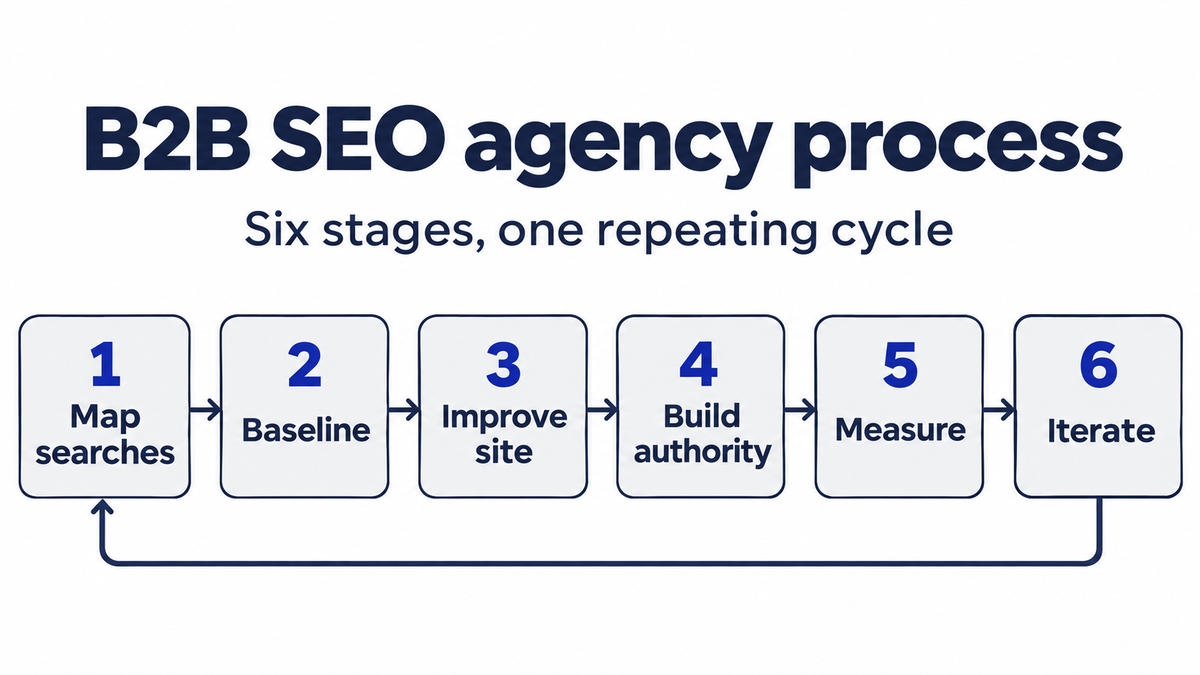
A B2B SEO agency works in six stages: map the searches and AI prompts your buyers use, set a baseline, improve the site you own, build authority, measure what reaches the pipeline, and repeat. Discovery and onboarding come first, and the stages overlap rather than finish one at a time. This guide walks through what happens at each stage, what you get, and what your team needs to provide.
We run this workflow ourselves in our B2B SEO services, with clear deliverables at each stage and reporting that connects visibility to leads where the data allows. If you are hiring a partner, the sections below also give you a way to judge whether their approach holds up.
What the B2B SEO process is, and why B2B needs its own
The B2B SEO process is the repeatable order in which an agency researches, fixes, builds, promotes and measures, tuned to how businesses buy. It matters because B2B buying does not look like a consumer checkout. Three things change the work:
- Many people decide. Forrester’s State of Business Buying 2024 found that 13 people within an organization are involved in a buying decision on average, with 89% of purchases involving two or more departments. Your content has to answer an economic buyer, a technical evaluator and an end user, not one searcher.
- Journeys are long and messy. Dreamdata’s 2024 benchmarks, based on its own customer data, put the average at 62 touches across at least three channels, and 192 days from first touch to closed-won. Search is one of many touches, so it needs to show up at several points.
- Search volume is low and intent is high. The searches that matter are often small, specific and commercial. A page that gets 40 visits a month can still produce more revenue than a blog post with 4,000.
The result is a B2B SEO strategy that finds the few searches that matter, serves several roles in the buying committee, and connects to your sales data so the team can see what search produced. Our guide to how B2B SEO differs from B2C SEO goes deeper on the differences. The rest of this guide stays on the work itself.
The six stages at a glance
The table below is the whole workflow on one screen. Each stage has a deliverable and a set of inputs from your team. Later sections cover each row in detail.
| Stage | What happens | What you get | What the agency needs from you |
|---|---|---|---|
| 1. Map buyer searches and AI prompts | ICP work, keyword and prompt research, competitor review | A page-level keyword plan and a prompt set | Product, customer and sales input |
| 2. Baseline and roadmap | Site audit, search and AI visibility check, prioritization | Audit findings and a prioritized roadmap | Search Console, GA4, CMS and sales system access |
| 3. Improve the site you own | Technical fixes, site structure, commercial pages, content | Implemented changes, new and improved pages | Developer time, expert time, approvals |
| 4. Build authority | Links, mentions, digital PR | Earned links and third-party mentions | Approvals, spokespeople or data if you have them |
| 5. Measure | Rankings, AI visibility, leads, pipeline | A monthly report and a quarterly review | Pipeline data and sales feedback |
| 6. Iterate | Re-run research, refresh content, shift priorities | The next cycle’s plan | Decisions on priorities |
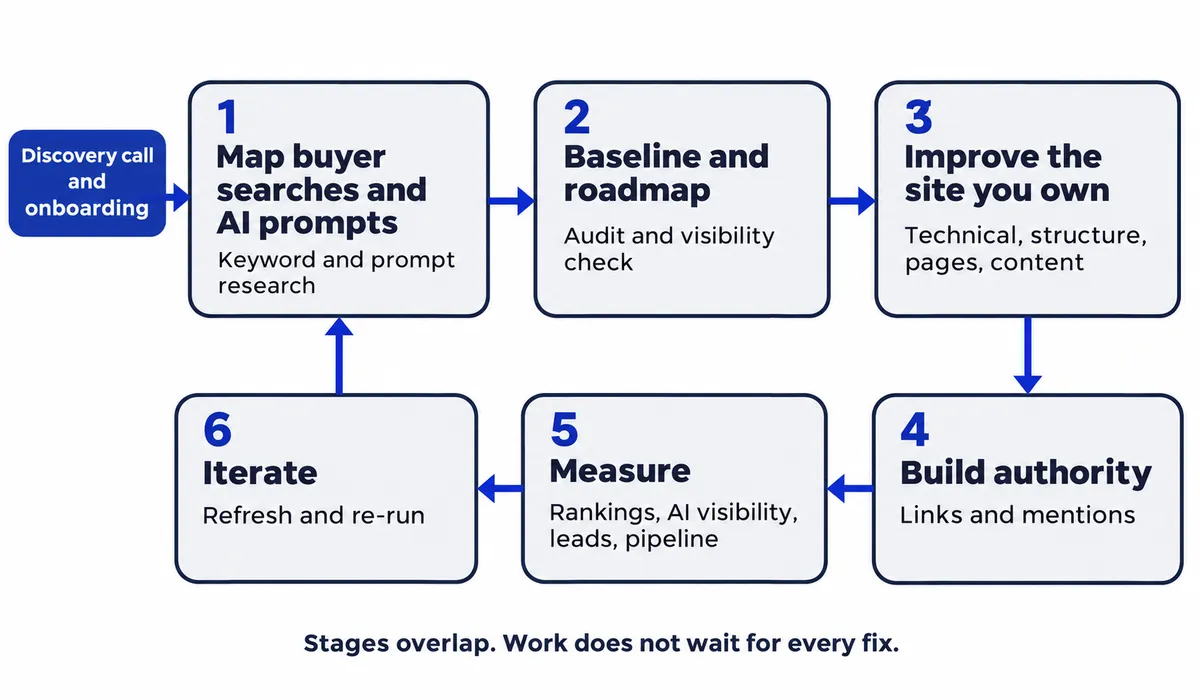
These stages overlap. Content and authority work do not wait for every technical fix to land, and measurement starts on day one, not in month six.
Before stage one: the discovery call and onboarding
No B2B SEO engagement can start until the agency understands your business and can see your data. That happens in two steps.
What a discovery call covers
A good discovery call is a diagnosis, not a pitch. The agency asks what you sell, who buys it, your average deal value and sales cycle, what you have already tried in search, which pages bring in money, and what your commercial team considers a good lead. You get a read on where the opportunity sits, and the agency decides whether SEO is the right fit at all. Sometimes the honest answer is that it is not yet.
How your team and the agency split the work
The agency leads research, audits, technical direction, content briefs and reporting. Your team supplies the knowledge no outsider has: how your product really differs, which customers are the best fit, and what buyers say on calls. Marketing owns approvals and brand decisions. The commercial team shares feedback on lead quality. A developer ships the technical changes. When any of these people slows down, the work slows with it, so agree on owners and response times early. A shared task list with a named person and a due date beside each item prevents most avoidable delays.
Access and tracking setup
Once you sign, the agency needs access to a short list of systems:
- Google Search Console, for queries, impressions and indexing data
- GA4, for visits and conversions by landing page
- Your CMS, so changes can be made or reviewed
- A developer contact, for technical work
- Your CRM (HubSpot, Salesforce or similar), plus how leads get tagged by source
Tracking comes before content. If form fills and demo requests are not tied to landing pages and passed into your sales system, stage five cannot report on revenue impact, and the whole campaign gets judged on traffic. Fixing this in the first few weeks is cheap. It usually takes a short working session between the agency, your marketing operations contact and whoever owns the CRM, and it saves arguments later about which leads came from search. Fixing it in month six means you have no baseline to compare against.
Stage 1: Map buyer searches and AI prompts
The first stage answers one question: what do your buyers type or ask at each point in their decision, and which of those searches could realistically produce revenue?
ICP and buyer journey
The agency defines your ideal customer profile and the roles inside the buying committee. Then it maps their questions across the buyer journey: understanding the problem, exploring solution types, comparing vendors and validating a shortlist. A finance lead and an IT lead search for different things, and your pages need to meet both.
Keyword research and mapping
Keyword research turns those questions into search terms, grouped by search intent and clustered into topics. The output is a keyword map: each target page gets one primary job, and the gaps where no page exists become the content plan. Low volume is fine when the intent is right. The goal is not the biggest list, it is the one that matches how your buyers search. A SaaS company selling billing software, for example, gets more from “invoice approval workflow software” than from a broad term like “accounting”, even though the broad term has far more searches. The first draws a buyer with a problem and a budget. The second draws students, job seekers and competitors. We lay out the method in our write-up of how to research B2B keywords step by step.
Competitor analysis
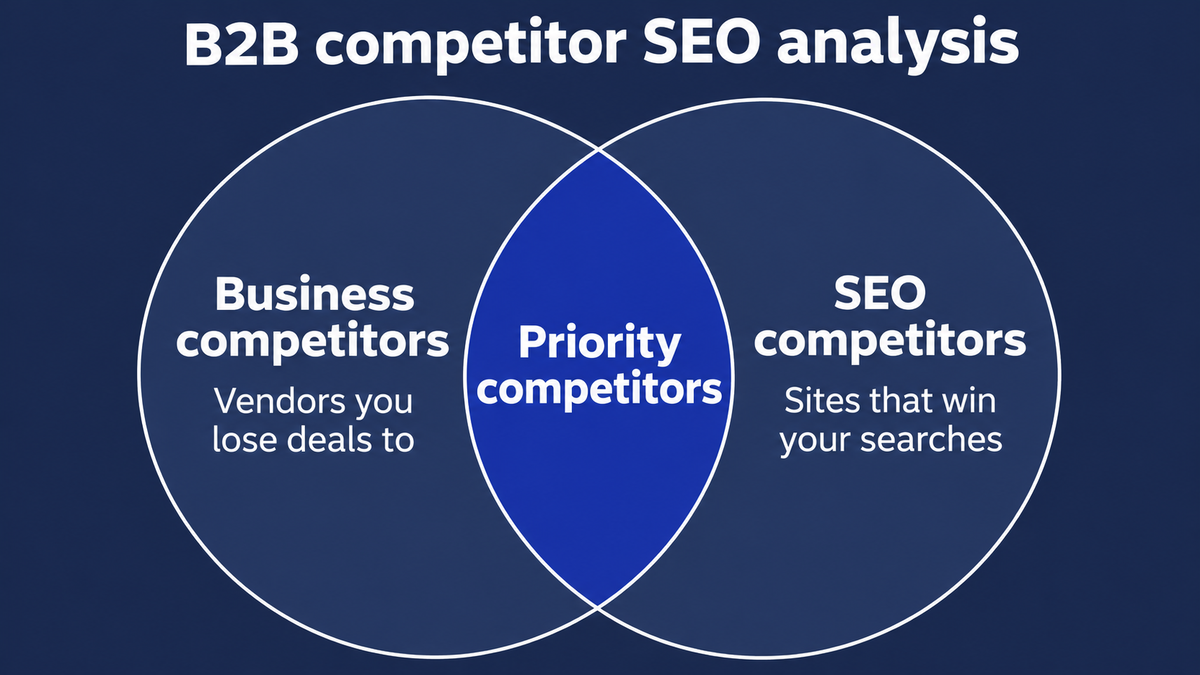
The agency also reviews who ranks for your target searches, which pages win, and which companies and sources show up in AI answers. Those competitors are often not the ones your team names. Our guide to B2B competitor SEO analysis covers how to do this review.
Buyer prompts for AI search
Buyers now also ask ChatGPT, AI Mode and Perplexity. Forrester’s research found that almost 95% of buyers expect to use generative AI to support their decision and purchase process in the next 12 months. So the agency writes a fixed set of prompts that cover problems, categories, comparisons and recommendations, and uses it again at every later stage.
What you get: a set of target keywords and prompts, each tied to a specific page.
Stage 2: Establish the baseline and the roadmap
In stage 2, before changing anything, the agency measures where you stand. Without a baseline, no one can tell later whether the work did anything.
Technical and content audit
The SEO audit covers crawling and indexing, duplicate or competing pages, page speed, internal links, on-page basics and the quality of your commercial pages. It is not a 100-point checklist. Most sites have a handful of issues that matter and a long tail that does not.
Visibility audit across Google and AI answers
The visibility audit records how you show up today. That means rankings and Search Console data on the search side. On the AI side, it means whether answers mention, recommend or cite your company for the prompt set, and which third-party sites keep appearing instead. Note the date, platform and conditions for each check, because AI answers vary from run to run.
Prioritizing the roadmap
A roadmap is only useful if your team can act on it. Each item should say what to change, why it matters, who does it and how you will know it worked. Items that need a developer get grouped so they can be handled in one sprint instead of trickling in.
The agency ranks the work by commercial value, likely impact and effort. Quick wins go first. A noindex tag left on a money page is a good example: it costs an hour to fix and may be holding back your best page. Everything else is sequenced so the highest-value changes ship early. If you want to know when results start to show, see our post on how long SEO takes to work. The short version is that it depends on your starting point, your competition and how fast changes get implemented.
The roadmap should also name the tools used for each part of the work, so you know what the agency is relying on. Most teams use Search Console, a crawler, a rank and AI visibility tracker, and your sales data. The tools matter less than whether the findings are explained in plain language and tied to a page and a reason.
What you get: audit findings and a prioritized roadmap with owners and effort for each item.
Stage 3: Improve the site you own
Improving the site you own is the longest stage, and for most B2B companies it produces the biggest gains. It breaks into four parts.
Technical foundation
The technical foundation means search engines can crawl, render and index the pages that matter. The agency fixes indexing problems, redirects, speed issues and JavaScript rendering, and adds structured data where it fits. If key pages sit in Search Console as pages that are crawled but not indexed, that moves to the top of the list. For markup, see our schema markup basics for B2B.
Site architecture and internal linking
Good site architecture gives each service or solution a hub page, with supporting posts that link up to it. It also makes sure no two pages chase the same query. Internal links tell search engines and readers which pages matter most. In B2B, this structure often decides whether a new post helps your money pages or competes with them.
Commercial pages for B2B SEO
Service, solution, use-case, comparison and demo pages are where B2B SEO is won or lost. These pages need to say who the product is for, what it does, what proof exists and what to do next. The agency improves existing pages before writing new ones, because a weak commercial page wastes every visit sent to it.
Supporting content with subject-matter experts
Supporting content answers the questions your buying committee asks before they talk to a rep. A good content strategy starts with briefs built from the research, then interviews with your experts, then drafting, review and approval. Write for each role in the committee, and lead each section with a direct answer so the passage can be quoted by a person or an AI system.
One note on growth. B2B SEO compounds, because each good page adds to the authority of the pages around it, and a clear structure makes every new page more useful than the last. That is also why the order of work matters: fixing a weak commercial page first means every later visit lands somewhere that can convert.
What you get: implemented technical fixes, a clearer site structure, improved commercial pages and a steady run of supporting content.
Stage 4: Build authority and third-party proof
Your own site is only half of what matters in B2B SEO. Search engines and AI systems both look at what other sites say about you.
B2B SEO backlinks
The agency earns relevant links from industry sites, partners, associations and publications. Quality matters more than count: a few links from sites your buyers read beat dozens from sites no one visits. The tactics are covered in our post on B2B link building strategies.
Mentions and digital PR
Mentions come from original data, expert commentary and inclusion on the comparison and review sites that appear around your target prompts. This matters for AI search in particular, because answers often draw on third-party sources when deciding which companies to name. If you have data or spokespeople, this is where they earn their keep.
What you get: earned links and mentions on sources that matter to your buyers.
Stage 5: Measure what reaches the pipeline
Stage 5 turns the SEO work into numbers your finance and leadership teams care about.
Metrics that matter
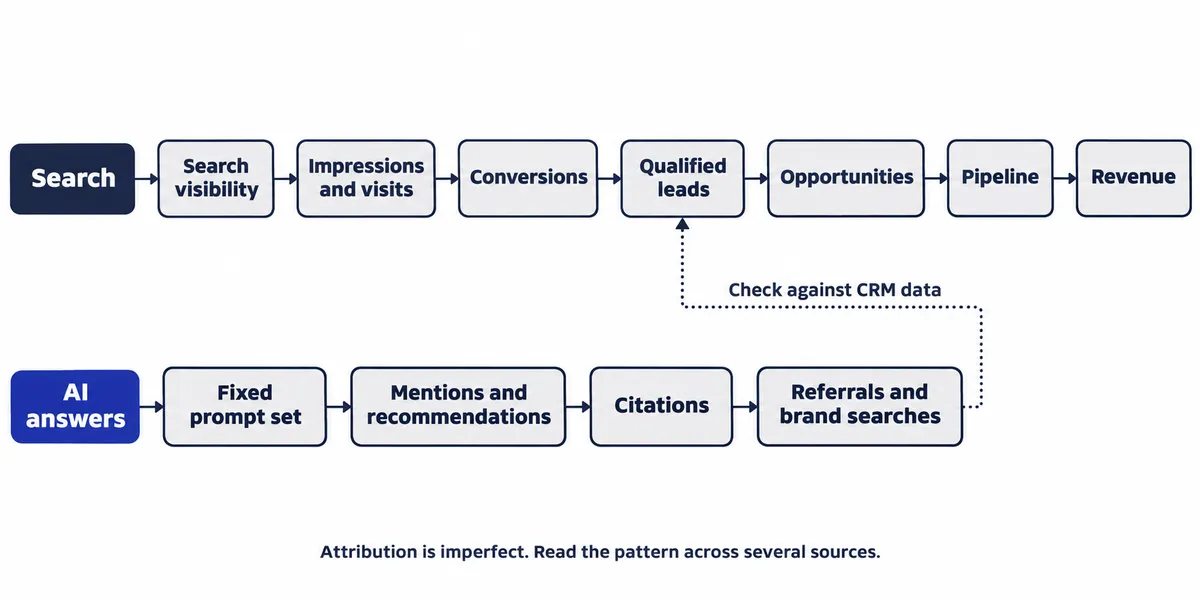
The measurement chain runs from search visibility to impressions and organic visits, then conversions, qualified leads, opportunities, pipeline and revenue. Rankings and traffic sit at the start of that chain. They are useful signals, but not the result. On the AI side, the agency re-runs the fixed prompt set and records mentions, recommendations and citations. Our guide to tracking AI visibility explains why those are kept separate rather than rolled into one score.
Reporting cadence
Marketing leaders and finance leaders read reports differently, so the format should serve both. A monthly report should say what was done, what moved and what comes next. A quarterly review resets priorities based on what the data shows. The format matters less than whether your team can read it and make a decision. See how to report SEO results to a B2B team for what to include.
Sales and marketing feedback
Numbers alone miss a lot. The best signal often comes from the sales team: which leads from organic were a good fit, what prospects said they searched for, and which pages they read before booking a call. A short monthly check-in with sales and marketing leads turns those comments into the next round of keyword and content decisions. It also shows whether the pages are attracting the right kind of buyer, not just more of them, and whether the pages that rank well are the ones bringing in deals.
Attribution limits
With long journeys and many touches, organic search usually gets under-credited in last-touch models. A buyer may find you through a guide, return through a branded search and convert from a direct visit. The honest approach is to state that limit and use several signals together: CRM source data, feedback from reps and what buyers say when they book a call. Perfect attribution does not exist, and a report that claims it should be treated with suspicion. Marketing teams that accept this tend to make better decisions, because they stop chasing a single number and start reading the pattern across several sources over a few quarters.
What you get: a monthly report and a quarterly review that connect visibility to leads and pipeline where the data allows.
Stage 6: Iterate and refresh
Stage 6 is where search becomes a loop, not a launch: the last stage feeds the first. The agency re-runs the same keyword and prompt set under the same conditions, so results are comparable. Pages that slipped down the rankings get refreshed with newer facts, clearer answers and better internal links. Topic clusters that work get expanded with more supporting pages. Work that is not paying off gets cut, and the freed-up effort moves to the gaps that now look most valuable. This is where growth comes from in a long B2B cycle: not from one big push, but from repeated small corrections that keep your site ahead of what buyers are asking. Each pass produces better research for the next round, which is why a B2B SEO strategy that is only run once rarely holds its gains.
Where AI search fits into B2B SEO
AI search is a layer inside every stage, not a separate project bolted on at the end. In practice that looks like this:
- Stage 1: the prompt set sits next to the keyword research.
- Stage 2: the baseline includes which brands AI answers mention and which sources they cite.
- Stage 3: pages carry clear, quotable answers and consistent facts about your company.
- Stage 4: third-party sources that AI answers rely on become link and mention targets.
- Stage 5: reports track AI mentions and citations alongside rankings and leads.
Google is direct about the foundation. Its documentation on AI features says there are no additional requirements to appear in AI Overviews or AI Mode, nor other special optimizations necessary. A page needs to be indexed and eligible to show in Search with a snippet. Google also notes that these features may use “query fan-out”, running several related searches across subtopics, and that clicks from them are counted in Search Console’s Performance report under the “Web” search type. So the SEO basics come first, and that is why stage three matters so much.
Other AI systems work differently from Google, and there is more to say about each. Our pages on generative engine optimization and answer engine optimization cover the AI-specific work, and our comparison of SEO, GEO and AEO shows how the terms relate.
Two common questions belong here too. Is SEO dead? No. It is changing shape, and the approach above is built for that. Can ChatGPT do SEO? It can speed up drafting and analysis, but it cannot access your analytics, work with your developers or earn a link, so it fits inside the work rather than replacing it.
How to evaluate an agency’s SEO process
You can test any agency’s SEO process with a few direct questions. Google’s guidance on whether you need an SEO suggests asking for examples of past work, whether they follow Google Search Essentials, what results to expect, in what timeframe and how success is measured, whether they have experience in your industry, how long they have been in business, and how they communicate, including whether they share every change they make to your site.
For B2B, add these:
- Who writes the content, and how do your subject-matter experts get involved?
- How will you connect SEO results to our sales pipeline?
- How do you measure AI visibility?
- What do you need from our team each month?
If you are comparing firms for AI search as well, our comparison of AI SEO agencies by buyer fit lists what to ask each one before hiring.
Ask your marketing team and your finance team what they would need to see in a report to keep funding the work, then check that the agency’s sample covers it. Also ask to see a sample report and a sample brief before you sign. A real SEO strategy shows up in these documents: the briefs name a buyer role and a search intent, and the reports name leads, not only visits. Vague documents usually mean a vague approach behind them, and a clear sample is a good sign that the work will be just as clear.
Watch for three red flags. The first is a guaranteed ranking: Google says no one can guarantee a #1 ranking. The second is a fixed number of posts or links per month, set before anyone has looked at the gap. The third is reporting that shows traffic but no leads.
If you want to compare your current setup against the stages above, you can talk through your current SEO process with us. We will tell you what we see, including when the answer is that you do not need an agency yet.
Frequently Asked Questions
What does a B2B SEO agency do?
An agency researches the searches and AI prompts your buyers use, fixes and builds the technical base and pages on your site, earns links and mentions from other sites, and reports on leads and pipeline. Google's own list of services an SEO can provide includes keyword research, content development, technical advice and optimizing for generative AI. The work is a repeating cycle, not a one-off project.
How long does each stage of the B2B SEO process take?
Discovery, setup and the baseline audit usually take weeks, not months. Implementation, content and authority work then run continuously and overlap with each other. Timing depends on your site size, technical condition, competition and how quickly changes get shipped on your side.
What does an agency need from our team?
Access to Google Search Console, GA4, your CMS and your CRM, plus accurate information about your product, customers and commercial priorities. The agency also needs time from subject-matter experts for content and quick approvals on pages and technical changes. Delays on these inputs slow results more than almost anything else.
Can anyone guarantee SEO rankings?
No. Google states that no one can guarantee a #1 ranking, so treat any guarantee as a red flag. A good agency commits to a clear plan, regular reporting and honest measurement instead of a promised position.
Is SEO dead or evolving in 2026?
SEO is evolving, not dying. AI Overviews, AI Mode and chatbots add new places where buyers get answers, but Google says pages need no special optimization beyond being indexed and eligible to show with a snippet. The SEO work stays the same at its core, with AI visibility added to research, content and reporting.
Can ChatGPT do SEO?
ChatGPT can help with drafts, clustering ideas and analysis, but it cannot see your Search Console or CRM data, talk to your sales team, ship technical fixes or earn links. Use it as a tool inside the work, not as a replacement for it.

Written by
Adriaan van Swieten
Adriaan leads Stijg Media and works directly on search, AI visibility, websites, and local growth strategy.
Meet Adriaan