SEO helps your business appear in search results. AEO helps answer systems find and use your content. GEO helps AI systems understand, describe and recommend your business. Here’s how they work together, where they overlap and what matters for your visibility.
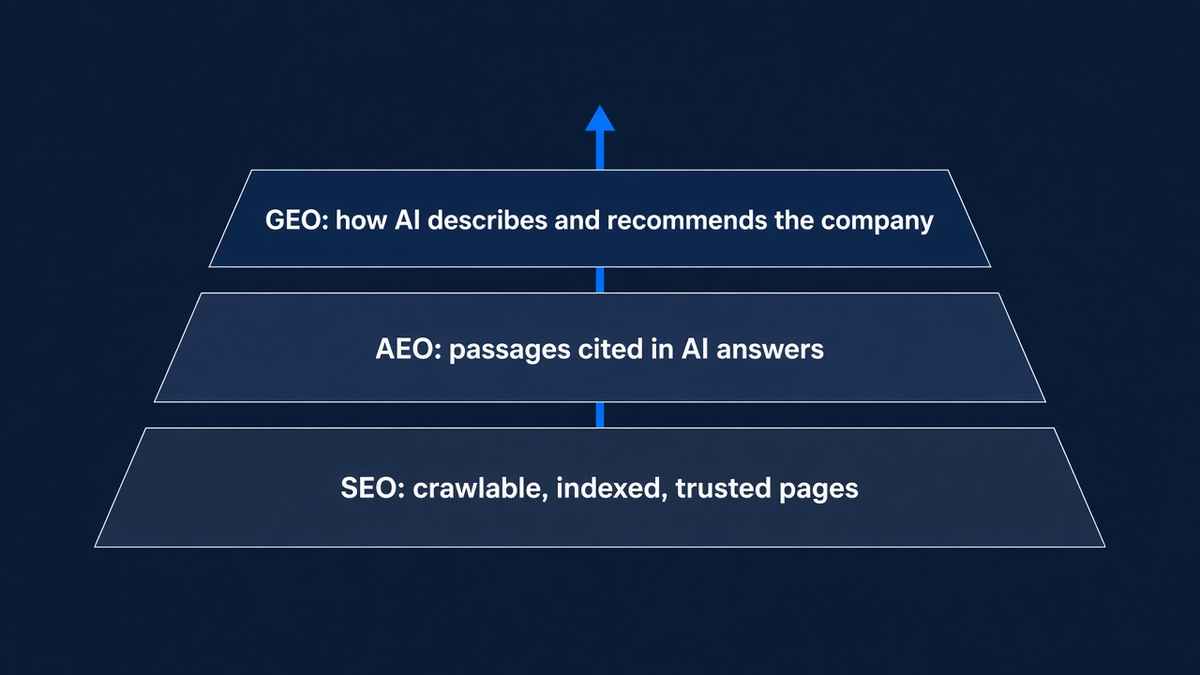
SEO, AEO and GEO are connected approaches to search visibility.
SEO (search engine optimization) improves how a website is discovered and ranked in traditional search results.
AEO (answer engine optimization) makes information easier for search and AI systems to retrieve, interpret and use in direct answers.
GEO (generative engine optimization) focuses on how a business, its expertise and its content are represented, cited and recommended in AI-generated responses.
In this context, GEO means generative engine optimization, not geographic targeting.
These are not three separate replacements for one another. They build on many of the same foundations, with different outcomes to measure.
Key Takeaways
- SEO targets organic rankings, clicks and conversions; AEO tracks answer use and citations; GEO tracks brand representation and recommendations.
- Google AI Overviews and AI Mode supporting links must be indexed and snippet-eligible, but eligibility does not guarantee citation.
- Mentions, citations and recommendations are separate observations across ChatGPT, Perplexity, Gemini and other AI services.
- Repeated, dated prompt checks reveal more than a single favourable AI answer.
For a B2B company already investing in search, start with the priority decision.
SEO vs GEO vs AEO at a Glance
| SEO | AEO | GEO | |
|---|---|---|---|
| Full name | Search engine optimization | Answer engine optimization | Generative engine optimization |
| Primary question | Can buyers find the page? | Does the answer use or cite the passage? | How does the AI describe or recommend the company? |
| Where it appears | Google and Bing organic results, featured snippets (and as source pages for AI answers) | AI answers and citations across Google AI Overviews / AI Mode, ChatGPT, Perplexity, Gemini, Copilot, Claude | Brand description and recommendation context on those same AI surfaces |
| Main unit | Page and search intent | Question and extractable passage | Brand entity and corroborating sources |
| Evidence | Rankings, clicks, leads | Mentions, cited URLs, factual accuracy | Recommendation context, share of voice, sentiment |
| Main work | Crawlability, relevant content, internal links, authority | Direct answers, clear passages, retrieval access | Consistent entity facts, original evidence, third-party references |
The columns describe overlapping work, not mutually exclusive platforms.
What Is SEO (Search Engine Optimization)?
Search engine optimization (SEO) improves a site’s visibility in search results through crawlable and indexable pages, relevant content and a credible off-site reputation. Stijg Media’s SEO work includes keyword research by search intent, internal linking and relevant backlinks. Google Search Console tracks impressions and clicks; qualified enquiries measure commercial value.
For more on trust and execution, see E-E-A-T evidence and on-page versus off-page SEO.
An SEO Example for a B2B Company
An inventory-software company targets “inventory software for distributors” with a relevant product-category page. Its goal is qualified demo requests from organic discovery. This is an illustrative scenario, not a client result.
What Is AEO (Answer Engine Optimization)?
Answer engine optimization (AEO) improves the chances that an AI-generated response accurately uses, mentions or cites a business’s information. Its roots include featured snippets, People Also Ask and voice search through Siri and Alexa, while large language models (LLMs) can synthesise longer answers. A mention is not necessarily a citation.
Read Stijg Media’s full AEO guide or its answer engine optimization services.
An AEO Example for a B2B Company
A buyer asks ChatGPT, “What should a distributor look for in inventory software?” The company publishes a self-contained buying-guide passage answering that question. Check whether the response uses the information and cites the URL. This is an illustrative prompt, not a recorded result.
What Is GEO (Generative Engine Optimization)?
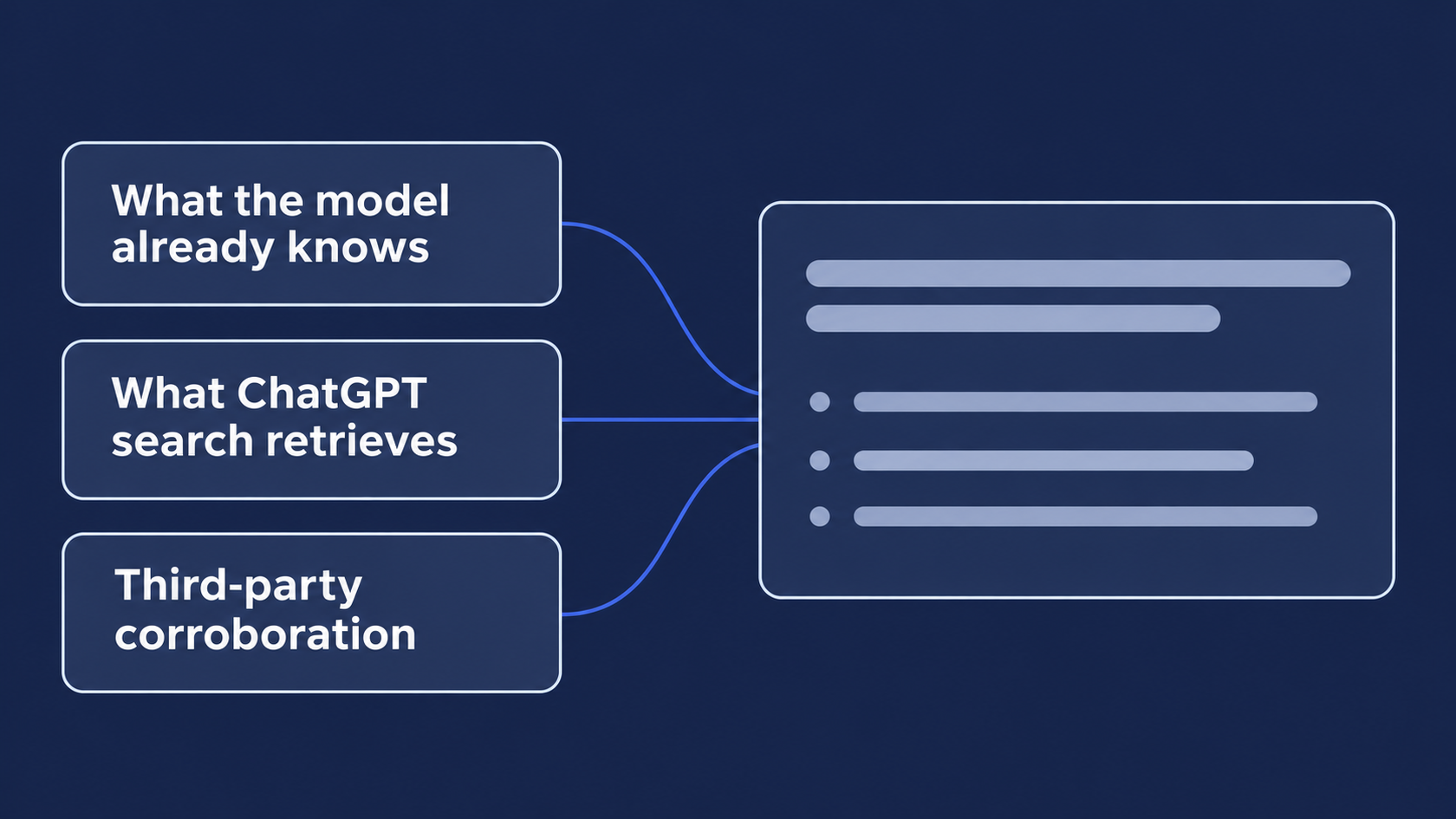
Generative engine optimization (GEO) strengthens the evidence AI systems use to categorise, describe and potentially recommend a brand. It connects the company’s actual services, audiences and differentiators with consistent website facts, topical authority, original data, reviews, trade coverage and relevant third-party brand mentions. GEO here means generative engine optimization, not geographic targeting.
Pranjal Aggarwal and co-authors submitted the research paper “GEO: Generative Engine Optimization” on November 16, 2023. Stijg Media explains its approach on the generative engine optimization page.
The key semantic relationships are Stijg Media - offers - SEO, AEO and GEO services; AEO - measures - answer use and citation; and GEO - evaluates - brand interpretation and recommendations. Publish accurate facts about the organisation, services and founder in visible content, then represent those same real relationships in appropriate structured data. Schema markup cannot substitute for independent evidence.
A GEO Example for a B2B Company
A buyer asks Gemini or Perplexity which vendors suit a distributor with 200 staff. The software company checks whether it appears on the shortlist and whether the answer correctly identifies its products and target customers. This is an illustrative scenario, not a client result.
GEO vs SEO: What Is the Difference?
GEO vs SEO comes down to the unit of visibility: search engine optimization targets the discoverability of relevant URLs for search queries, whereas generative engine optimization tracks how a brand is represented in AI-generated answers.
A conventional query might be “inventory software distributors”; a longer AI prompt might ask which tools fit a distributor moving away from spreadsheets. SEO evaluates page positions and resulting clicks. GEO evaluates category association, shortlist inclusion and recommendation accuracy over repeated prompts. Both depend on discoverable information and external credibility, but a URL ranking does not prove that an AI will recommend the brand.
AEO vs SEO: What Is the Difference?
AEO vs SEO is a difference in output, not a different internet: search engine optimization aims to make a URL visible in search results, while answer engine optimization aims to make an accurate, self-contained passage usable in a direct answer.
For AEO, put the answer close to a descriptive heading, identify the subject within the passage and keep comparisons or specifications together. Structured data can clarify facts where appropriate; it does not cause citation by itself. The same page can support search discovery and answer retrieval.
AEO vs GEO: Where Does the Line Sit?
At Stijg Media, AEO and GEO operate across the same AI services, including ChatGPT, Gemini, Perplexity, Microsoft Copilot and Google AI Overviews. AEO evaluates whether a particular answer uses or cites information. GEO evaluates how the AI understands, describes and recommends the company. That is an outcome-based distinction, not a split between platforms.
Other publishers group the two together or reserve AEO for voice and featured snippets. Under Stijg Media’s model, an AI Overview can cite a useful article but misclassify the business behind it: an AEO citation and a GEO accuracy problem can coexist. Google AI Mode is likewise relevant to both.
AI SEO is the umbrella term used here; LLMO, GAIO and “Search Everywhere Optimization” appear elsewhere. “AIO” is ambiguous because it can refer to AI optimization or Google AI Overviews.
How Do SEO, AEO and GEO Work Together?
SEO supports the crawlability, relevance and authority that underpin many AI retrieval pathways. AEO improves the precision of individual passages; GEO strengthens the company-level context found across owned and independent sources. A trade publication can contribute a backlink, become an answer citation and corroborate an entity association without guaranteeing any of those outcomes.
Google’s AI features documentation says supporting links in AI Overviews and AI Mode must be indexed and snippet-eligible, with no extra technical requirements for those features. That eligibility rule applies to Google, not every AI service. For ChatGPT Search, assess OAI-SearchBot access separately from GPTBot, which is associated with training; check robots.txt, server responses, CDN/WAF restrictions and accessible page content. Stijg Media covers AI crawler access.
For a closer look at the distinction between rankings and citations, see Stijg Media’s analysis.
What Did the “SEO vs GEO vs AEO” Results Show on October 30, 2026?
In Stijg Media’s October 30, 2026 desktop capture (Google US English, Massachusetts residential connection), the AI Overview cited 5 sources: an education publisher, an AI-visibility software blog, a Reddit r/DigitalMarketing thread and two agency blogs. None appeared among the 19 organic URLs recorded on pages 1 and 2 in that same load. Stijg Media appeared in neither set. This is a single observation, not proof that ranking and AI citation selection are independent.
A second load through a different exit location produced a different organic set, so geographic variation may partly explain the discrepancy. Compare dated queries, markets, outputs and source lists rather than relying on a single screenshot. The October 29 AEO capture provides a separate observation.
How Do You Measure SEO, AEO and GEO?
Keep three scoreboards. SEO: organic positions, Search Console clicks and qualified leads. AEO: answer accuracy, mentions and the exact URLs cited. GEO: category associations, recommendation context, sentiment and brand share of voice, defined as the proportion of sampled answers that mention the brand.
Google Search Console includes AI Overviews and AI Mode activity within the Web search type, not a separately broken-out AI series. Microsoft’s Bing Webmaster Tools AI Performance report identifies cited URLs across supported Microsoft AI surfaces.
For ChatGPT, Perplexity and Gemini, freeze a buyer-prompt panel covering category, comparison, problem and brand-validation questions. Capture each response, cited domain/URL, brand mentions, competing brands and recommendation language. Repeat the same prompts under comparable conditions. See how to measure AEO and the AI visibility tracking guide.
Track enquiries and buyer-reported discovery alongside visibility. AI-assisted demand can later appear as branded or direct traffic in GA4, but zero-click searches and attribution gaps mean that traffic alone cannot establish the source.
What Can SEO, AEO and GEO Not Promise?
None can guarantee an organic ranking, AI citation or recommendation. ChatGPT has no fixed ranking, and repeated responses may differ. Schema markup, backlinks, original data and mentions are inputs to investigate, not switches that guarantee an outcome.
Keyword volume is also estimated, not first-party search demand. On October 30, 2026, two Ahrefs reports gave 700 and 350 US monthly searches for “seo vs geo vs aeo”. Treat those figures as modelled estimates, not precise demand. Rising direct or branded visits alone cannot prove AI attribution. See what AEO can and cannot promise.
Should a Business Focus on SEO, AEO or GEO First?
A B2B company already paying for SEO should not purchase an isolated GEO programme before checking its website, buyer answers and off-site evidence. Prioritise fixes according to the actual bottleneck:
- Discovery: fix crawling, indexation, intent mismatch and internal links on commercial pages.
- Answer use: give important buyer questions clear standalone answers and check relevant AI search-crawler access.
- Brand interpretation: align factual company descriptions across the site, reviews, LinkedIn and industry coverage.
- Measurement: compare a fixed prompt panel with organic search performance and qualified enquiries.
These workstreams can run in parallel. The distinction is where to put the next pound or dollar, not whether to abandon traditional SEO.
Adriaan van Swieten, founder of Stijg Media and an SEO practitioner since 2017, connects these disciplines in the agency’s B2B SEO and AI search approach. Explore SEO, AEO and GEO according to the gap you need to close.
Where Are SEO, AEO and GEO Heading?
The terminology may change; the commercial question remains whether search and AI visibility generate qualified demand. Google and Microsoft already expose different parts of that picture in their respective reporting tools. A credible programme connects page discovery, answer retrieval, brand understanding and conversions rather than selling acronyms as separate miracles.
Frequently Asked Questions
What is GEO, and how is it different from SEO?
GEO is not a replacement for SEO. Generative engine optimization (GEO) is the work of making a business easier for AI systems such as ChatGPT, Gemini and Google AI Overviews to understand, trust, cite and recommend. It builds on SEO fundamentals, such as crawlable pages, useful content and trust signals, then adds entity clarity and third-party corroboration.
How do you optimize a website for AEO?
Answer engine optimization (AEO) starts with pages that answer real buyer questions directly, in self-contained passages under descriptive headings. Next, confirm that relevant AI crawlers can reach those pages, keep company facts consistent everywhere they appear and earn independent references. No single step, including schema markup, guarantees that an answer engine will cite the page.
Do GEO and AEO replace SEO?
No. GEO and AEO extend the same search foundation. Google AI Overviews and AI Mode require supporting links to be indexed and snippet-eligible, while other AI platforms have different retrieval pathways. Treat these as connected workstreams, not competing replacements.
Is Google AI Overviews part of SEO, AEO or GEO?
All three. SEO contributes the indexed source pages; AEO assesses which passages appear in an AI Overview; GEO assesses the company description and recommendation context. A supporting link is not the same thing as a brand recommendation. Google determines the sources it uses.

Written by
Adriaan van Swieten
Adriaan leads Stijg Media and works directly on search, AI visibility, websites, and local growth strategy.
Meet Adriaan