The best AI SEO agency for your business depends on what you need done. Stijg Media is our pick for established B2B companies that want the founder to handle strategy and implementation. iPullRank is a fit for enterprise technical SEO and AI search. Omniscient Digital is a fit for B2B software companies building organic pipeline, and Siege Media is a fit for brands that need original content, design, and digital PR alongside search.
Those are different jobs. In our 30-response AI search study, changing the question from a broad search for AI SEO agencies to a specific B2B buying scenario changed which firms were recommended, not just how many. Across all 30 answers, 44 different agencies made a shortlist and only 7 of them showed up for every question. That’s a useful reminder: start with the work you need done, not someone else’s list of the top AI SEO agencies.
Disclosure: Stijg Media publishes this guide and is included in the comparison. The categories are editorial judgments about buyer fit, not independent awards or a ranking of agency performance. The AI study is reported separately. Stijg Media was neither named nor cited in any of the 30 study responses.
The 10 best AI SEO agencies at a glance
| Agency | Best for | Pricing information |
|---|---|---|
| Stijg Media | Founder-led, hands-on AI SEO for B2B companies | Custom scope |
| iPullRank | Enterprise technical SEO and AI search | Ask for a proposal |
| Omniscient Digital | B2B software companies building organic pipeline | Ask for a proposal |
| Siege Media | Content-led AI visibility, design, and digital PR | Content marketing starts at $8,000/month; confirm GEO scope separately |
| Directive | B2B companies tying search to pipeline | Ask for a proposal |
| First Page Sage | Expert-led B2B content and lead generation | Ask for a proposal |
| Searchbloom | Businesses combining traditional SEO and AI search, including local or multi-location companies | SEO starts at $3,000/month; confirm AI SEO scope separately |
| Onely | Technically complex websites with discoverability problems | Ask for a proposal |
| WebFX | Businesses that want AI SEO inside a broader digital marketing program | AI SEO starts at $3,000/month with a six-month commitment |
| Seer Interactive | Enterprise teams that need AI search measurement and experimentation | Ask for a proposal |
The published prices are not like-for-like. A content marketing minimum, an SEO starting price, and an AI SEO package can buy very different work. Confirm what’s included before comparing proposals. Prices were checked on each agency’s own site on November 19, 2026.
How we evaluated the agencies
We looked at published service offerings, delivery models, pricing where available, and case studies or examples of how each firm approaches the work. We assessed fit against three buyer questions: Does the agency solve the problem we have? Who will do the work? What evidence can we check before signing?
Agency-published case studies tell you what a firm reports about a particular engagement. They aren’t independently audited or directly comparable. An increase in mentions across a tracked prompt set is different from an increase in qualified leads. We haven’t hired all ten agencies, and we didn’t use the frequency of AI recommendations to determine our picks.
What changed when we asked AI for a B2B shortlist?
We asked a search-enabled AI model three questions, ten times each, and coded every answer:
- “What are the best AI SEO agencies in the United States?”
- “What are the best agencies in the United States for improving a company’s visibility in ChatGPT?”
- “Which AI SEO agencies would you shortlist for an established US B2B service company with a lean marketing team?”
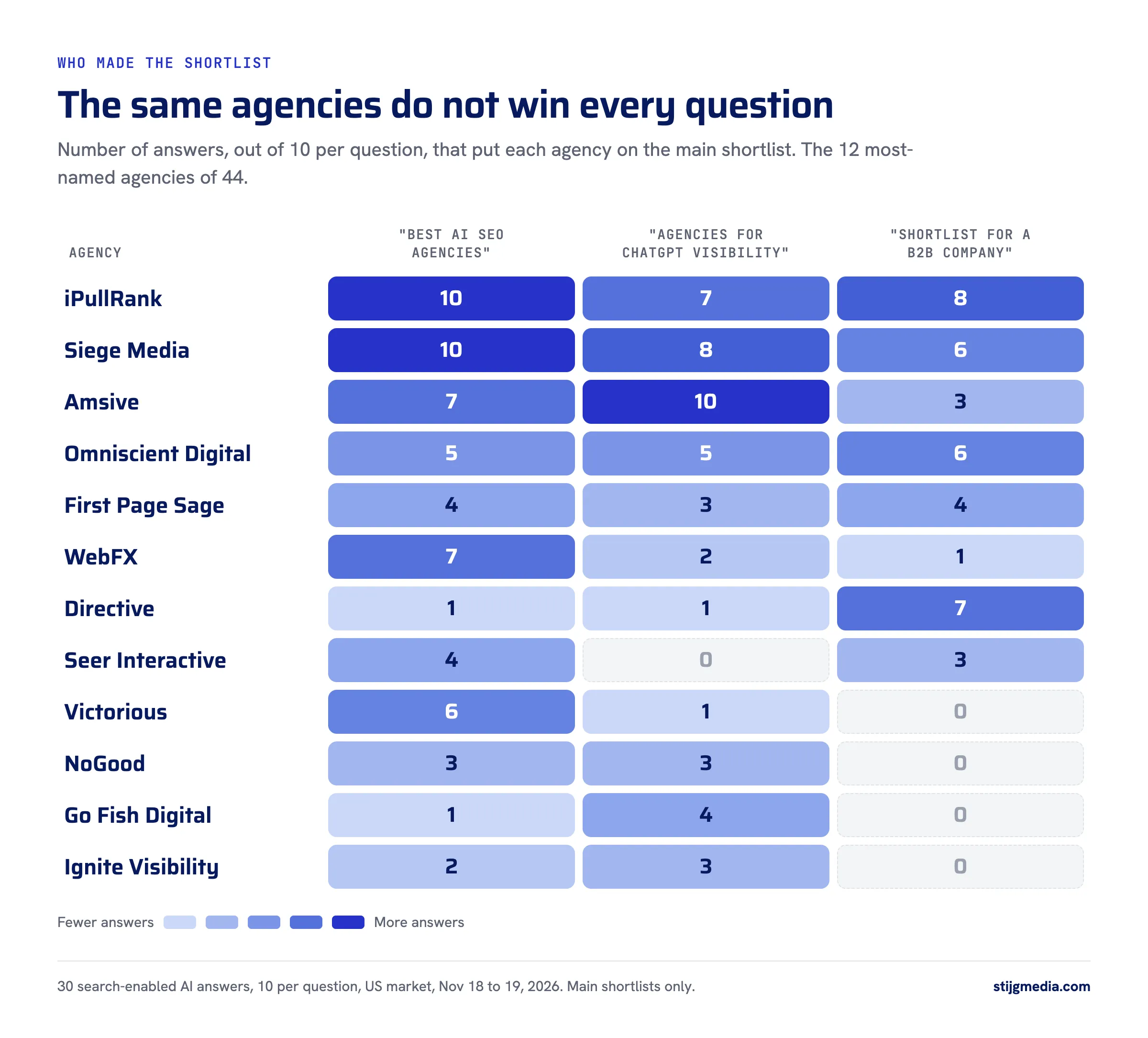
The broad question produced an average of 7.9 agencies per answer. The ChatGPT visibility question averaged 6.6. The B2B shortlist question averaged 5.1. The names changed, too.
| Agency | Best AI SEO agencies | Agencies for ChatGPT visibility | Shortlist for a B2B company |
|---|---|---|---|
| iPullRank | 10/10 | 7/10 | 8/10 |
| Siege Media | 10/10 | 8/10 | 6/10 |
| Amsive | 7/10 | 10/10 | 3/10 |
| Omniscient Digital | 5/10 | 5/10 | 6/10 |
| First Page Sage | 4/10 | 3/10 | 4/10 |
| WebFX | 7/10 | 2/10 | 1/10 |
| Directive | 1/10 | 1/10 | 7/10 |
| Seer Interactive | 4/10 | 0/10 | 3/10 |
| Victorious | 6/10 | 1/10 | 0/10 |
| NoGood | 3/10 | 3/10 | 0/10 |
| Go Fish Digital | 1/10 | 4/10 | 0/10 |
| Ignite Visibility | 2/10 | 3/10 | 0/10 |
Each figure is the number of answers, out of ten for that question, that included the agency in the main shortlist. The table shows the 12 most-named agencies of 44.
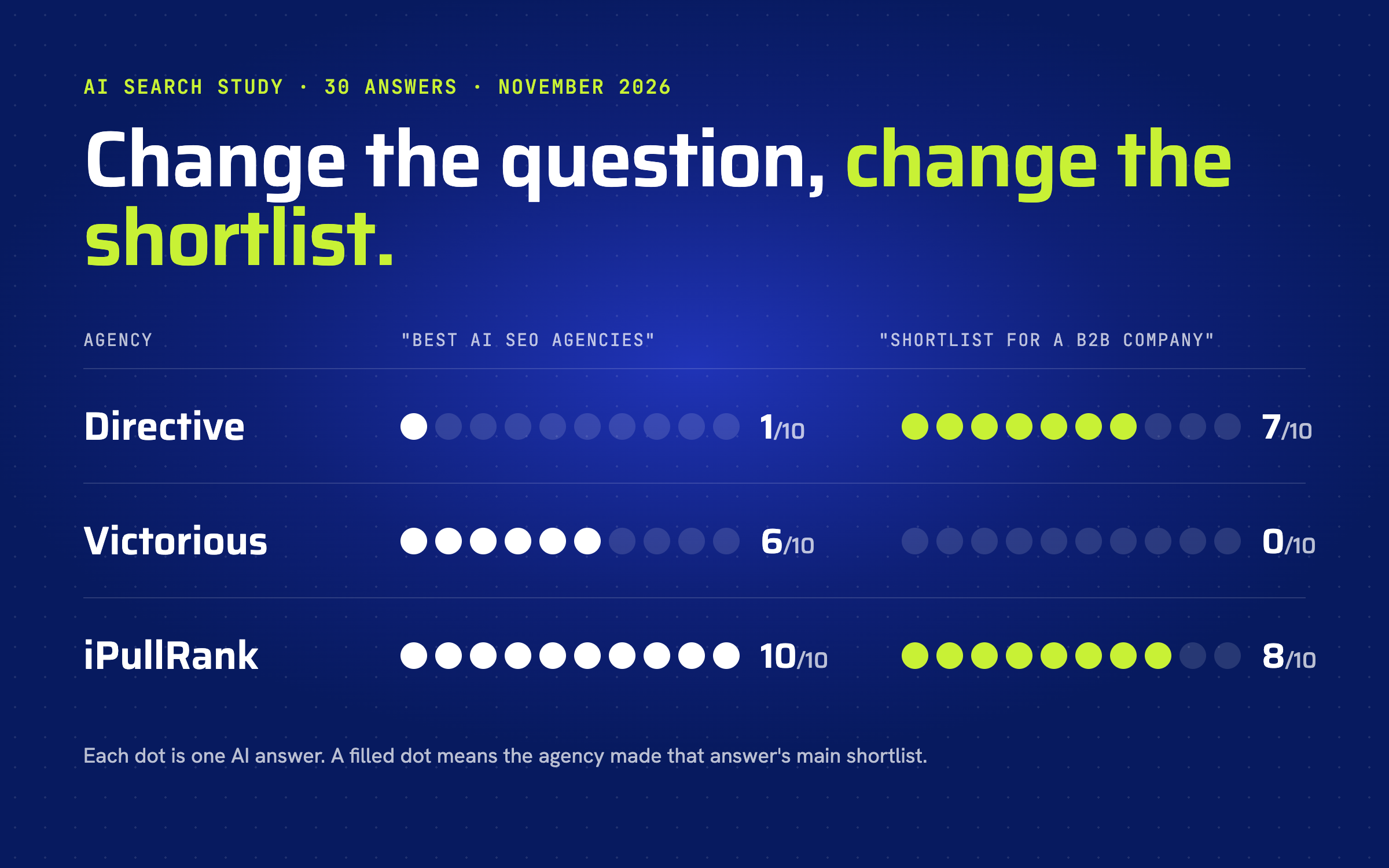
Directive came up much more often in the B2B scenario. Victorious appeared in six broad answers and no B2B answers. iPullRank remained a frequent pick in all three. When we counted only the first five names in each answer, Directive still went from 0/10 broad to 6/10 B2B, while Victorious went from 5/10 to 0/10. The results weren’t simply a consequence of shorter lists.
Most agencies showed up once or twice, not every time
Across the 30 answers, 44 different agencies made at least one main shortlist. Only 7 appeared under all three questions: iPullRank, Siege Media, Amsive, Omniscient Digital, First Page Sage, WebFX, and Directive. 19 agencies appeared in exactly one answer out of 30.
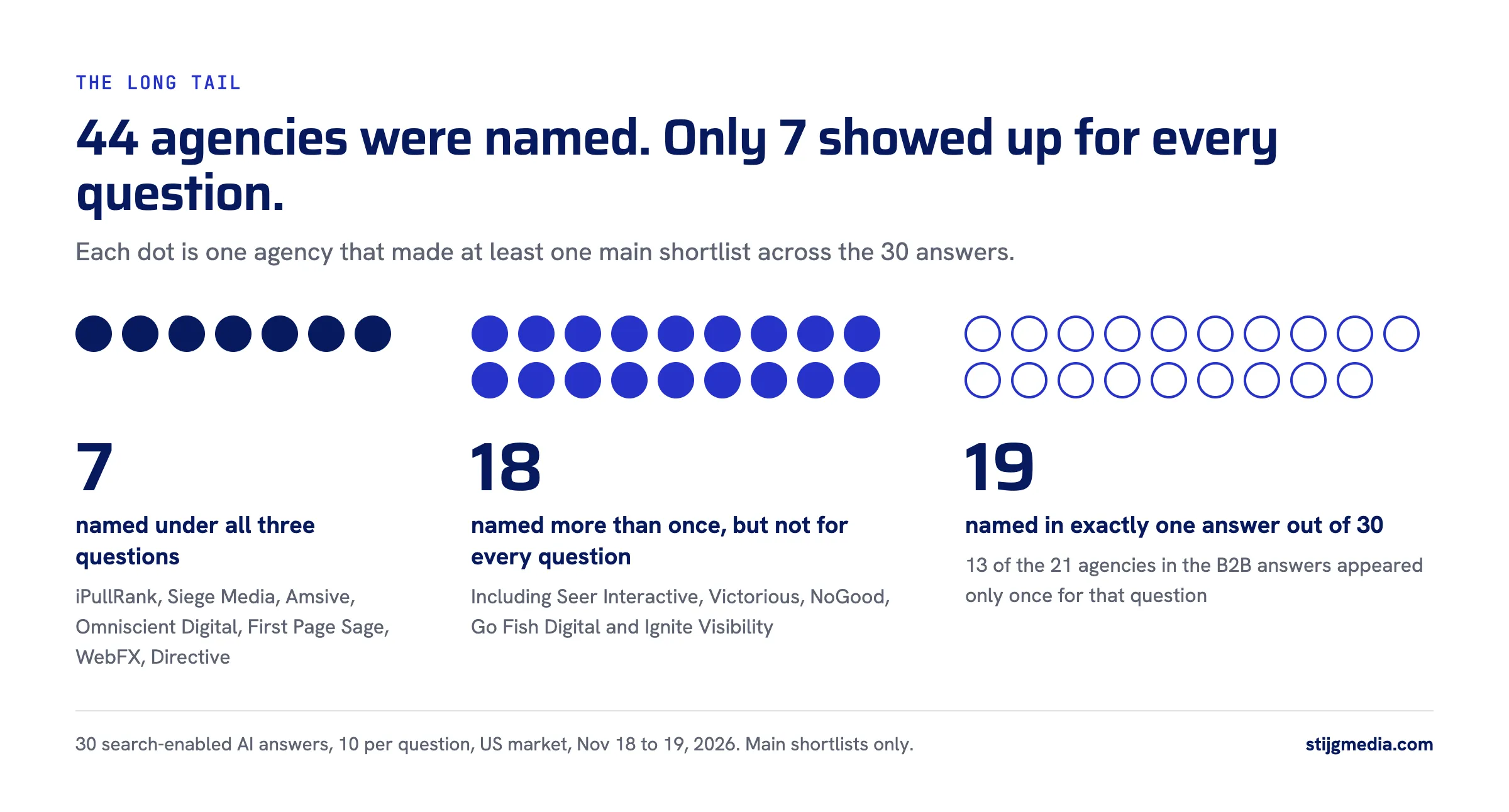
The B2B question had the shortest lists and the least agreement about who belongs on them. Its ten answers named 21 agencies. Thirteen of those appeared once for that question, and 11 never appeared for either of the other two questions. If you ask an AI tool for a shortlist once and act on it, you’re looking at one draw from a wide pool.
Each broad question had a favorite source. The B2B question didn’t.
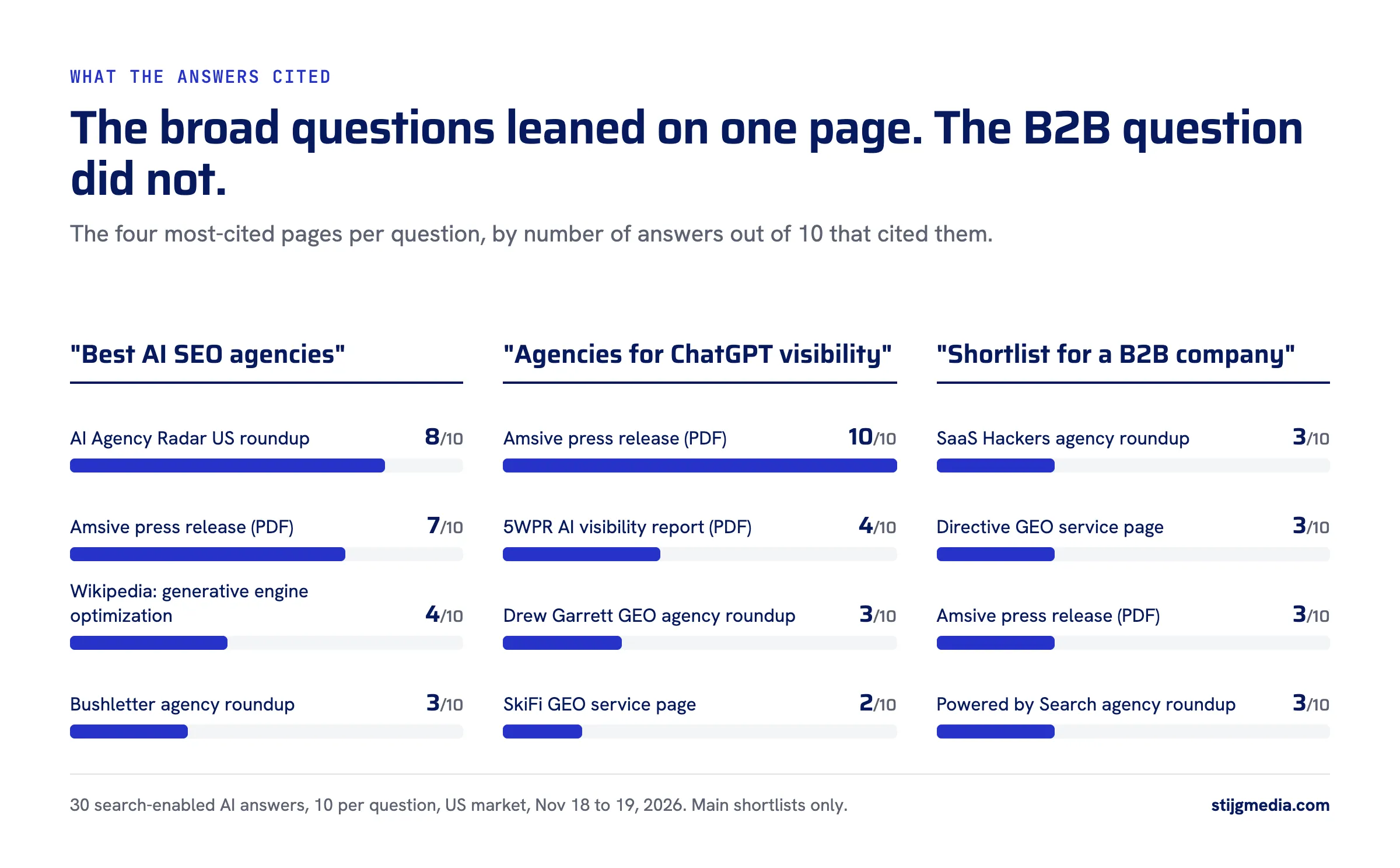
AI Agency Radar’s US roundup appeared in 8 of 10 broad answers. For the B2B question, no individual URL appeared in more than 3 of 10 answers. On average the model retrieved about 42 pages per answer and cited between five and six of them.
One pattern stood out. A 2025 Amsive press release about its answer engine optimization service was cited in 20 of the 30 answers. Those were exactly the 20 answers that put Amsive on the shortlist. It was cited in all ten ChatGPT visibility answers, where Amsive went ten for ten.
Agency-owned pages were common in general. About a third of the cited sources (56 of 159, counting each site once per answer) belonged to an agency named somewhere in the study, and in 51 of those 56 cases that agency was on the same answer’s shortlist.
A citation tells us which page appeared in the answer, not whether it caused a particular recommendation or verified the agency’s claims. The model may decide to include an agency first and then look for a page to support it. Either way, the page it reached for was often the agency’s own.
The model went looking for the agencies’ own pages
The export also shows the searches the model ran. It ran between 7 and 10 per answer. Three things were consistent:
- It searched specific agency sites. Every one of the 30 answers included at least one search restricted to a named agency’s website, and every one included a search naming iPullRank.
- It checked a directory. 20 of the 30 answers included a search on Clutch.
- It carried the buyer context into the search. For the B2B question, 61 of 79 searches contained “B2B”. For the other two questions, none did.
For a buyer, that means the detail you put in the question shapes what gets searched, not just how the answer is worded. For brands that want to be recommended, it means the model reads the content on your own product and service pages, including who you say you serve. We cover that side in how B2B companies get recommended by ChatGPT.
How our own picks did
We didn’t use the study to choose the ten agencies in this guide, and it shows. Counting main shortlists across all 30 answers: iPullRank 25, Siege Media 24, Omniscient Digital 16, First Page Sage 11, WebFX 10, Directive 9, Seer Interactive 7, Searchbloom 1, Onely 0, and Stijg Media 0. Stijg Media wasn’t named, cited, or among the pages retrieved.
How we tested: On November 18 and 19, 2026, we collected five US-market answers per question per day through HQ’s tracker and DataForSEO. The requests specified gpt-5.6-terra with web search enabled; the exports did not independently verify the model pin. This was an endpoint study, not a test in the consumer ChatGPT app. We counted each agency once per answer when it appeared in the main shortlist and excluded separately labeled conditional add-ons. Two answers offered two agencies as an either/or for one slot. We counted that as one slot for list length and credited both agencies.
What the test can and can’t tell you: We compared three exact wordings, not a controlled test of buyer type alone. The B2B question also asked for a shortlist rather than the best agencies. Ten answers per question is enough to see a pattern, not enough to rank agencies. The practical takeaway is to give an AI tool enough context to start a useful search, such as your industry, team size, and implementation needs, then verify the firms it returns. The results don’t establish which agency is best. Stijg Media’s editorial inclusion below is separate from the study.
The 10 best AI SEO agencies by buyer fit
Stijg Media: Best for Founder-Led, Hands-On AI SEO for B2B Companies
Choose Stijg Media if you want the person who diagnoses the search problem to help fix it. Stijg works with established US B2B companies that need both Google SEO and AI search visibility but don’t have a large in-house team to implement the work. Clients work directly with founder Adriaan van Swieten on technical SEO, website and content changes, entity optimization, and measurement. The focus is on the searches and buying questions that can lead to qualified inquiries, not just the ones that generate impressions.
The distinction is clearest when a project crosses disciplines. If an important product or service is poorly explained, hard to find from the rest of the site, and absent from relevant AI answers, the work may involve rewriting its page, changing internal links, and tracking the buyer questions it should inform. Those are implementation tasks, not three separate reports for your team to coordinate.
Evidence and trade-off: Stijg’s public client reviews include a local business owner who reported calls from people who said AI had recommended her. That’s a client-reported example, not evidence of repeatable national B2B AI search results. Our pick is based on the founder-led delivery model and fit for B2B firms. If you require a large enterprise delivery team or a published case study in your exact sector before hiring, weigh those requirements explicitly. Engagements are custom-scoped.
Need someone to own the strategy and implementation? Explore Stijg Media’s B2B SEO and AI search services.
iPullRank: Best for Enterprise Technical SEO and AI Search
iPullRank is a fit when technical SEO is a cross-team problem: a complex site, several business lines, or a backlog that needs engineering, editorial, and leadership buy-in. Its published services combine GEO, technical SEO, and content strategy, with a top tier aimed at large organizations. Its AI Search Manual is a useful sample of how the firm thinks about relevance and retrieval. It’s not a substitute for reviewing a comparable client engagement.
Ask before hiring: Who will translate findings into engineering tickets, and who will verify the fixes after release? If you only need one focused implementation project, compare that scope with a specialist before buying a broader program.
Omniscient Digital: Best for B2B Software Companies Building Organic Pipeline
Omniscient Digital is a fit for B2B software teams that want SEO, content, AI search, and digital PR planned around the same buyer journey. It publishes examples from software companies including OnBoard, where it reports that visibility across tracked, unbranded AI prompts rose from 73% to 88% between January and August 2026. The public case makes it possible to ask a better question than “Can you get us cited?”: how did the team define the prompt set, and how did it connect the work to booked meetings?
Ask before hiring: Which parts of the engagement focus on commercial pages and authority building, and which focus on editorial production? For an urgent, stand-alone technical fix, compare a narrower proposal.
Siege Media: Best for Content-Led AI Visibility, Design, and Digital PR
Siege Media is a fit when your search strategy needs assets worth discovering and referencing: original data, well-designed guides, interactive resources, or buyer comparisons. Its published GEO process includes prompt-level citation mapping, content production, and digital PR outreach. Its content service combines writing, design, development, and PR. Siege publishes an $8,000/month minimum for content marketing. Don’t assume that’s a standalone GEO quote.
Ask before hiring: Which proposed asset fills a real gap in your market, and how will it reach publishers or buyers after launch? If the primary blocker is a broken site architecture, settle the technical scope before paying for production.
Directive: Best for B2B Companies Tying Search to Pipeline
Directive is a fit for B2B marketing teams that want SEO and GEO evaluated against pipeline rather than traffic alone. Its published GEO service is built around high-intent buyer research, and its case studies include examples linking organic work to business outcomes. Directive was also the most striking example of a buyer-specific shift in our study: 7/10 B2B answers versus 1/10 broad answers. That’s a study observation, not why it earned this editorial category.
Ask before hiring: How are sourced and influenced opportunities defined, and what reporting can you verify in your CRM? Ask them to separate search visibility, conversions, and pipeline rather than rolling them into one figure.
First Page Sage: Best for Expert-Led B2B Content and Lead Generation
First Page Sage is a fit for companies that sell something complicated and need authoritative pages that help buyers evaluate it. Its offering combines search strategy, thought leadership, and GEO. Its published case study for a nearshore software development company describes an engagement that combined all three, rather than treating AI visibility as a separate content project.
Ask before hiring: Who interviews your subject-matter experts and who verifies technical claims? If domain expertise is the reason customers choose you, the writing process matters as much as the publishing schedule.
Searchbloom: Best for Combining Traditional SEO and AI Search
Searchbloom is a fit if you’re looking for an integrated SEO and AI search program, particularly when business profiles and location visibility matter alongside the website. In a published case study for a custom closet company, Searchbloom reports 20 of 51 search leads recorded as coming from AI search in September 2026. The case also notes that the CRM didn’t have an AI search source field in the earlier comparison period, so the data doesn’t establish a year-over-year increase in AI leads specifically. Searchbloom publishes an SEO starting price of $3,000/month. Confirm what the AI search scope adds.
Ask before hiring: How will you distinguish a tracked AI referral from a lead who tells the sales team an AI tool recommended you? Both are useful, but they’re different kinds of evidence.
Onely: Best for Technically Complex Websites With Discoverability Problems
Onely is a fit when site architecture, JavaScript rendering, or indexation is the problem you need to investigate before investing in more content. Its technical SEO background and published GEO service make it a relevant option when you want someone to connect the state of the site with its search visibility.
Ask before hiring: What would confirm the suspected blocker, and what’s included after diagnosis? A technical audit and a verified production fix are different deliverables. Make sure the proposal says who owns each.
WebFX: Best for AI SEO Inside a Broader Digital Marketing Program
WebFX is a fit for businesses that want to buy AI SEO alongside a broader set of digital marketing services. It publishes an AI search optimization plan starting at $3,000/month with a six-month commitment, which gives buyers a concrete starting point for budgeting. Its offer pairs AI visibility tracking with agency services. Check exactly which changes, content, and reporting the base plan includes.
Ask before hiring: Who owns the account day to day, what gets implemented each month, and what requires a change in scope? A published plan helps with budgeting. It doesn’t answer those delivery questions.
Seer Interactive: Best for Enterprise AI Search Measurement and Experimentation
Seer Interactive is a fit for enterprise brands that want to know what changed, how it was measured, and what to test next. Its public GEO material lists a structured test framework among its deliverables and tracks separate signals: how often AI recommends a brand, how accurately it describes the brand, and whether AI referrals convert. That distinction matters if you already have analytics infrastructure and want more than a count of mentions.
Ask before hiring: How will the team design a test around your site, and what decision will the result change? If the immediate need is to rewrite and ship a handful of product or service pages, compare the cost of that smaller scope.
What does an AI SEO agency actually do?
An AI SEO agency works to improve how a brand is discovered and described in AI-generated search answers, alongside its Google rankings. The work usually sits on top of a normal SEO strategy rather than replacing it. Typical AI SEO services include:
- Prompt and visibility tracking: recording how often AI answers mention, cite, or recommend the brand across a fixed set of buyer questions.
- Technical SEO: removing crawl, rendering, and indexation barriers so Google and AI crawlers can read the site.
- Content optimization: improving service or product pages and adding evidence that helps buyers evaluate your offer.
- Entity and brand work: keeping the facts about the brand consistent across the site, business profiles, and structured data.
- Third-party coverage: digital PR, review management, and outreach to the sources that cover your market, because AI answers often lean on what other sites say about brands.
- Reporting: connecting AI visibility to visits, leads, and sales.
You’ll often see the work called generative engine optimization (GEO) or answer engine optimization (AEO), and some agencies sell it as AI search optimization. The names overlap, and we untangle them in SEO vs GEO vs AEO. Whether you hire a specialist or a full-service digital marketing agency, the scope matters more than the acronym.
A useful engagement should distinguish three things: whether your brand is mentioned, whether a page is cited, and whether the answer actually recommends you for the right job. Those can move independently. So can traffic and leads. A cited research article is valuable in a different way from an answer that sends a qualified buyer to a product or service page. Our guide to tracking AI visibility shows how to keep those signals apart in a report.
Google AI Overviews, ChatGPT, Gemini, Claude and Perplexity: which platforms should an agency cover?
AI search isn’t one place. A buyer might read a Google AI Overview above the regular results, ask ChatGPT for a shortlist, or put the same question to Gemini, Claude, or Perplexity. Each one retrieves and cites content in its own way, so a brand can show up in one and be missing from another.
That matters when you compare proposals:
- Google AI Overviews and AI Mode sit inside Google Search, so they’re closest to the SEO and content optimization most brands already do.
- ChatGPT can search the web before it answers. The model in our study ran its own searches and read agencies’ own pages each time.
- Gemini, Claude and Perplexity each have their own search and citation behavior. Check which ones your buyers actually use before you pay to track all of them.
Our study covered one model, so it says nothing about how the other platforms would answer the same questions. The answers themselves treated AI search as more than one platform: 24 of the 30 named Google AI Overviews, Gemini, and Perplexity as well as ChatGPT.
Ask each agency three things:
- Which AI platforms do you track for brands like ours?
- How often do you re-run the same prompts?
- Do you report each platform separately, or as one blended score?
A single blended AI visibility score hides the difference between a brand that Google AI Overviews cite and a brand that ChatGPT recommends.
How much do AI SEO agencies cost in 2026?
The public offers in this guide show why a single price range can mislead. WebFX lists $3,000/month for an AI SEO plan. Searchbloom lists $3,000/month as an SEO starting price. Siege Media lists $8,000/month as a content marketing minimum. Those figures don’t represent a market average or buy the same work.
For a fair comparison, ask every agency to price the same work: the initial assessment, changes it will implement, content or outreach it will deliver, reporting it will maintain, and work your team still needs to do. A focused audit can be useful if you have implementation capacity. If you don’t, a cheaper proposal that hands you a backlog may cost more once your team has to find someone to clear it.
How to choose the right AI SEO agency
Start with the constraint. If you’re an established B2B company with a lean marketing team, ask who will actually make the changes. If you’re a SaaS company competing for category visibility, ask to see a relevant content and distribution program. If you’re an enterprise with technical debt or several teams involved, ask who will own engineering coordination and how success will be measured across the site.
Before signing, get clear answers to five questions:
- What would you fix first, and why? Ask for an example tied to a commercial page or buyer question, not a generic roadmap.
- Who will implement it? Name the agency owner for the work and any tasks that stay with your team.
- What will you measure? Ask for the prompt set, the surfaces being tested, and how the agency separates mentions, citations, and recommendations.
- What evidence supports the proposal? Look for a comparable client example, a clear baseline, and enough detail to understand what was measured.
- What happens if visibility rises but inquiries don’t? A useful answer should cover buyer fit, landing pages, and lead attribution, not just a plan to track more prompts.
Treat guaranteed placement in ChatGPT answers, a proprietary score with no explanation, or a case study with no baseline as reasons to ask harder questions. You’re buying work and judgment, not a promised position in a generated answer.
The bottom line
Shortlist two or three agencies based on the work you need done. Give them the same brief, ask who will implement the changes, and compare the evidence behind their proposals. Use AI recommendations to find candidates, not to make the hiring decision. In our study the same question, asked ten times, never returned the same list twice.
If you run an established B2B company and want the same specialist to diagnose the opportunity and help implement the work, talk to Stijg Media about your Google and AI search visibility.
Frequently Asked Questions
Which AI SEO agency is best for B2B companies?
It depends on the B2B business and the work it needs. Stijg Media is our editorial pick for established B2B companies that want founder-led strategy and hands-on implementation. Omniscient Digital is a fit for software companies building organic pipeline. Directive is worth shortlisting when a B2B team needs a pipeline-focused search program. Look for the delivery model and evidence that match your situation.
Can an agency guarantee that ChatGPT will recommend my company?
No. An agency can improve what relevant sources say about your business, make your site easier to understand, and measure how you appear across a defined set of prompts. It can't guarantee a particular recommendation. If a proposal offers a guarantee, ask what is actually being guaranteed: the work, a reporting metric, or a result the agency doesn't control.
Does AI SEO replace traditional SEO?
No. Technical accessibility, useful content, and clear explanations of what you sell still matter. AI search adds questions that a rankings report won't answer: whether an answer mentions your company, describes it correctly, or recommends it for the job you want to win. Measure those separately rather than assuming a Google ranking tells you how you appear in an AI answer.
How long does AI SEO take to produce results?
There is no reliable universal timeline. You can establish a baseline and fix some problems early. Changes in repeat recommendations or qualified leads require more observation. Ask for milestones on what the agency controls, meaning what it will audit, ship, and measure, and agree on how you'll evaluate changes over time.
How can I check whether AI recommends my business?
Start with questions a buyer would ask without naming you. Include your product or service, customer type, and market where relevant. Record the wording, tool, date, companies recommended, and sources cited. Repeat the same questions on more than one date so you don't mistake one answer for a pattern. Then check whether any mention actually matches the work you sell.
What is AI SEO called now?
AI SEO also goes by generative engine optimization (GEO), answer engine optimization (AEO), LLM optimization (LLMO) and AI search optimization. The terms overlap. All of them describe work to get a brand mentioned, cited or recommended in answers from tools such as Google AI Overviews, ChatGPT, Gemini, Claude and Perplexity.
Is an AI SEO agency different from an SEO or digital marketing agency?
Often it's the same agency with an added service. Most AI SEO work builds on technical SEO, content and brand authority, which SEO agencies already do. The difference is in focus and measurement: tracking how AI answers describe your brand, which sources they cite, and whether they recommend you. Ask any SEO or digital marketing agency what its AI SEO scope adds to a standard retainer.
Do AI tools recommend the same agencies every time?
No. In our 30-answer study, 44 different agencies made at least one shortlist, only 7 appeared under all three questions, and 19 appeared in exactly one answer. iPullRank and Siege Media came up most often, in 25 and 24 of 30 answers. Run the same question several times, on more than one day, before you treat a name as a pattern.

Written by
Adriaan van Swieten
Adriaan leads Stijg Media and works directly on search, AI visibility, websites, and local growth strategy.
Meet Adriaan