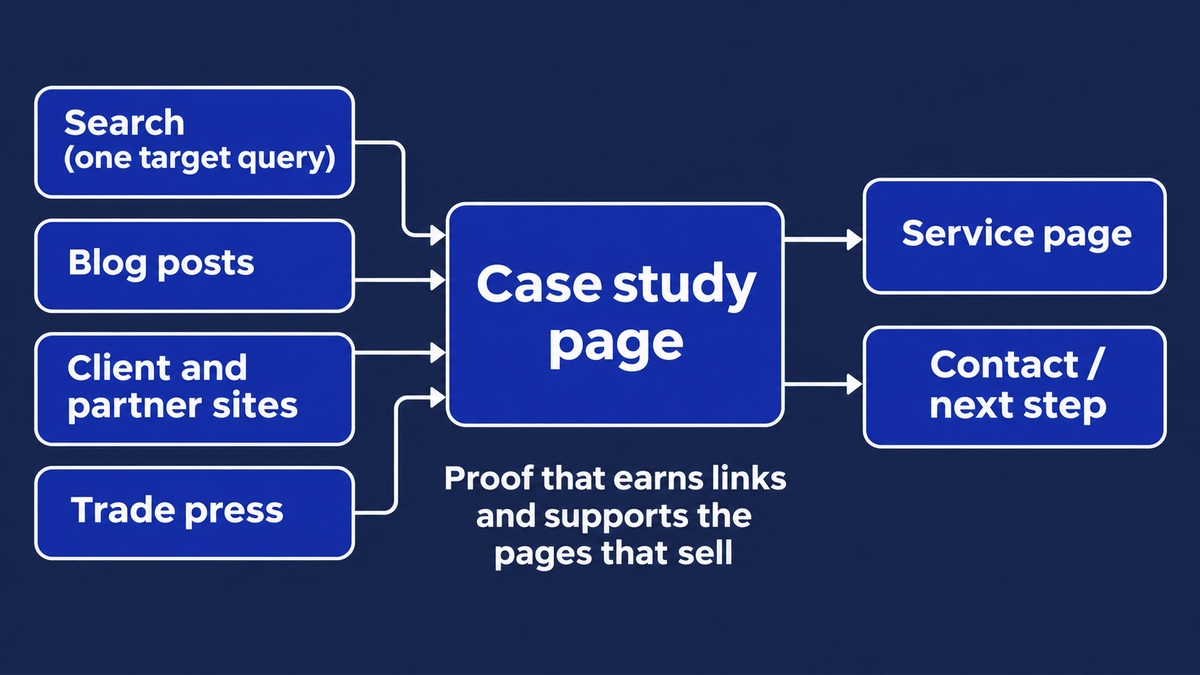
A B2B case study helps SEO when it lives on a crawlable page, targets one specific search, shows specific results and links to the service pages it proves. Most case studies do none of that. They sit in a gated PDF, carry a vague title and never get a link from anywhere else on the site.
This guide covers how to plan, write, optimize and promote customer stories so they work as search assets and as sales proof. It is the kind of thinking we bring to B2B SEO services: proof pages should earn their place in the site, not sit in a forgotten corner. It also touches on content marketing basics, since a case study is one of the few formats that serves both search and sales.
Why case studies matter for B2B SEO
Case studies matter because B2B buyers look for proof before they commit, and a good case study page can also improve search visibility and get quoted in AI answers. Buying decisions involve several people and long timelines, so every one of them wants evidence that a supplier has solved a problem like theirs.
The research backs this up. In the Content Marketing Institute and MarketingProfs 2027 B2B report, 861 B2B marketers were asked what builds trust and credibility. Half (50%) named “showcasing customer stories and testimonials” among their top answers, behind useful practical information (64%) and demonstrating industry expertise (59%).
Do case studies help SEO? Yes, if they are indexable pages with a clear search target. They don’t help when they are gated or orphaned. Done well, they support your overall SEO strategy by giving service pages something concrete to point at.
A well-built case study page can:
- Rank for long-tail searches that combine a problem and an industry
- Convert visitors who are already comparing suppliers
- Earn links from the client, partners and trade press
- Feed AI answers with specific, quotable facts
- Give your sales team a link to send instead of a slide deck
Plan each case study before you write
Have a clear plan for each case study before the first interview, because a story with no job to do ends up as a generic success story. Decide what the page must achieve for search and for sales, then collect the material that supports it.
Set objectives for each case study
Write down these objectives before you schedule the call with the customer:
- Target query: the one search this page should win
- Target service page: the page this story proves and will link to
- Buyer role: the person who will read it, such as an operations director or a procurement lead
- Proof points needed: the numbers, dates and quotes that make the story believable
- Approval owner: who at the client signs off on names, figures and quotes
The interview itself is a separate skill, and plenty of guides cover it. What matters here is that you know what the page is for before you start asking questions.
Keyword research for case study pages
A case study should target one specific long-tail search, not a head term. Head terms belong to your service pages. The case study supports them by winning the narrower, proof-shaped search around it.
Patterns that work, with examples:
- Service for industry: “SEO for industrial companies”
- Problem plus industry: “slow quote turnaround distributors”
- Software or integration: “ERP migration case study”
- Alternative or switch: moving off a legacy supplier or platform
- Industry plus service plus proof: “logistics marketing case study”
To identify your highest value keywords, start with the services that bring in the most revenue and list the industries and problems you win work in. Then prioritize commercial intent keywords, the searches that suggest someone is close to choosing a supplier. Our B2B keyword research process walks through how to find and check those terms.
Keep the service page and the case study apart. If a service page and a case study both chase the same phrase, they compete with each other. Let the service page own the broad phrase and let the case study own the specific story.
Match the query to the buyer stage
Case study searches sit in the middle to late part of the funnel. Someone typing a service plus an industry already knows the category and is comparing options. That is why case study pages can convert well even with few visits, and why they deserve a clear next step at the bottom.
Technical SEO: publish case studies as pages, not gated PDFs
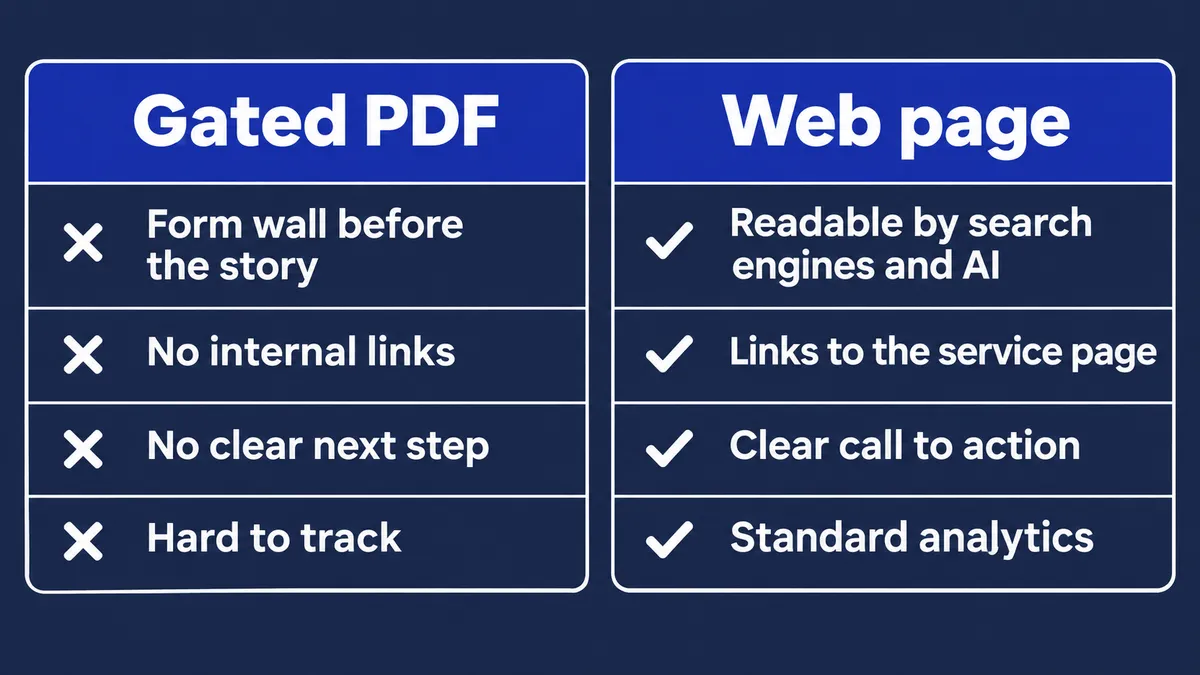
Publish the full case study as a normal HTML page that anyone, and any crawler, can read without filling in a form. That one choice decides whether search engines and buyers can read the full story.
The case against PDFs is not that they can’t rank. Google lists PDF among the file types it can index. The case is practical. A PDF has weaker internal linking, no site navigation, no built-in call to action, poorer mobile reading and harder analytics. A form wall is worse: if the story only appears after someone submits their details, it is not on the crawlable page for crawlers to read.
When gating still makes sense
Gate an extra, never the story itself. A full ROI workbook, a technical appendix or a detailed implementation plan can sit behind a form if you want leads. The case study page should still tell the complete story in text, with a link to the gated extra for people who want more.
Check the page is indexed
Publishing does not guarantee indexing. Use the URL Inspection tool in Google Search Console to confirm each case study is indexed and that Google sees the full text. If a page shows up as crawled but not indexed, fix that first, because a case study nobody can find does no work for you.
Structure the page: summary, challenge, solution, results
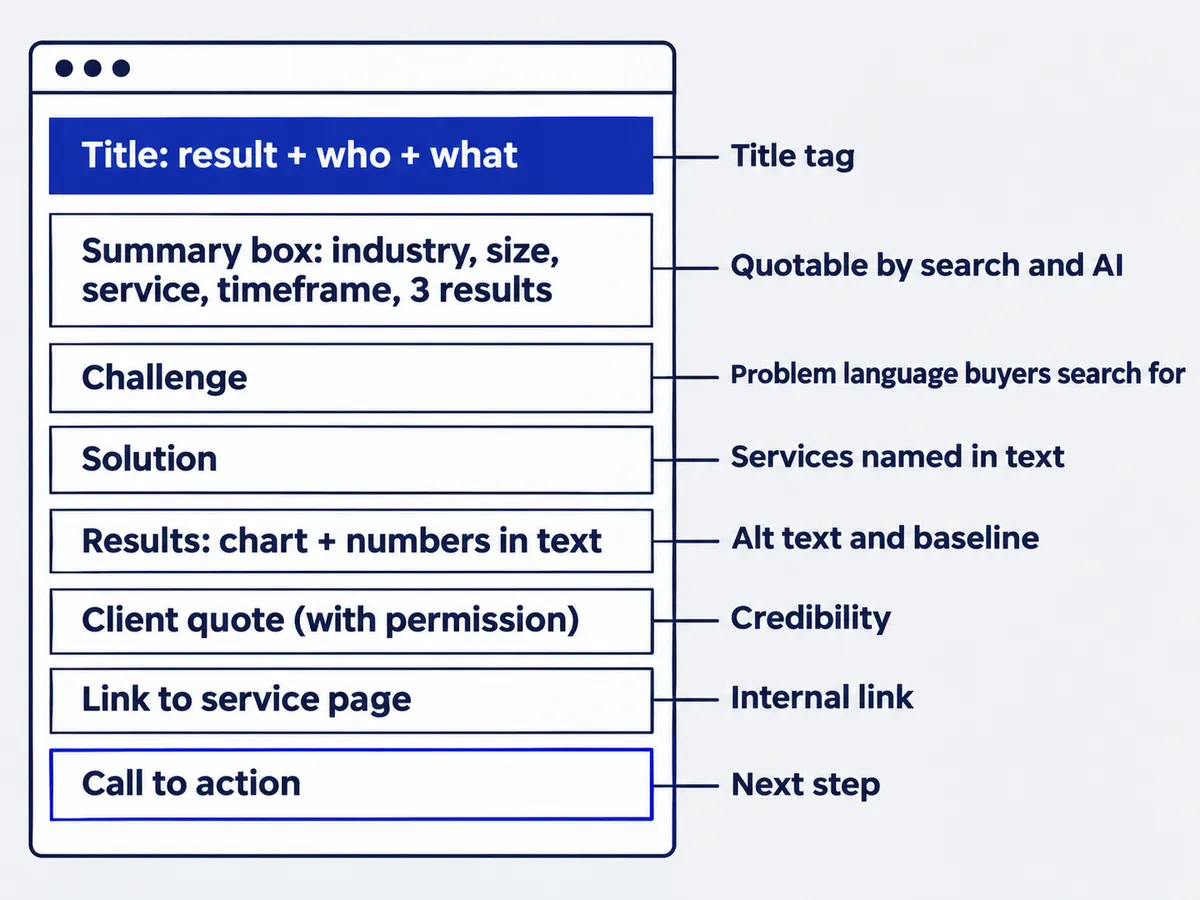
Structure a case study page so a skimmer gets the point in ten seconds and a careful reader gets the full story. The order that works is summary, challenge, solution, results, then a next step.
Lead with a summary box
Open with a short bulleted summary:
- The client, or an anonymized description
- Industry and company size
- The service delivered
- Timeframe
- Two or three headline results
A summary box helps skimmers and sales teams, and it gives AI tools a clean, self-contained passage to quote.
Write results that hold up
Results are where most case studies lose credibility. A few rules keep yours honest:
- State the baseline and the timeframe for every number
- Say what changed, and what else changed at the same time, such as ad spend, a product launch or seasonality
- Favor leads and revenue over pageviews
- Report non-branded organic traffic, not total traffic that includes people searching your name
- Get client approval for every number and quote
Add one or two real quotes from the customer, with permission. A short, specific quote beats a paragraph of praise.
Publishing a case study without naming the client
If an NDA blocks the client’s name, publish an anonymized case study. Describe the client by industry, size, region and the job titles involved, and keep the details that make it believable: the problem, the timeline and the numbers. A specific story about “a regional distributor with 200 employees” works better than a named client with vague claims.
On-page optimization for case study pages
Optimizing a case study comes down to describing the story clearly in the places search engines and readers look first. A few specific choices matter most.
Title tag. Put the result, who it was for and what you did, in a length that won’t get cut off in results (roughly 50 to 60 characters is a sensible aim, not a Google rule). The pattern looks like “How a [industry] supplier [result] with [service]”. That is a template, not a real result.
Meta description. One or two sentences naming the problem and the outcome.
Headings. Use clear headings that describe what is in each section, and keep the page design simple so the text stays easy to scan. Where a buyer would ask a question, phrase the heading as that question.
Images. Use before and after charts and screenshots, with descriptive file names and alt text that says what the chart shows. Put the key numbers in the text too, so they don’t exist only inside an image.
Schema. Article markup is fine for a case study. Don’t add review stars to your own testimonials: Google says that if the entity being reviewed controls the reviews about itself, pages using LocalBusiness or any other Organization structured data are ineligible for the star review feature. For more detail, see our guide to schema markup for B2B sites.
Link case studies into your content strategy
Link case studies into your content strategy so they have a job beyond sitting on a page. A case study with no internal links is invisible to visitors and weak for search.
Do these things:
- Build a hub. Create a case study index that visitors can filter by industry and service.
- Link from service pages. Each service page and landing page should link to its matching case studies with descriptive anchors.
- Link back. Each case study should link to the service page it proves.
- Use blog posts as support. Related posts can link to a case study as proof, and a companion post can explain the how in more depth than the case study should.
Google’s own guidance on AI features lists “making your content easily findable through internal links” as a best practice, so this is not just a tidy-up job. It is also part of the SEO work on your own site that pays off for every page you publish. If you are still deciding whether you need a blog to hold this supporting content, case studies are a strong reason to say yes.
Turn case studies into backlinks and PR
Case studies can earn backlinks because they contain specific, original information that other sites want to cite. The clients, partners and vendors in your story often have their own news pages and are happy to link to a joint success.
Ask the client, partners and vendors directly. Send the finished case study with a short note and suggest where it might fit on their site. Trade press also picks up specific, data-backed outcomes, because editors need facts they can attribute. A case study with original numbers gives them something concrete.
Two other posts cover case-led links and PR in depth. Our guide to digital PR for B2B explains how to pitch case-led stories, and our B2B link building strategies post shows where case studies fit among other ways to build authority. Keep your own approach simple: publish the case study, tell the people in it, and pitch it where the numbers are a good fit.
Make case studies easy for AI search to cite
Case studies are easy for AI search to cite when they state results in plain text and name the industry, the service and the timeframe. Google says there are no additional requirements to appear in AI Overviews or AI Mode, and no special optimizations beyond normal SEO. Its best practices include keeping important content available in text and making sure structured data matches the visible text on the page.
In practice, that means:
- A summary box that stands on its own
- Results written as sentences with numbers and timeframes, not buried in a chart image
- The client’s industry and your service named in the text
- Sections that make sense when read alone
If you want the wider picture, our pages on generative engine optimization and answer engine optimization cover how AI tools choose sources.
What a good SEO case study shows
A good B2B SEO case study shows the baseline, the work, the timeline and the business result, with enough detail that a skeptical reader can judge it. This matters whether you are writing your own or comparing agencies, because a case study teardown is a good way to spot weak claims. Our review of ten AI SEO agencies applies the same test to the case studies those agencies publish.
Use this checklist to learn how much to trust any agency’s case study:
- Baseline and dates: where things started and over what period
- Non-branded organic traffic: not total visits
- Keyword rankings tied to commercial pages: not a list of easy wins
- Leads, pipeline or revenue: not pageviews
- Their entire strategy: what was done and in what order, not one tactic
- What didn’t work: every real project has some of this
- Other changes in the period: ads, launches, seasonality
- How long it took: results timelines vary, and how long SEO takes to work depends on the market
Published agency case studies often quote traffic gains as a percentage with no baseline and no timeframe. Ask for both. A percentage on a tiny starting number tells you very little.
How to measure results from case study pages
Measure case study pages by what they do for leads and sales, not pageviews. A case study that few people find on their own but is sent to every serious prospect can be worth more than a popular blog post.
Track these:
- Rankings and Search Console data for the target query: impressions, clicks and position
- Organic visits to each case study page
- Assisted conversions: sessions where a case study was viewed before a form fill
- Sales use: how often your reps send the link, and what prospects say about it
- Links earned by each page
Set up these case study metrics alongside the rest of your reporting. Our guide to SEO reporting for B2B teams covers the full setup, and it keeps case study pages from being judged on the wrong numbers.
Quick checklist for case study pages
Here is the short version to keep next to your next draft:
- Pick one specific long-tail query and one service page for each case study
- Publish the full story as an HTML page, not a gated PDF
- Open with a summary box that works on its own
- State baselines, timeframes and other changes for every number
- Get client approval for names, figures and quotes
- Write a descriptive title, meta description and chart alt text
- Link the case study to its service page, and the service page back to it
- Ask the client and partners to link to the page
- Check indexing in Search Console
- Measure leads and sales use, not pageviews
If you want a second pair of eyes on your case study pages, get in touch and we will take a look.
Frequently Asked Questions
Do case studies help SEO?
Yes, when each one is an indexable page that targets a specific search and links to the service it proves. They can rank for long-tail problem and industry searches, give service pages proof to link to, and earn links from clients and partners. A case study locked in a gated PDF or left unlinked does little for search.
Should B2B case studies be gated or published as PDFs?
Publish the full story as a normal web page. Google can index PDFs, but a page carries navigation, internal links, a clear next step and cleaner analytics, and anything behind a form is invisible to search. Gate an extra such as a detailed workbook if you want leads, not the case study itself.
What keywords should a B2B case study target?
One specific long-tail search per case study, usually a service plus an industry or a problem plus an industry. Leave the broad head term to the service page so the two don't compete, and link the case study to that page.
Can you publish a case study without naming the client?
Yes. Describe the client by industry, size and region, keep the real numbers and timeframe, and get approval for what you publish. Specific results with an anonymous client are more useful than a named client with vague praise.
What should a case study page include?
A descriptive title and meta description, a summary of the client, problem, service and results at the top, the challenge, solution and results in text, charts with alt text, links to the related service page and a clear next step. Add Article markup if your site uses it, but no review stars on your own testimonials.

Written by
Adriaan van Swieten
Adriaan leads Stijg Media and works directly on search, AI visibility, websites, and local growth strategy.
Meet Adriaan