B2B search · Strategy + implementation

B2B SEO Agency for Google and AI Search

Stijg Media provides fully implemented SEO and AI SEO campaigns for established B2B companies that want to be found in Google, recommended in AI search, and turn that visibility into qualified business opportunities.

Start a conversation With Adriaan van Swieten

We'll discuss what you sell, who buys it, what you're currently doing in search, where the opportunity sits and whether there's a sensible fit.

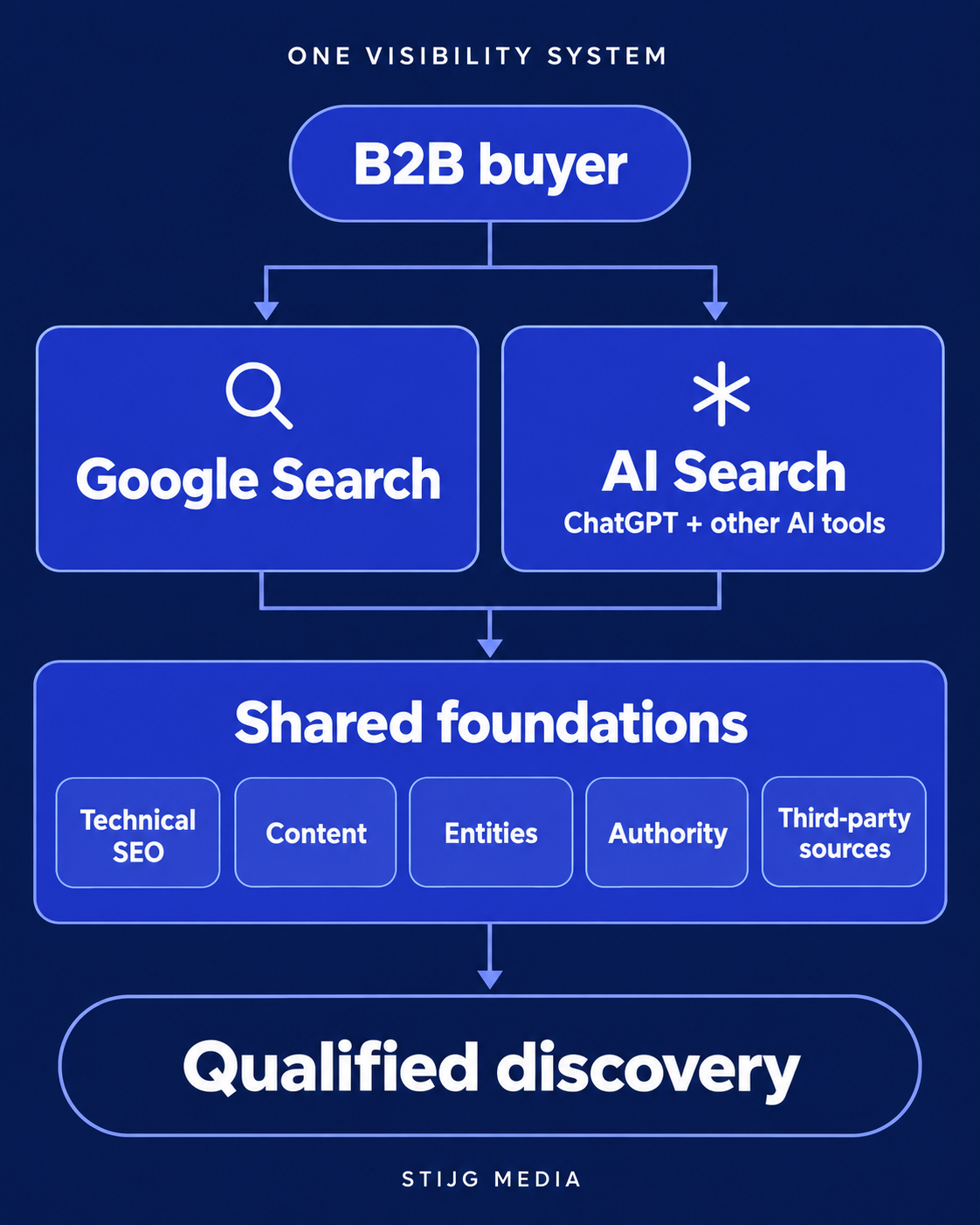
Diagram showing a B2B buyer reaching Google and AI search, which share technical SEO, content, entity, authority and third-party signals.
01 / Connected searchGoogle + AI search. One strategy. View full-size diagram ↗

We work with companies that already invest in SEO and want to expand into AI search, as well as established B2B businesses building a serious search program for the first time.

We handle both strategy and implementation across technical SEO, content, site architecture, AI retrievability, entity optimization, links, third-party mentions and ongoing measurement.

One visibility strategy

SEO and AI Search Should Be One Visibility Strategy

B2B buyers still use Google to research problems, compare solutions and evaluate providers. Increasingly, they can ask ChatGPT, Google AI features, Perplexity and other AI systems many of the same questions.

That adds another visibility layer. It doesn't replace SEO. Our search engine optimization work provides the foundation.

Many of the fundamentals are shared: technically accessible pages, clear entities, strong commercial content, useful information, relevant authority and credible third-party references.

AI search adds another set of questions. Which prompts are your buyers asking? Which companies get recommended? Which sources get cited? Where are competitors appearing that you aren't?

That's why Stijg Media treats SEO and AI SEO as one visibility strategy:

A continuous process

How the campaign works

Stijg Media runs SEO and AI SEO campaigns through a continuous six-stage process.

  1. Map queries and prompts

    Identify commercially relevant search queries, buyer prompts and competitors.

  2. Establish the baseline

    Measure existing search visibility, AI recommendations, citations and recurring sources.

  3. Improve owned assets

    Implement technical, architectural, content and retrievability improvements.

  4. Strengthen authority

    Improve entity signals, links and third-party validation.

  5. Measure results

    Rerun the original query and prompt set and connect visibility to commercial outcomes where possible.

  6. Iterate

    Scale what works and prioritize the remaining gaps.

Each cycle informs the next round of research and priorities.

Your starting point

Where Is Your Search Program Today?

You Already Invest in SEO

If SEO is already producing results, we don't replace it with an “AI SEO strategy.”

We baseline your visibility across relevant AI prompts, identify which competitors and sources dominate those answers, and find the gaps in your existing program.

That might mean improving existing pages, making important information easier to retrieve, strengthening entity signals or earning visibility on third-party sources that influence both search and AI recommendations.

The objective is to preserve what works and add the missing AI-search layer.
You're Building SEO From the Ground Up

If you haven't invested seriously in SEO before, we start with the fundamentals.

We map commercial search demand and buyer prompts, establish the technical and competitive baseline, then build the site architecture, commercial pages, supporting content, authority and entity signals needed to compete.

AI visibility is measured from the beginning rather than bolted on later.

Campaign scope

What Our B2B SEO and AI SEO Campaigns Include

Every campaign is scoped around the business, competitive environment and starting position. We don't sell a fixed package where every client gets the same number of articles or links.

Buyer Query and AI Prompt Research

We map how potential customers research problems, solutions, categories, comparisons, providers and brands across both search engines and AI platforms.

The goal isn't the biggest possible keyword list. It's identifying the queries and prompts that could actually influence a B2B buying decision.

Technical SEO, Architecture and Internal Linking

We identify and implement technical and structural changes affecting crawling, indexation, page targeting and authority distribution.

That can include site architecture, internal linking, cannibalization, on-page optimization, structured data where appropriate and improvements to important commercial pages.

We prioritize issues by likely commercial impact rather than producing a 100-point technical checklist.

Commercial Pages and B2B Content

B2B search isn't won by publishing hundreds of generic articles.

Depending on the opportunity, we build or improve service pages, solution pages, comparisons, use-case content, buyer resources and supporting informational content.

Where specialist knowledge matters, we work with your subject-matter experts rather than inventing expertise with AI.

Every page needs a defined search job and a sensible route toward a commercial action.

AI Retrievability and Entity Optimization

We improve how clearly search and AI systems can understand important facts, entities, relationships and answers across the site.

That can include clearer passage structure, explicit answers to buyer questions, entity consistency, content updates and appropriate structured data.

The goal is not to “optimize for an LLM” in isolation. It's to make the business and its expertise easier to retrieve and understand.

Our generative engine optimization work improves how AI systems understand and recommend your business. Through answer engine optimization, we also make useful answers easier to find and cite.

Links, Mentions and Third-Party Validation

Relevant backlinks still build search authority, but third-party sources also influence how companies are validated and surfaced in AI-generated answers.

We analyze both.

Depending on the market, work can include link acquisition, digital PR, industry mentions, business citations and inclusion in publications, directories, comparison sites and other sources that repeatedly appear around the target query and prompt universe.

Conversion-Path Improvements

More visibility isn't particularly useful if the resulting demand lands on the wrong page or encounters a weak conversion path.

Where necessary, we improve landing-page structure, calls to action and the journey between informational discovery and commercial pages.

Traffic is an input. Qualified opportunities are the outcome.

Talk through what your search program needs.

Start a conversation

SEO + AI search

What Changes When You Add AI SEO to an Existing SEO Program?

Adding AI SEO usually changes the research, retrievability, third-party source strategy and measurement layer more than it changes the underlying SEO fundamentals.

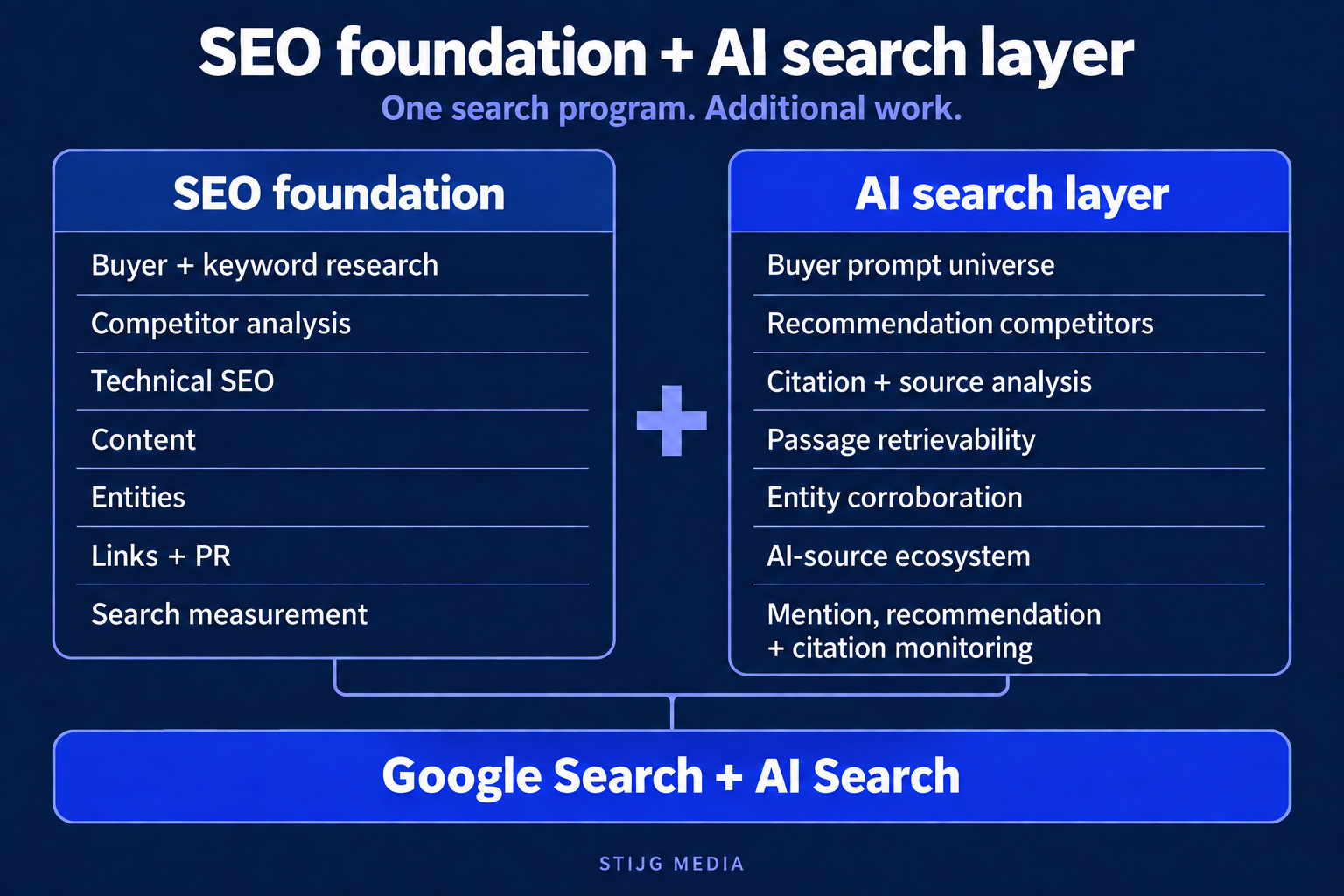
Diagram showing the SEO foundation plus additional AI-search work in buyer prompts, competitors, sources, passage retrievability, entities and visibility monitoring.
AI search adds to the SEO foundation. View full-size diagram ↗
Existing SEO foundationAdditional AI-search work
Keyword and buyer researchCommercial AI prompt universe
Competitor analysisRecommendation and citation competitors
Technical SEOAI retrievability review
Content strategyGrounding and recommendation coverage
Entity optimizationWider entity corroboration
Link acquisition and PRAI source-ecosystem targeting
Search reportingMention, recommendation and citation monitoring

Generative engine optimization (GEO), answer engine optimization (AEO) and AI SEO aren't replacements for SEO. They're additional ways of competing for visibility during the same buying journey.

From research to action

What the First 90 Days Look Like

The exact priorities depend on whether we're improving an established SEO program or building one from scratch, but the operating framework is consistent.

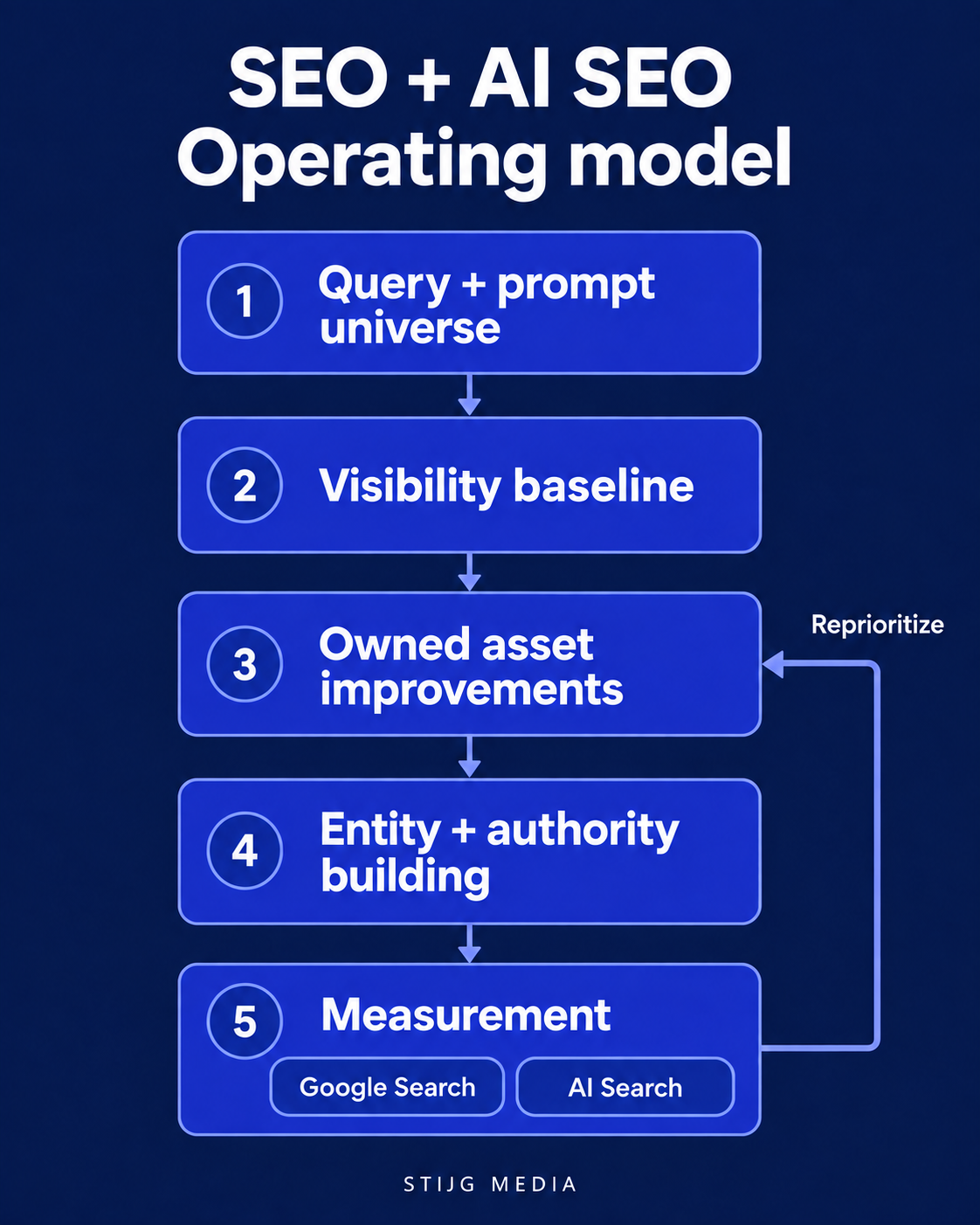
Five-stage SEO and AI search process: query research, baseline, owned asset improvements, entity and authority building, then measurement across Google and AI search, feeding back into priorities.
Measure both search channels, then update priorities. View full-size diagram ↗

Buyer Universe and Baseline

We define business goals, ICP, products or services and commercial priorities, then map the traditional query and AI-prompt universe.

We benchmark current search visibility, AI mentions and recommendations, citations, competitors and relevant third-party sources.

Opportunity Map

We analyze technical issues, content gaps, competitor strengths, entity weaknesses, authority gaps and recurring sources within AI answers.

Work is prioritized by commercial value, probability of impact and implementation effort.

Owned-Asset Implementation

We implement the highest-priority technical, architectural, on-page and content changes, including AI retrievability and entity improvements where relevant.

Authority and Third-Party Validation

We strengthen the external signals needed to compete through relevant links, mentions, citations, digital PR and third-party sources.

Remeasure and Iterate

We rerun the original query and prompt benchmarks under consistent conditions, compare changes and scale what is working.

These phases overlap. SEO isn’t a waterfall project where technical work has to finish before content or authority work can begin.

Clear responsibilities

Who Writes, Approves and Implements the Work?

Stijg Media handles both strategy and implementation. We don't deliver a strategy deck and leave your marketing team to execute it.

WorkStijg MediaYour team
Query, prompt and competitor researchLeadCommercial context
Technical SEOLeadAccess and dev support where needed
Architecture and internal linkingLeadApproval where required
Content strategy and creationLeadExpertise and approval
Entity optimizationLeadAccurate business information
Links, mentions and digital PRLeadApproval where required
Measurement and prioritizationLeadCRM and commercial context

Your team doesn't need to become the SEO team.

We primarily need access, accurate business information, subject-matter expertise when required, commercial priorities and timely approvals.

AI search measurement

How Stijg Media Measures AI Search Visibility

We measure AI visibility against a fixed universe of commercially relevant buyer prompts, rather than relying on isolated screenshots or a generic AI visibility score.

The prompt set can cover problems, solutions, categories, comparisons, recommendations, brands and trust-validation questions.

For each prompt and platform, we can track:

What we record in each AI answer

One prompt and platform. Three parts of the picture.

Your brand

Brand mentioned
Does the answer name your business?
Brand recommended
Does it recommend you as a provider?
Recommendation context
How, and for which need, does it recommend you?

Citations and sources

Brand cited
Does it cite your business or content?
Cited URL/domain
Which page or website does it cite?
Recurring third-party sources
Which outside sources appear across observations?

Competitors

Competitors present
Which other businesses appear in the answer?
Competitor share
How often do competitors appear across the fixed prompt set?

Compare these observations across the same prompt set over time.

Important prompts can be observed repeatedly because generative answers vary between runs. Platforms, models, geography where relevant, measurement conditions and dates are documented so later observations can be compared with the original baseline.

Commercial Recommendation Share

This focuses on high-intent prompts where an AI system could influence which provider or product the buyer selects.

The important question isn't merely whether your brand appears. It's whether you're being recommended in conversations that could realistically influence a purchase.

Category Authority

Category Authority covers problem, educational and category-level prompts where your company might be mentioned or cited as an authority without being directly recommended as the provider.

That's a different visibility job, so we measure it separately.

AI Visibility Is Not Revenue

An AI mention isn't a lead, and a citation isn't revenue.

Where the data allows it, we measure the downstream chain separately:

AI visibility → citation, referral or brand discovery → lead → qualified opportunity → revenue

Attribution is imperfect. We'd rather state that limitation than manufacture causation.

Commercial measurement

How We Measure SEO and Commercial Progress

Traditional SEO follows the same principle.

Depending on the client's systems and available data, we can connect:

search visibility → impressions and organic visits → conversions → qualified leads → opportunities → pipeline → revenue

For B2B companies, this distinction matters.

A low-volume commercial query can be extremely valuable if the searcher is close to a high-value purchase. A large traffic increase can be almost worthless if those visitors don't fit your ideal customer profile.

The measurement framework should reflect how your business actually makes money.

Client experience

What Clients Report About Working With Stijg Media

Our public Google reviews provide examples of what clients have experienced. These are customer-reported outcomes rather than controlled B2B case studies, and results vary by market, starting point and competition.

AI recommendations★★★★★

“For example, I have received multiple calls from people tell me that AI recommended me as the best couples therapist in my city.”

Emily SanchezGoogle review excerpt ·
Work implemented★★★★★

“What really sets him apart is his ability to execute - he doesn't just recommend, he implements effectively and on a timely basis.”

Lori UnderwoodGoogle review excerpt ·

Search rankings: In a June 2024 Google review, Steve Milt reported moving from page eight to page one within six months and remaining there at the time of his review.

Long-term SEO expertise: In a September 6, 2024 Google review, Ben Lund reported a six-year relationship and endorsed Stijg Media's technical, on-page and off-page SEO expertise.

These aren't promises of equivalent results. They are examples of the work and outcomes clients have chosen to report publicly.

You can read more verified client reviews from businesses that have worked with Stijg Media.

The right fit

Who Is a Good Fit for Stijg Media?

Our B2B SEO and AI SEO service is designed for established companies that see search as a commercial acquisition channel.

It's likely to be a good fit if:

  • you have an established product or service and know who buys it;
  • search can influence meaningful customer acquisition;
  • you want implementation rather than another strategy deck;
  • you can provide access to internal expertise where required;
  • technical and content changes can actually be implemented;
  • you care more about qualified demand than vanity traffic.

It's probably not a good fit if you're still establishing product-market fit, want guaranteed ChatGPT recommendations within a fixed number of weeks, or simply want high-volume content production without the underlying strategy.

Project scope

How Much Does B2B SEO and AI SEO Cost?

Stijg Media scopes each engagement around the project rather than selling fixed packages.

Investment depends on factors such as your current search position, number of products or services, technical condition, content requirements, competitive environment, authority gap, target markets and implementation requirements.

An established SEO program adding AI-search work has a very different scope from a company building its organic acquisition program from scratch.

The first conversation gives us enough context to determine what the project actually requires.

Your questions

Questions About Working With a B2B SEO Agency

How long does B2B SEO take?

There is no universal timeline. Site authority, technical condition, competition, content and link gaps, target queries and implementation speed all affect how quickly progress appears.

We establish the baseline first, then measure progress against the actual starting point rather than an arbitrary industry promise.

Can Stijg Media work with our existing marketing team?

Yes. We can operate as the SEO and AI-search specialist alongside an internal marketing team.

Stijg leads the research, prioritization and agreed implementation while your team provides business context, subject-matter expertise and approvals where required.

Can Stijg Media work alongside our existing SEO provider?

Potentially, provided responsibilities are clearly separated.

For example, Stijg could focus on AI-search research, measurement and implementation while another provider retains defined SEO responsibilities. If two teams would be changing the same pages or strategy without clear ownership, it usually creates more problems than it solves.

Do we need both SEO and AI SEO?

For most established B2B companies, they should be treated as connected rather than competing choices.

Google remains an important discovery and validation channel, while AI systems create additional recommendation, research and citation surfaces. Because much of the underlying work overlaps, we plan them within one visibility strategy.

How much time will our team need to contribute?

That depends on the complexity of your business and approval process.

We primarily need access to the necessary systems, commercial priorities, accurate business information, subject-matter expertise when required, and timely feedback or approvals. Stijg handles the SEO and AI SEO work itself.

Does Stijg Media work with software, technology and hardware companies?

The service is suited to complex B2B products and services, including software, technology and hardware businesses where buyers research extensively before contacting a provider.

The initial conversation is used to understand the product, market and buying journey before determining whether we're the right fit.

What is the difference between B2B SEO and B2C SEO?

B2B SEO typically has to support longer buying cycles, multiple decision-makers and more specialized products or services.

That means a smaller number of high-intent searches can be more valuable than large volumes of broad traffic, and content often needs input from sales, product or technical experts to answer the questions buyers use to evaluate a provider.

What is a B2B SEO agency?

A B2B SEO agency helps companies improve organic visibility for the searches that influence business buying decisions.

That can include technical SEO, commercial pages, content, links and authority building. Stijg Media also integrates AI-search optimization so the same strategy considers visibility across both traditional search and AI-driven recommendations.

Let’s talk

Start a Conversation About Your Search Visibility

If you're already investing in SEO and trying to work out what AI search changes, or you're building a serious search program for the first time, start with a conversation.

You'll speak directly with Adriaan van Swieten about your business, customers, current search position, internal resources and what you're trying to achieve.

There is no generic audit pitch or fixed package waiting at the end of the call.

The objective is to understand the opportunity, determine whether Stijg Media is a good fit, and work out what a sensible next step looks like.