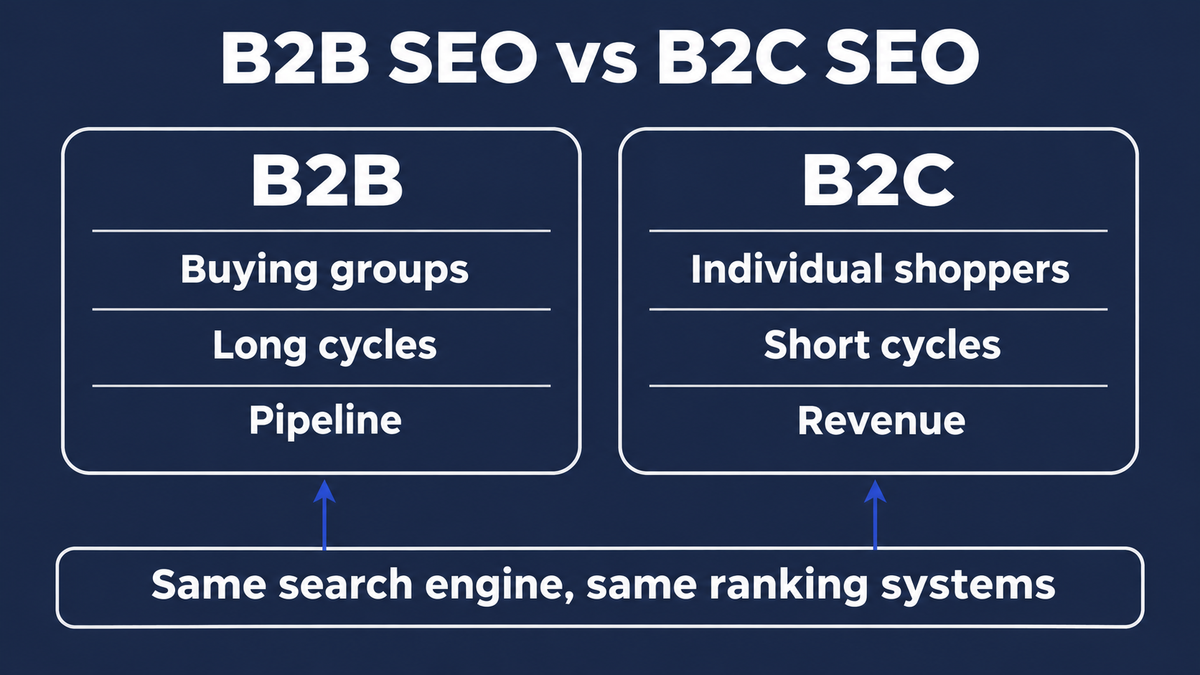
B2B SEO and B2C SEO use the same search engines and the same ranking systems. The difference is the buyer: B2B SEO reaches a small number of professionals who research as a group over months, while B2C SEO reaches many individual consumers who often decide in a single session.
Below we walk through each difference in turn, show what stays the same, and give a worked example of one SEO task done both ways. If you sell to other businesses and want a team that works this way every day, see how a B2B SEO agency approaches it.
What B2B SEO and B2C SEO Mean
Before comparing them, it helps to pin down what each term covers.
B2B SEO
B2B SEO is the work of making a company’s website visible to the professionals who buy from other companies. The goal is pipeline, not a quick sale. The searcher is usually a professional with a problem to solve, a budget to defend and colleagues to convince. It sits inside the wider world of digital marketing, next to email, events and paid media, but it is a channel buyers use to research before they ever speak to sales.
B2C SEO
B2C SEO is the work of making a website visible to individual consumers. The goal is a purchase, a booking, a call or a store visit. Online stores and local service companies are the classic examples. The customers are shoppers, and the marketing is built around product, price and convenience. Our guide to ecommerce SEO covers that side in detail.
Key Differences Between B2B and B2C SEO at a Glance
The table below sums up the key differences. The sections after it explain each row.
| Factor | B2B SEO | B2C SEO |
|---|---|---|
| Target audience | Professionals and buying groups | Individual consumers and households |
| Who decides | Several roles across the company | Usually one person, sometimes family |
| Buying cycle | Long, with research before contact | Short, often one session |
| Keywords | Narrow, technical, low volume | Broad, higher volume, more modifiers |
| Content | Guides, comparisons, case studies, documentation | Product pages, reviews, buying guides, video |
| Conversion goal | Demo, consultation or contact request | Purchase, booking, call or visit |
| Link building | Trade media, associations, partners | Consumer media, reviews, influencers |
| Main metrics | Lead quality, pipeline, revenue influenced | Orders, conversion rate, revenue |
Target Audience and Multiple Stakeholders
A consumer usually decides alone, or with a partner or family. A business purchase rarely works that way. According to Forrester’s 2024 State of Business Buying research, on average 13 people within an organization take part in a buying decision, and 89% of purchases involve two or more departments.
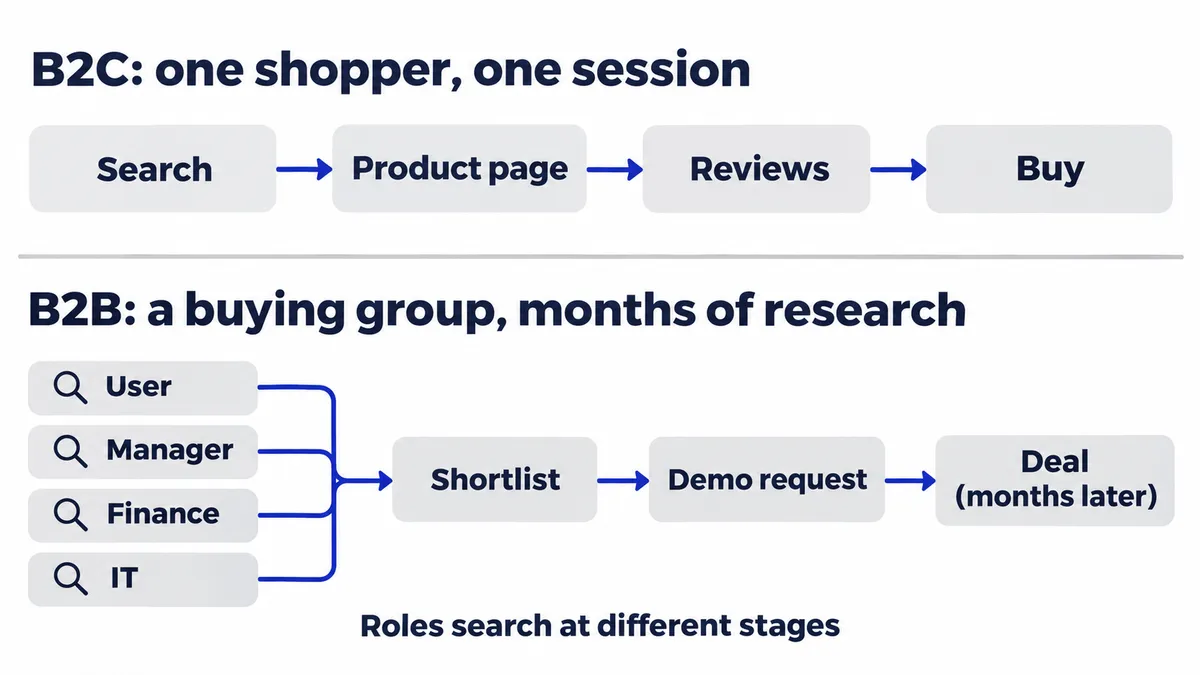
That changes who your site has to talk to. With multiple stakeholders, each role searches in a different way:
- The day-to-day user searches for features, workflows and how the product compares with what they use now.
- The finance lead searches for price, total cost and return on investment.
- IT and security search for integrations, compliance and data handling.
- The executive sponsor searches for outcomes and proof that peers got them.
Good B2B SEO maps these customer segments to pages that answer each role’s questions. Good B2C SEO usually starts from one persona and a clear product need. In both cases, the point is to understand how decisions get made before you pick a single keyword.
Buyer Journey and Sales Cycle Length
B2C journeys are often short: a quick search, a look at reviews, a purchase. Big-ticket items take longer, but the buyer is still mostly deciding alone.
B2B marketing has to cope with far longer decisions. According to 6sense’s 2025 Buyer Experience Report, as summarized by CustomerThink, the average B2B buying cycle was 10.1 months, and buyers first contacted a seller when they were about 61% of the way through their buying process. Most of the research happens before anyone fills in a form.
For SEO, that means long sales cycles need content for every stage, not just product pages. Your site has to be useful when a buyer is still naming the problem, and again when they are building a shortlist. Treat it as one of the long-term strategies in your marketing mix, because the payoff shows up months after the work. Buyers who arrive that way have already done their homework before they talk to sales, and existing customers find answers there too.
What Each Stage Needs
- Awareness: educational guides and explainers that name the problem in the buyer’s words.
- Consideration: solution pages, comparison pages and “alternatives” pages that help buyers weigh options.
- Decision: case studies, integration details, security notes and a page that explains how pricing works.
B2B Keyword Research Targets Niche Keywords, Not Traffic Volume
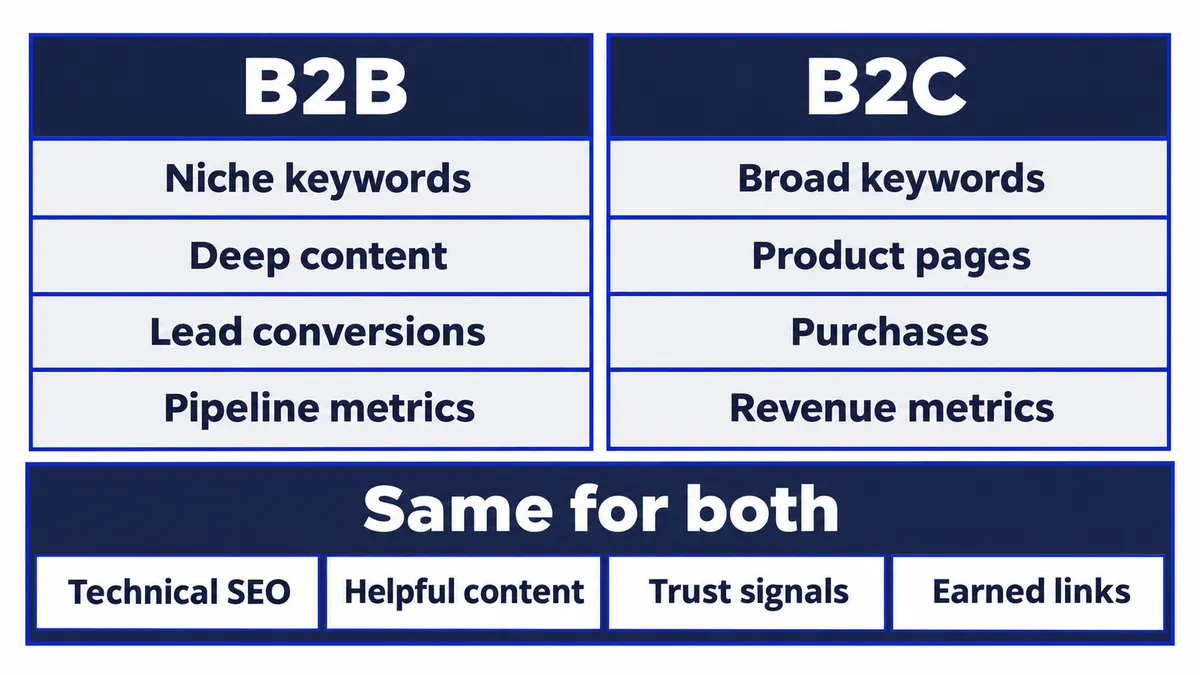
B2B keywords often look tiny in keyword platforms, and that is fine. These terms are narrower and more technical, and many show little or no search volume. A single good lead can be worth far more than a thousand casual visits, so the right move is to target industry-specific keywords that signal real buyer intent, even when they drive low volumes.
B2C keywords tend to run the other way. They are broader, with higher volume and more competition. Searchers add modifiers like “best”, “cheap”, “near me” and “reviews”, and the same head terms are fought over by large brands.
In practice, B2B keyword research leans on sales calls, customer emails and the questions prospects ask before they buy, not just on a volume column. Chasing traffic volume is the habit consumer-brand teams bring with them and then regret. For the full method, see our guide to a B2B keyword research process.
B2B Content Needs Depth and Authority
B2B buyers are risk-averse, and they read. The content that wins is detailed: guides, comparison pages, case studies, technical documentation, integration pages and cost information. Detail matters because the reader is trying to justify a decision to colleagues. Covering a subject fully, rather than publishing one-off posts, builds the topical authority that Google and buyers both notice. It is slow authority-building work, and it pays back for years.
Two practical notes:
- Don’t hide your best content. A whitepaper behind a form can’t rank. Publish an ungated summary page and keep the full PDF as the download.
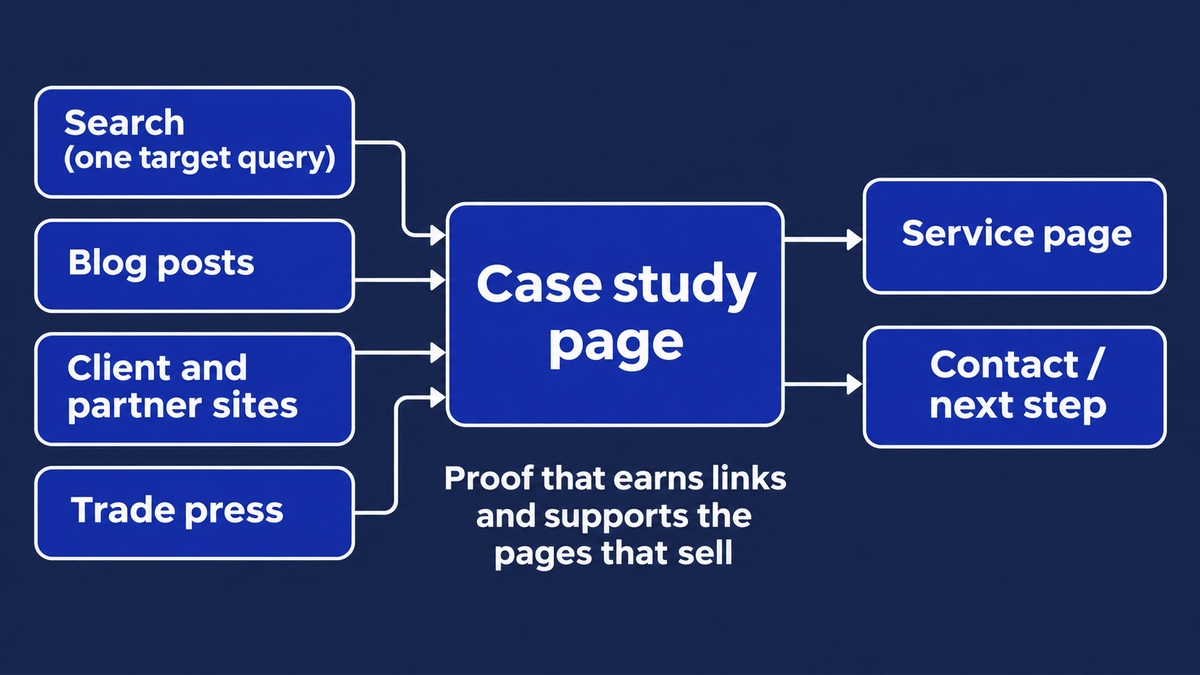
- Show proof. Case studies do double duty as credibility for buyers and as pages that can rank. We cover case studies that rank separately.
Who Writes It
B2B content usually needs input from sales, product or engineering to be believable. A generalist rewriting whatever already ranks rarely produces something a skeptical buyer will trust. For how this fits into an engagement, see how a B2B SEO engagement runs.
B2C content tends to be faster, more visual and more emotional. Product and category pages, reviews, buying guides and video do most of the work, and the page has to make the purchase easy.
Conversion Goals: Qualified Leads vs Purchases
A B2B page should convert on a step toward a sales conversation, not a purchase. The common conversions are a demo request, a consultation, a trial, a contact form, a cost inquiry or a content download.
A form fill is not the finish line, though. Leads then go through lead scoring and qualification in the CRM, where sales decides which ones are real. That is why B2B teams separate sales-ready leads from raw form fills.
B2C conversions are more direct: add to cart, purchase, booking, call or store visit. The path from landing page to money is short and easy to measure.
Cost is a good example of how the two models convert differently. Consumer product pages show prices. Many B2B companies don’t, but their buyers still look for them. A page that explains how cost is set, including what drives it and, where you are willing, typical ranges, answers a real query and earns trust.
Link Building: Specialist Sources vs Consumer Media
Consumer sites can earn links from a broad pool: consumer media, review sites, gift guides, bloggers and influencers. The pool is large, but so is the competition for those links.
B2B has fewer, more specialized sources. Think trade publications, industry associations, partners and integration directories, and original research. The links are harder to get and often worth more because the audience is exactly your buyer.
We keep tactics out of this comparison, but if you want them, read our guides to B2B link building strategies and digital PR for SEO.
Measuring B2B SEO Results Takes More Time
B2C results are comparatively simple to read: revenue from search, order rate, transactions, average order value and repeat purchases.
B2B results run through a longer chain: visibility, visits, conversions, qualified leads, opportunities, pipeline and revenue. Each step can sit weeks or months from the next.
Attribution makes B2B measurement harder. With a cycle of about ten months and a whole group involved, the person who found you through search may not be the one who fills in the form. Deals often close offline. A last-click report undercounts SEO in that world. A few fixes help:
- Add a “how did you hear about us” field to your forms.
- Pass the landing page and source into your CRM with every lead.
- Report on the pipeline that organic search started or touched, not just visits.
- Judge results over quarters, not weeks.
Our guide to SEO reporting for B2B companies goes deeper on what to put in the report.
What Stays the Same for Both
Does Google rank B2B sites differently? No. Google uses the same systems for every site. Its own documentation says its automated ranking systems are designed to prioritize helpful, reliable information that’s created to benefit people. On E-E-A-T (experience, expertise, authoritativeness and trust), Google is blunt: “Of these aspects, trust is most important.”
So the fundamentals are shared:
- A crawlable, indexable site.
- Fast, mobile-friendly pages.
- A clear site structure and sensible internal links.
- Content that matches search intent.
- Trust signals, which we explain in our guide to E-E-A-T.
- Earned links, which is the off-page half of on-page and off-page SEO.
Everything above is covered by our SEO services, whichever kind of buyer you serve. The strategy differs; the foundation doesn’t. Good marketing services in either model start from that base, then adapt the plan to the buyer. Two marketing plans can share that foundation and still look very little alike.
The Same SEO Task Done Two Ways
Here is one task, done two ways. The companies are made up: a B2B company selling fleet maintenance software, and a B2C store selling running shoes. This is an illustration, not a client story.
Choosing Keywords
The software company targets searches like “fleet maintenance software for construction companies” and “fleet maintenance software ERP integration”. Volumes are small, and every searcher is a possible buyer. The shoe store targets “best running shoes for flat feet” and “trail running shoes sale”, where volumes are larger and competition is heavy.
Building the Page
The software company builds a solution page with use cases, integrations, security notes, a case study and a demo request. The shoe store builds a product or category page with price, sizes, reviews, photos and a buy button. Product structured data helps here, since Google says sharing ecommerce data and site structure helps it find and understand content and can help products appear in Google Search.
Counting a Win
For the software company, a win is a demo request from a fleet manager at a company of the right size, tracked to an opportunity months later. For the shoe store, a win is an order that same day.
When Businesses Sell to Both
Some companies don’t fit one label. Coca-Cola is a good case. By its own description, the company creates the concentrates and syrups for its drinks, and local bottling partners mix, bottle and package the final beverages, then work with local businesses. That makes much of its business model B2B, while its consumer marketing speaks to shoppers. Netflix, by contrast, is a consumer subscription service, so B2C.
Many other businesses sit in the middle: software with self-serve plans and enterprise sales, or wholesalers that also run retail stores. For these hybrid businesses, the advice is the same. Separate the two audiences with their own pages or sections, their own keywords and their own paths to a sale. One page trying to serve a buying committee and a casual shopper usually serves neither.
How AI Search Changes Both Models
Both models now show up in AI Overviews and AI assistants. Business buyers use these assistants to research vendors and build shortlists. Gartner research reported by Distribution Strategy Group found that 45% of B2B buyers used AI during a recent purchase.
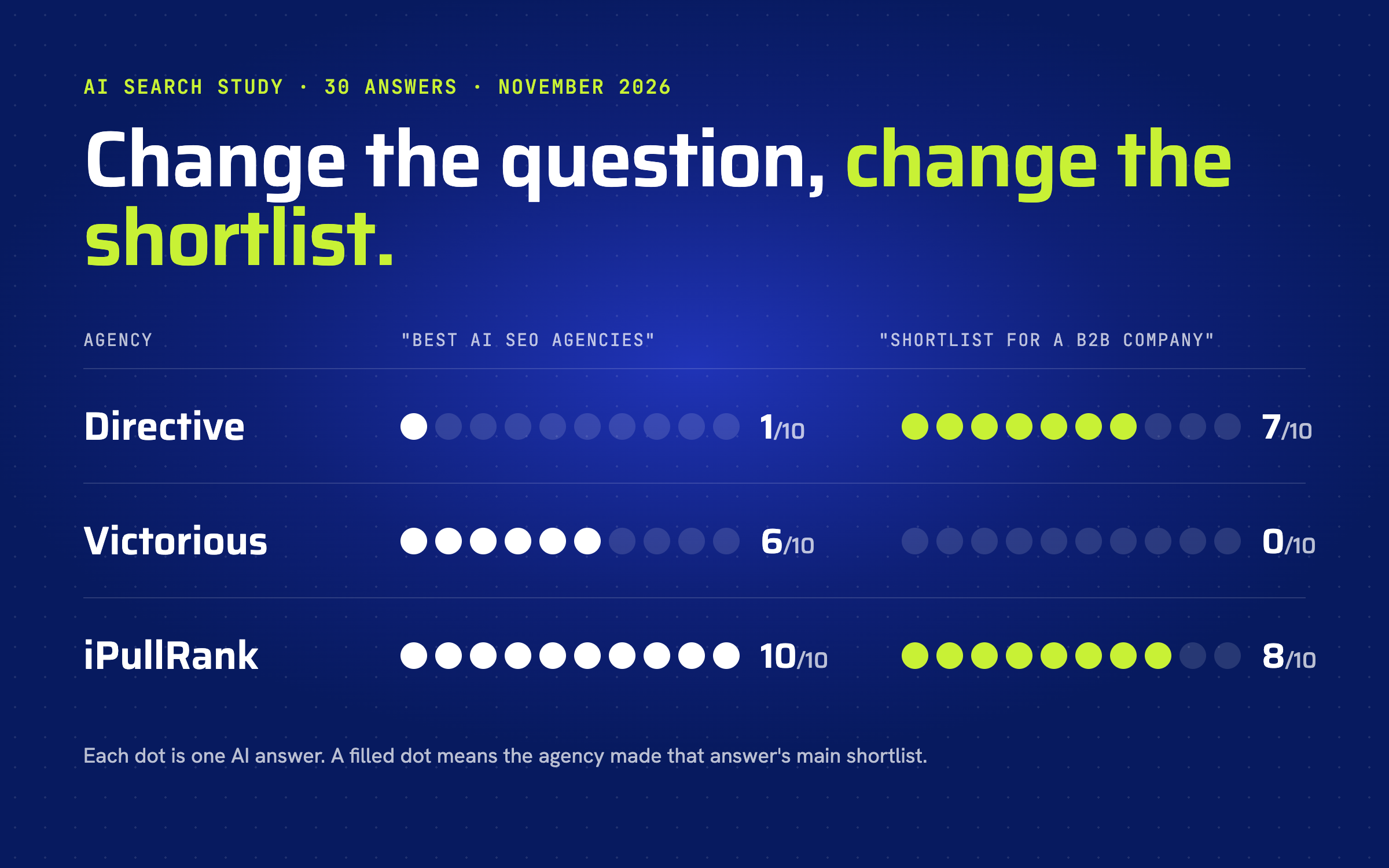
Early AI research matters more in B2B because shortlists form early, and, as the 6sense figure above shows, buyers talk to sellers late. Being named in AI answers for problem and comparison questions can decide whether you make the list. In our study of AI SEO agency recommendations, adding a B2B buying scenario to the question changed which agencies were named. B2C sees the same shift in shopping and product questions.
The foundation is still SEO. Learn how generative engine optimization builds on it, and how to track your AI visibility over time.
Choosing the Right Approach
The right strategy follows how your customers decide. Digital marketing has no single playbook, and SEO is no exception. If a group of professionals researches for months, plan for depth, patience and pipeline metrics. If one person decides quickly, plan for reach, product pages and conversion rate. If you’d like a second opinion on which model fits you, talk to us about your search strategy.
Frequently Asked Questions
Is Coca-Cola a B2B or B2C company?
Both. The company makes the concentrates and syrups for its drinks, and local bottling partners turn them into finished beverages and distribute them through local businesses. That trade relationship is B2B. Its consumer marketing, and most of its public-facing content, speaks to consumers, which is B2C.
Is Netflix B2B or B2C?
Netflix is B2C. It sells a subscription directly to consumers, so its SEO is built around viewers looking for shows, films and the service itself.
What is the difference between business and consumer digital marketing?
The channels are largely the same, but the buyers differ. B2B marketing persuades groups of professionals over longer cycles using expertise and proof. B2C marketing persuades individuals faster using brand, price and convenience. SEO follows the same split.
What is SaaS SEO for software companies?
SaaS SEO is B2B SEO for software companies. It targets problem, solution, comparison, alternative and integration searches, and it treats a demo or trial request as the conversion. Many SaaS companies also offer a self-serve plan, so they often run a B2C-style path alongside it.
Does Google rank business websites differently from consumer websites?
No. Google uses the same ranking systems for every site, and they reward helpful, reliable content from trustworthy sources. What differs is the queries, the competition and what a good answer looks like for that searcher.
Is it harder to rank when selling to other companies?
It is different, not harder. B2B has lower search volumes and fewer link sources, but often less competition per keyword and more value per lead. B2C usually faces more competitors and bigger brands on broad terms. B2B results take longer to show up in revenue because of the buying cycle.

Written by
Adriaan van Swieten
Adriaan leads Stijg Media and works directly on search, AI visibility, websites, and local growth strategy.
Meet Adriaan