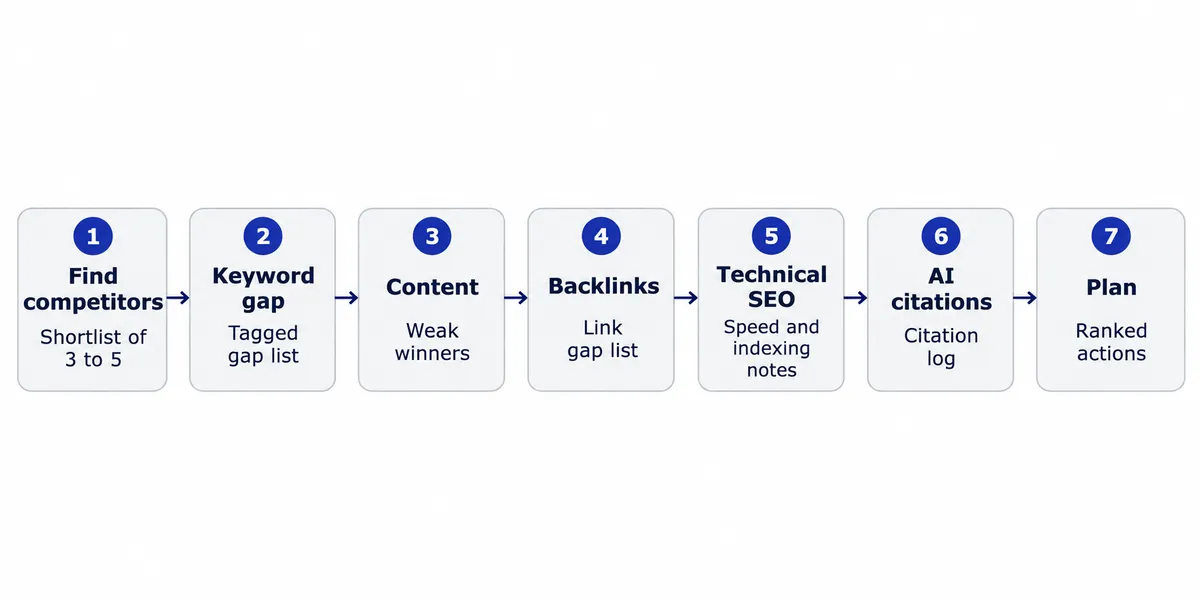
A B2B SEO competitor analysis is a structured look at which sites win the Google searches and AI answers your buyers use, why they win, and where you can take ground from them. This guide gives you seven steps, a table of tools and a template you can copy into a spreadsheet.
Business buyers behave differently from consumers. The keyword sets are small and high in value, the buying cycle is long, and the sites that beat you are often publishers, review sites and software vendors rather than the companies you lose deals to. If you want help with the work, see how a B2B SEO agency like ours approaches rival sites and AI citations.
What a B2B competitive analysis for search covers (and what it doesn’t)
A competitor analysis for SEO looks at how rival sites perform in organic search: the keywords they hold, the content that wins, the backlinks behind it, their technical health and, now, the sources AI answers cite. It is narrower than general competitive intelligence, which also covers pricing, positioning and product features. It is not a SWOT or a pricing study.
By the end you should have these outputs:
- A shortlist of three to five competitors
- A list of missing keywords, tagged by intent and funnel stage
- A list of content gaps and weak competitor pages
- A link gap list
- A technical comparison
- An AI citation log
- A ranked action plan
Our SEO services follow the same sequence, because each output feeds the next one.
Why competitor analysis works differently in B2B
Search volume is a poor guide in B2B marketing. A keyword with 30 searches a month can matter more than one with 3,000 if the person typing it is comparing vendors and has a budget. We would rather win ten queries that buyers make late in their decision than chase one broad term that brings readers who will never buy.
Three more things change the work:
- Several people look. The end user, the technical evaluator and the budget owner each type different questions.
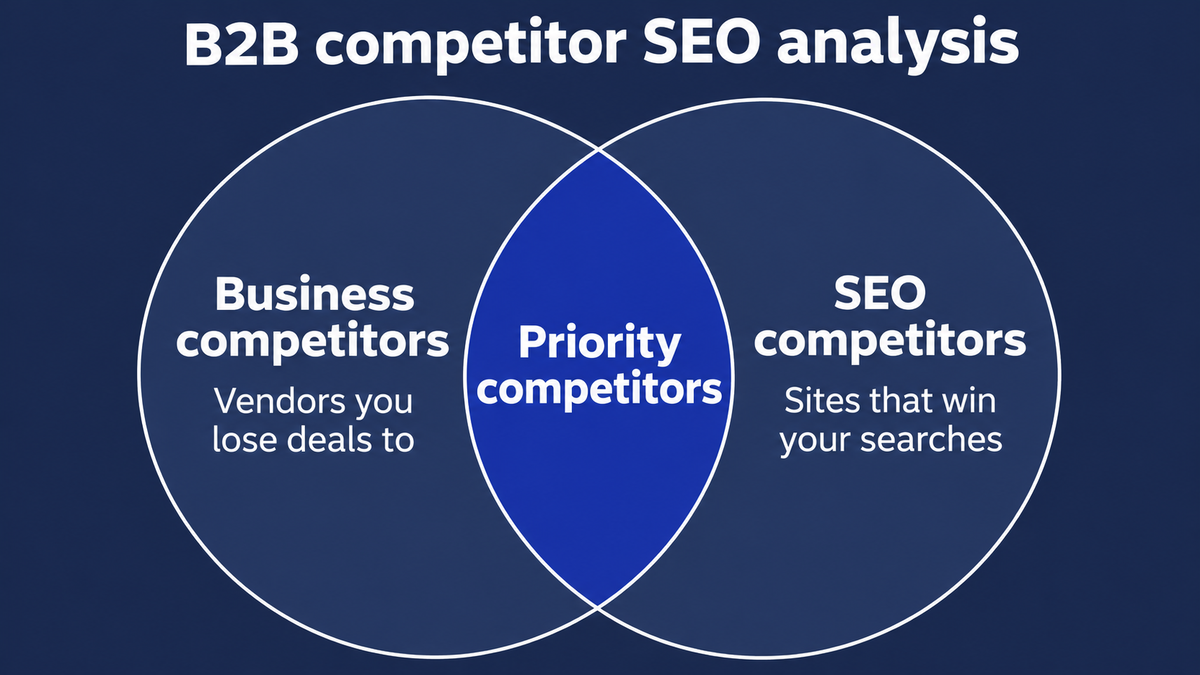
- Your SEO rivals are not always your business rivals. A trade publication can own the top three results for your best keyword without selling anything.
- Cycles are long. Content can take months to turn into a deal, so judge each opportunity by fit with your offer, not by quick traffic.
If one company keeps outranking you, our post on why a competitor outranks you covers the quick checks to make before a full review.
Step 1: Identify your real SEO competitors
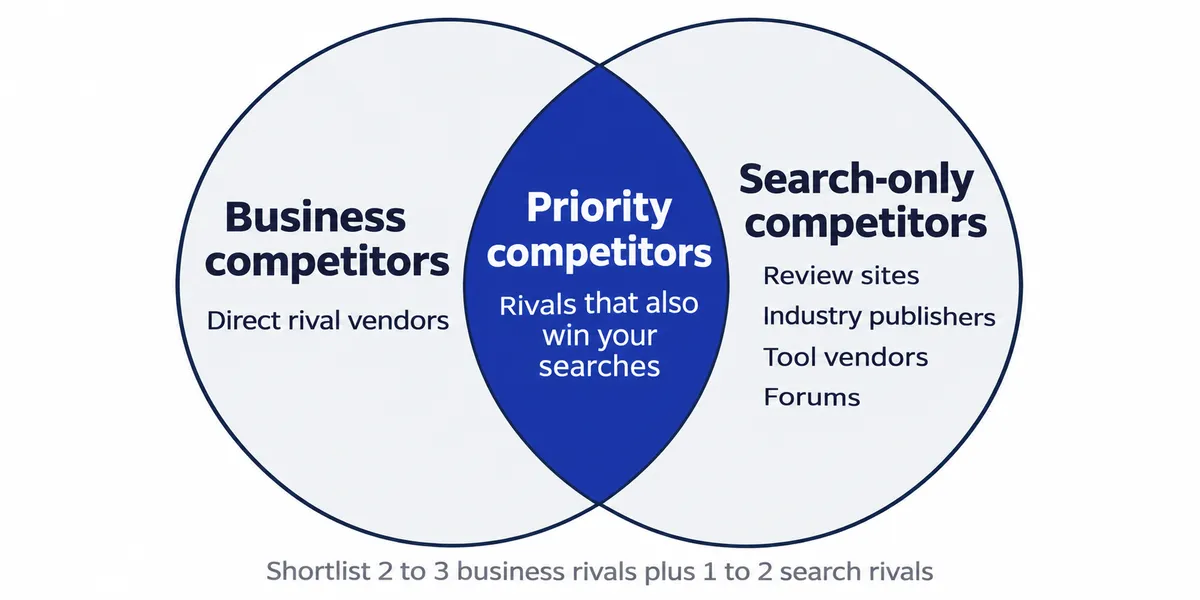
Take 10 to 20 keywords that a buyer would type when they have a problem you solve, then check who holds the top 10 results. Use a logged-out or incognito window set to your target country. Write down every domain that shows up more than once. Those repeat winners are your competition for attention.
Sort what you find into types, because each type teaches you something different.
| Type | What you’ll see | What to learn from them | Treat as a target? |
|---|---|---|---|
| Direct rival vendors | Solution and product pages | Page types, offers, proof | Yes |
| Review and comparison sites | Category listings and “best of” lists | Which criteria buyers compare | Partly: learn from them, try to get listed |
| Industry publishers and trade media | Guides, news, studies | Topics buyers trust and cite | Partly: pitch them, match their depth |
| Tool vendors | Free tools, templates, how-to guides | Formats that earn mentions | Yes, if they cover your topic |
| Agencies and consultants | Service pages, blog posts | Positioning and depth | Yes |
| Forums and communities | Reddit and Q&A threads | The real wording of questions | No: use as input |
We recommend a shortlist of three to five for the deep dive: two or three business rivals plus one or two pure search rivals. The results for this very topic show the pattern. Tool homepages and listicles sit next to long guides, so no single format will beat all of them.
Step 2: Run a keyword gap analysis
A keyword gap is the list of keywords your competitors rank for that you do not. The idea is simple, and every major SEO platform has a version of it. Read the output as a list of questions, not a to-do list: each term needs a decision about whether it fits your offer before it earns a page.
In Semrush, the gap tool offers a side-by-side comparison between keyword profiles of up to five domains. Its “Missing” view shows terms where all your competitors appear and you do not. “Untapped” shows terms where at least one competitor appears and you do not. In Ahrefs, the Content Gap tool takes the full keyword list of a competitor and subtracts the ones your own site already covers, and you can filter to terms that any, at least a set number, or all of the competitors cover.
This step of the competitor analysis only covers the gap against rivals. The full method for finding and grouping terms, including volumes and clusters, lives in our B2B keyword research process.
Filter by search intent and funnel stage
A raw list of keywords is full of junk. Remove job-seeker terms, student questions and pure definitions that no buyer needs. Then tag what is left:
- Problem-aware: the buyer describes a pain, not a product
- Solution-aware: the buyer knows the category and compares approaches
- Vendor comparison: the buyer names vendors or asks for alternatives
- Pricing: the buyer wants cost or packages
Search intent decides how you answer each one, and the tag tells you which stage of the buying journey you are filling. A gap full of problem-aware terms points to education work. A gap full of comparison terms points to commercial pages, which usually pay back faster.
Don’t drop low-volume terms
A term with 10 to 50 searches a month often has a clear buyer behind it. Keep it when the intent is strong. Judge it by who is looking, not by the number in the tool.
Check competitors’ Google Ads keywords
Tools such as SpyFu and Semrush also show the keywords rivals buy in Google Ads. If a competitor keeps paying for a term month after month, it probably converts for them. Add those keywords to your list and note whether you have content for them.
Step 3: Compare content strategy and page types
For each priority keyword, open the URLs that rank and note what a buyer sees. Do this by hand for your top 10 to 20 terms. A short checklist keeps the notes comparable:
- Type: guide, comparison, solution page, pricing page or glossary entry
- Depth and freshness: word count is a weak signal, but the date and the detail are not
- Formats: tables, calculators, templates, diagrams
- Proof: case studies, original findings, named authors, customer quotes
- Calls to action and next steps
Look for weak winners, which are ranking URLs that are thin, outdated or generic. They are the easiest to beat, because a more complete page with real proof can replace them. Compare author and proof signals against what Google describes as E-E-A-T when you judge who has earned a spot.
Do not copy the top result. Matching it makes you the second-best version of the same thing. Beat it with something it lacks, such as a clearer definition, a better comparison or first-hand experience. This is where your own content strategy gets shaped: you decide which topics you will cover deeper than anyone, and which you will skip.
A quick illustration, with made-up details: say a rival’s comparison page appears for several vendor-alternative keywords, but it was last updated two years ago and lists features the product no longer has. That is a gap with a visible weakness, and it sits close to a buying decision. Now say a publisher holds the top spot for a broad definition keyword with a thorough guide. That is a gap too, but you would need real depth to compete, and the readers are early in their research. The first goes near the top of the plan.
Step 4: Backlink analysis, or where their authority comes from
A link comparison shows why a competitor’s page performs even when its content looks average. Compare referring domains, not raw counts, because a hundred backlinks from one site count for far less than backlinks from a hundred sites.
Look at which competitor pages earn those links. In this market it is often a free tool, a study or a template, not the homepage. Then run a link gap analysis: find the sites that point to two or more of your competitors but not to you. Those are your warmest prospects.
Check the age of those backlinks as well. A page that earned them years ago from sources that still matter has a durable advantage, while a page that gained a burst of mentions last month may be the result of a campaign you can study. Common sources worth checking are industry associations, partner and integration directories, podcasts and trade media. Once you have the list, B2B link building strategies explains what to do with it, so we won’t go into outreach here.
Step 5: Compare technical SEO
Keep the technical SEO comparison short. You are looking for gaps big enough to matter, not perfect scores. Compare:
- Indexability: whether key URLs are crawlable and indexed
- Site structure and internal paths to the money pages
- Page speed and Core Web Vitals
- Mobile experience
Core Web Vitals are LCP, INP and CLS. The “good” thresholds are LCP within 2.5 seconds, INP at 200 milliseconds or less and CLS at 0.1 or less, assessed at the 75th percentile of loads. INP replaced FID as a Core Web Vital on 12 March 2024, so any report that still lists FID is out of date.
PageSpeed Insights shows field data from real users where it is available, which makes it a fair way to compare your domain with a competitor’s. For context on how much this matters, read how much site speed matters for SEO, and for the wider split of work see on-page versus off-page SEO.
Step 6: Check which competitors AI answers cite
AI Overviews, AI Mode, ChatGPT and Perplexity now answer many research questions directly. The sources they cite are a second competitor list, and it often differs from the one in the results.
A simple method for checking AI citations in your market:
- Write 15 to 30 questions a buyer would ask, from first questions to vendor comparison.
- Run each one in the same assistants, under the same conditions, each month.
- Log which brands are mentioned, which domains are cited and how your company is described.
- Note the cited sources and what they share.
Sources that AI answers cite tend to have clear definitions, comparison tables, original findings and mentions from third parties. That fits what Google says. There are no additional requirements to appear in AI Overviews or AI Mode, and a page must be indexed and eligible to show with a snippet. Traffic from these features counts under “Web” in the Search Console Performance report. The advice to site owners is to make unique, non-commodity content.
To keep this check going over time, read how to track AI visibility. To see whether the sites AI cites are also the ones that rank, read our post on whether AI citations follow organic rankings. The wider practice is covered on our pages for generative engine optimization and answer engine optimization.
Step 7: Turn the findings into a prioritised plan
SEO findings without a ranked plan are just a spreadsheet. Score each opportunity on three things: how well it fits what you sell, how weak the competing content is, and how much effort it takes. Rate each from 1 to 3, where a higher number is better (so low effort scores 3). Then add them up.
This scoring table is an example only. The opportunities are made up to show the method.
| Opportunity | Funnel stage | Fit (1-3) | Competitor weakness (1-3) | Effort, inverted (1-3) | Score | Owner |
|---|---|---|---|---|---|---|
| Comparison page against the category leader | Vendor comparison | 3 | 2 | 2 | 7 | Content lead |
| Pricing explainer | Pricing | 3 | 3 | 3 | 9 | Marketing manager |
| Integration guide | Solution-aware | 2 | 2 | 1 | 5 | Product marketer |
As a rule of thumb, start with bottom-of-funnel gaps where a competitor’s content is weak, then move to mid-funnel, then to broad education. Fit counts most. A weak competitor page on a topic you can’t credibly speak about is a trap, not an opportunity.
Turn the top of the ranked list into a content strategy for the next quarter: name the pages you will build or rewrite, the person who owns each one and the date you will check results. A plan with no owner tends to stall, and the marketing team then ends up with a report nobody uses.
After you act, track progress against the same list. Our guide to SEO reporting for B2B teams shows how to report positions and share of voice against competitors.
Competitor analysis tools for SEO
There is no single best tool for competitor analysis. Most teams pair one all-in-one suite with free tools from Google and a few manual checks. Whichever you pick, give each tool one job in your process so the numbers stay comparable from one quarter to the next.
| Tool | Best for in a competitor review |
|---|---|
| Semrush | Missing and untapped terms, traffic estimates and ads research |
| Ahrefs | Content gap, backlink analysis and Site Explorer |
| SpyFu | Competitors’ paid campaigns and organic history |
| SE Ranking | An all-in-one suite with competitor research and a rank tracker |
| Google Search Console | Your own queries, impressions and average position |
| PageSpeed Insights | Core Web Vitals for your URLs and theirs |
| Manual lookups and AI assistants | Live results and AI citation checks |
Treat traffic data in any tool as estimates. They are good for comparing sites with each other and poor as absolute numbers. Use the suite for SEO monitoring too: set up alerts for new competitor content and new inbound links, so the next review starts with fresh material.
A simple competitor analysis template
Copy this competitor analysis template into a spreadsheet, with one row per competitor. Fill it in as you work through the seven steps.
| Competitor | Type | Priority keywords they win | URLs that win them | Referring domains to top URLs | Technical notes | Cited in AI answers? | Our move |
|---|---|---|---|---|---|---|---|
| Example Vendor A | Business rival | (add terms) | (add URLs) | (add count) | (add notes) | Yes or no | (add action) |
| Example Publisher B | Search rival | (add terms) | (add URLs) | (add count) | (add notes) | Yes or no | (add action) |
Keep the sheet current and refresh it each quarter. Share it with sales as well as marketing, since the sales team hears which rivals come up in calls and can tell you when a competitor you had not listed starts appearing in deals. Add a column for the date, so you can see what changed since the last run.
How often to repeat it, and mistakes to avoid
We recommend a full SEO competitor review every quarter or before each content planning cycle. Check rankings and AI citations for your priority set each month, and run an extra check after a major Google update or a competitor launch.
Common mistakes
- Studying only business rivals and missing the publishers that own your searches
- Chasing volume over intent
- Copying the top result instead of beating it
- Ignoring AI answers
- Collecting data without a ranked plan
- Treating tool traffic estimates as facts
If you would rather have an expert run the research for your market, you can talk to us about a competitor analysis and we will tell you where the biggest gaps are.
Frequently Asked Questions
What is the best tool for competitor research?
No single tool is best. Most teams pair one all-in-one suite, such as Semrush or Ahrefs, for keyword and backlink gaps with free tools like Search Console and PageSpeed Insights. SpyFu adds value if your rivals run paid campaigns. Pick the suite your team will actually open every month.
How do you research your SEO competitors?
Start by listing the sites that win your buyers' searches, then compare their keyword sets against yours for three to five of them. Compare the pages that rank, their referring domains and their technical health. Next, log which brands AI answers cite, and finish by scoring every gap so you work on the highest-value ones first.
How many competitors should a team study?
Three to five for the deep dive: two or three business rivals plus one or two sites that win your searches but do not sell what you sell. You can track a wider list lightly, but a deep dive on ten sites mostly produces noise.
How often should you repeat the research?
Run the full review every quarter or before each content planning cycle. Check rankings and AI citations for your priority set every month. Add an extra run after a major Google update or when a competitor launches a new product or site.
What is B2B in SEO, and how does the competitor analysis differ?
B2B SEO is optimization aimed at business buyers. Searches are fewer, deal values are higher, several people take part in each decision and cycles run long. That means you weigh intent and fit with your offer above volume, and you include publishers and review sites in the competitor set.

Written by
Adriaan van Swieten
Adriaan leads Stijg Media and works directly on search, AI visibility, websites, and local growth strategy.
Meet Adriaan