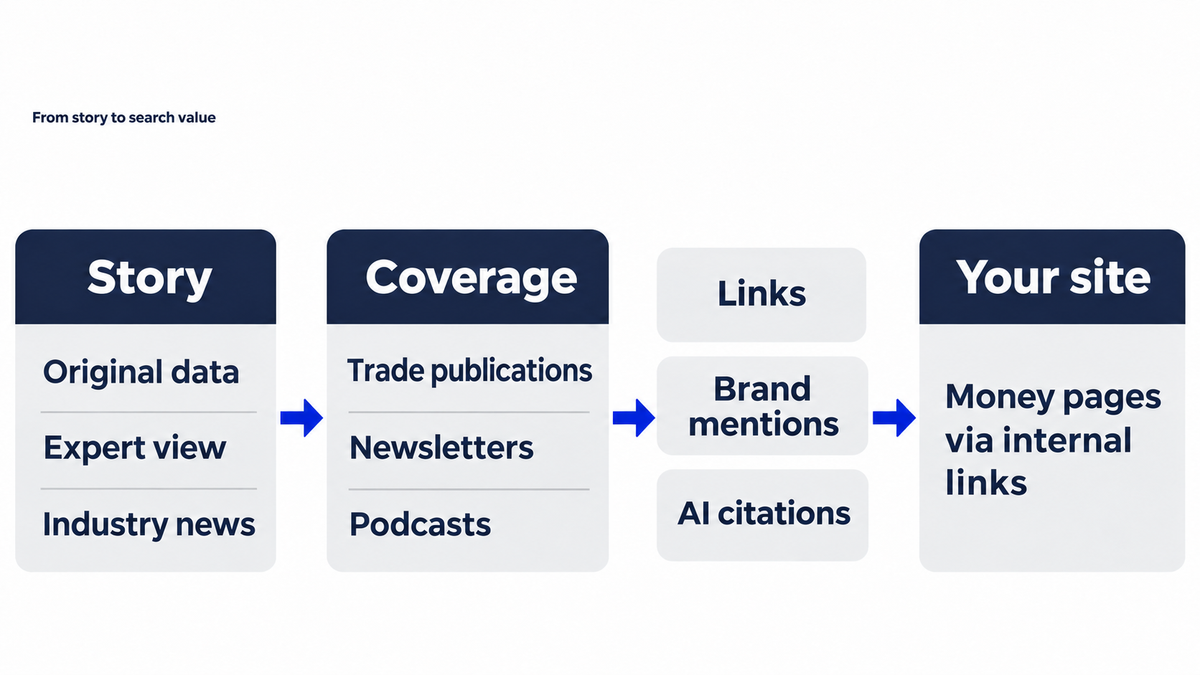
Digital PR for B2B companies is the practice of earning coverage in online publications, trade media and industry newsletters, so that those sites link to you, mention you and get cited alongside you. For search, that coverage is how a B2B site builds the kind of authority Google’s link systems and AI assistants look for.
This guide is for B2B marketers, founders and search leads who want to know whether PR is worth the effort, how it works for a company with a small buyer pool, and how to run a programme that ends in rankings instead of a clipping file. We cover the definition, the mechanism, the tactics, a step-by-step process, how to send authority to your money pages, and how to measure it.
We run this kind of off-page work as part of our B2B SEO services, so what follows is a working method, not theory. We have not published digital PR case results, so you will not find invented numbers here. Where we cite a figure, it links to the source.
What Digital PR Is (and What It Isn’t)
Digital PR is the practice of securing media coverage on websites, newsletters and podcasts that your buyers read, and earning links and mentions from it. It borrows the craft of public relations (finding a story, pitching journalists, building relationships) and points it at an online result: links that send authority to your site and mentions that tie your brand to a topic.
Digital PR sits inside off-page work. If you want the wider picture of on-page and off-page work, start there. Few off-page activities produce links that a search engine treats as genuine editorial votes, because a journalist chose to write about you.
Most digital PR output is coverage you did not pay for, written by someone else. That is why it carries weight with readers and with search engines.
Digital PR also overlaps with wider content marketing. A good campaign gives your content team material for months: the research becomes articles, a webinar, sales enablement and a talking point for account managers. Treat it as part of your digital marketing mix, not an isolated stunt, and the same work pays off in more than one place.
Digital PR vs Traditional PR
Old-school PR measures mentions, audience size and sentiment. A print feature with no link is still a win. Digital PR keeps those aims and adds three questions: does the coverage link to us, which page does it link to, and is the outlet relevant to our topic?
The channels also differ. Classic PR leans on print, broadcast and events. Digital PR works through online outlets, newsletters, podcasts and the journalists who write for them, and it treats a link as a deliverable instead of a bonus.
Digital PR vs Link Building
Link building is the goal. Digital PR offers one route to it. Where outreach for guest posts, directories or link exchanges asks a site owner for a placement, digital PR gives a journalist a reason to cover you and lets the link follow from the story. We cover the full range in the full list of other B2B link building strategies, so we will keep this page on the PR side.
| Traditional PR | Digital PR | Link building | |
|---|---|---|---|
| Main goal | Reputation and awareness | Coverage that earns links and mentions | Links to specific pages |
| Typical output | Features, interviews, event mentions | Articles, quotes, data coverage, podcast spots | Placed links, listings, partner links |
| How success is measured | Audience size, mentions, sentiment | Relevant links, mentions, referral visits, AI citations | Links gained, rankings |
| Who it reaches | General or sector audience | Readers of online outlets and the journalists behind them | Search engines first, readers second |
| Effect on search | Indirect | Direct and indirect | Direct |
How Digital PR Improves B2B Search Rankings
Digital PR improves B2B rankings in four ways: it earns editorial links, it builds brand mentions that confirm what you are known for, it sends relevant visitors, and it feeds the sources AI assistants cite. Each works on its own, and together they build one signal: other credible sites treat you as a source on your topic.
Editorial Links From Relevant Media Outlets
Links from real publications remain the main ranking lever PR pulls. The documentation from Google says PageRank “continues to be part of our core ranking systems”, which means links from other sites still carry weight.
For a B2B company, relevance matters more than a big name. A link from a respected trade title in your sector tells search engines more about your topic than a link from a general news site that covers everything. It also puts you in front of people who might buy.
Brand Mentions and Entity Trust
Brand mentions work through a simple mechanism. Search engines and AI systems read the web the way an analyst would: who gets named in connection with which topic, and by whom?
When your company keeps appearing next to your topic in credible places, search engines and AI systems learn to connect the two. That is entity trust, and it lines up with what is known as E-E-A-T: experience, expertise, authoritativeness and trust.
A mention without a link will not pass PageRank, but it still helps. It supports your brand’s reputation, and it gives you something to ask a publication to turn into a link later.
Referral Traffic That Can Reach Buyers
A trade article read by your buyers sends visits that behave differently from a viral consumer hit. The audience is smaller, but it is the right audience, and a long B2B sales cycle means people come back to the article and share it with colleagues. Track these visits and the conversions they assist, not only the raw count.
Citations in AI Answers
AI assistants cite earned coverage far more than anything you publish or pay for. Muck Rack’s analysis of more than 25 million links cited by ChatGPT, Claude and Gemini found that earned media accounted for about 84% of citations, while paid and advertorial content made up 0.3%. Journalism alone was 27% of the sources.
Earned coverage is why digital PR now matters for AI search as well as classic search. If you care about generative engine optimization, sometimes called AI SEO, coverage in trusted publications is one of the inputs you can influence. The same pattern explains how ChatGPT decides which companies to recommend. It is the same earned coverage, read by a different system.
A fair question is how much of this is ranking work and how much is brand work. Both. The links and mentions feed your website’s SEO efforts, while the brand recognition shortens sales conversations later. Keep both aims in view when you judge the work, and you will avoid the common mistake of calling it a failure because the clippings were not the ones you hoped for.
Why B2B PR Works Differently From Consumer PR
B2B PR works differently from consumer PR because the audience is smaller, the buyers are specialists and the product is rarely a story on its own. A tactic that wins a consumer brand national headlines can leave a B2B company with a viral link and no buyers.
Your Target Audience Is a Buying Committee
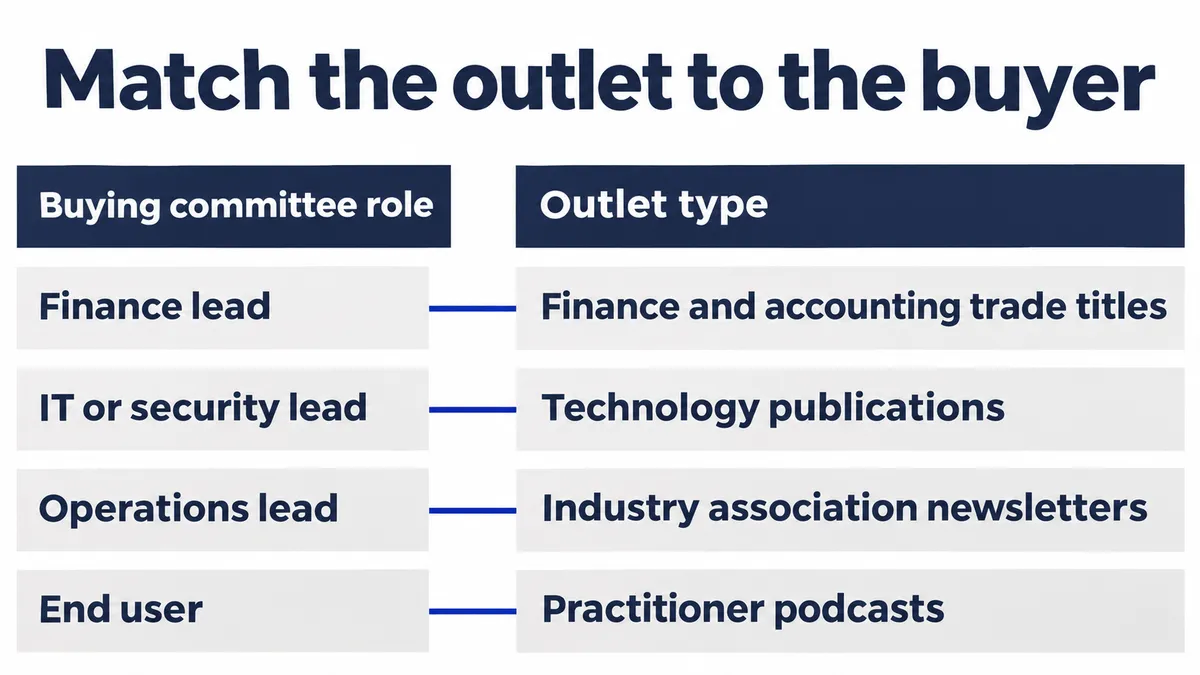
A B2B purchase is rarely one person’s call. Finance, IT, operations and the end user each read different sources, and each needs a different reason to trust you. Your target audience is that committee, not a single persona.
A useful exercise is to map outlets to roles:
- Finance lead: finance and accounting trade titles, analyst blogs
- IT or security lead: technology publications, vendor-neutral newsletters
- Operations lead: industry association sites, sector news
- End user: practitioner podcasts, community newsletters
Long sales cycles help here. Coverage gets re-read and forwarded internally for months, so one relevant article can do work well after it goes live.
Trade Publications Often Beat National Headlines
Industry publications, association sites, niche newsletters and practitioner podcasts have smaller audiences but much higher relevance, and they are easier to land. Their editors need steady, useful material from people who know the industry.
A national outlet is worth chasing only when you have data that can interest a broader audience. Otherwise, a national mention can be a distraction: impressive in a slide, thin on buyers.
Small Markets Need Sharper Stories
Journalists cover what their readers need. Your product launch is rarely that. What does work for a specialist audience:
- Data readers cannot get anywhere else
- An expert view on the week’s industry news
- A practical how-to from someone who does the work
- A clear explanation of a regulation or standard that affects buyers
If your product feels dry, the story is almost always in what you know that your market does not.
B2B Tactics That Earn Press Coverage
These digital PR tactics reliably earn coverage for B2B companies. We describe the type of asset for each, because the right one depends on what your company knows.
Original Research and Data-Backed Content
Original data is the strongest asset in B2B because trade journalists rarely have time to gather their own. Sources worth considering:
- Anonymised, aggregated data from your own product
- A short survey of your customers or your industry
- Public datasets combined with your analysis
- Benchmarks that show how companies in a sector compare
Data-backed content gives a journalist a number to quote and a reason to link. Practitioners agree on where the value lies. In BuzzStream’s 2026 survey of more than 150 digital PR practitioners, 85.8% said building backlinks is the most effective use of digital PR.
Expert Commentary and Thought Leadership
Make one or two subject experts available to the press. That means responding to journalist request services, offering comment on stories in your sector and writing bylined pieces for trade titles. In B2B, the influencers worth knowing are analysts, podcast hosts and newsletter writers, and many of them find sources on social media, especially LinkedIn. Good thought leadership here is specific and opinionated, written by someone who does the work, not a general essay about the future of your field.
Expert commentary is also the cheapest tactic to start. It costs expert time and a habit of replying fast.
Reactive PR on Industry News
Regulation changes, funding rounds, outages and earnings in your industry all create a short window in which journalists want an informed view. A fast, useful comment wins the quote. Prepare for it: know who your spokespeople are, agree on topics they can speak to and keep a way to get approval quickly.
Press Releases: Useful, but Not for Links
The release still has a place. In Cision’s 2025 State of the Media survey of more than 3,000 journalists in 19 markets, 72% said the release is the most useful thing PR teams provide.
But writing a release to get links is a weak plan. Google’s spam policies list “links with optimized anchor text in articles, guest posts, or press releases distributed on other sites” as link spam. Muck Rack’s AI citation analysis also found direct wire links are a negligible share of what assistants cite. A release earns its keep when a journalist reads it and writes their own article.
Customer, Partner and Product Stories
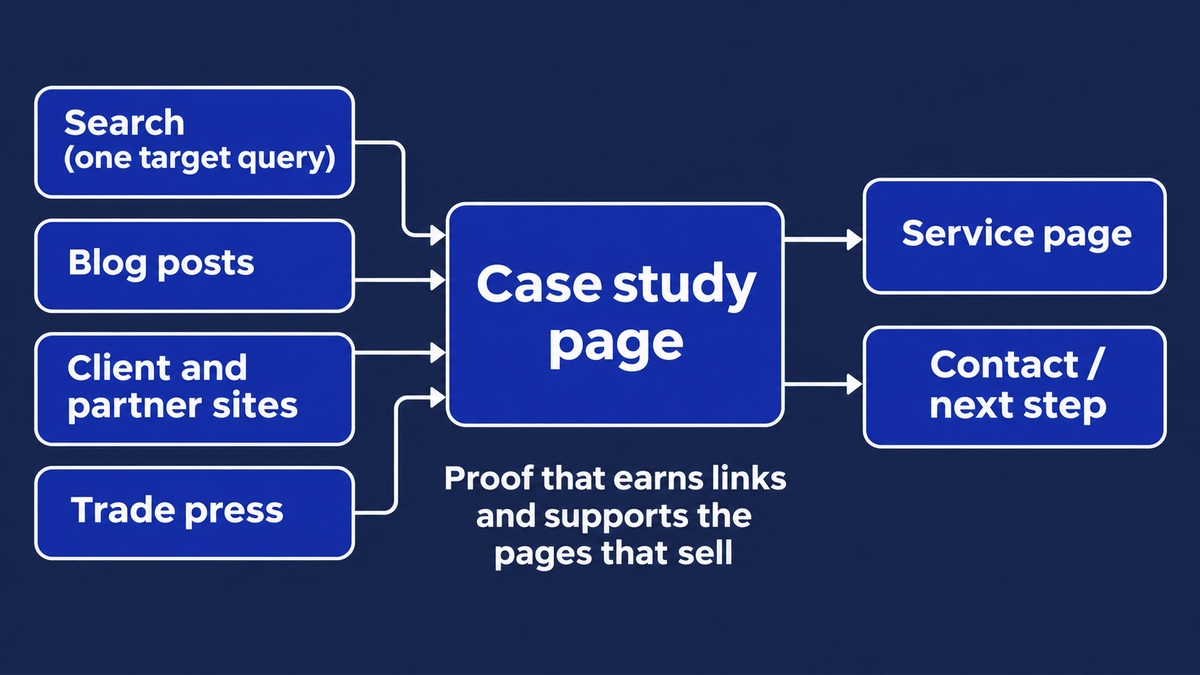
Joint stories with customers and partners, integration launches and case-led features give a trade outlet something concrete to cover. A SaaS company can pair a partner integration with real usage data. Treat finished case studies as press assets too: our advice on turning case studies into pages that rank covers how to build them so they earn attention on their own site.
How to Run a Campaign for Search, Step by Step
A search-focused digital PR campaign follows six steps. Each step ends with an output, so you can tell whether it is done.
Step 1: Pick the Pages You Want to Rank
Start from your priority service and solution pages and the keyword clusters behind them. PR works best when it supports pages that already deserve to rank. This is the same logic as how a full B2B search programme runs, with PR slotted in as the off-page workstream.
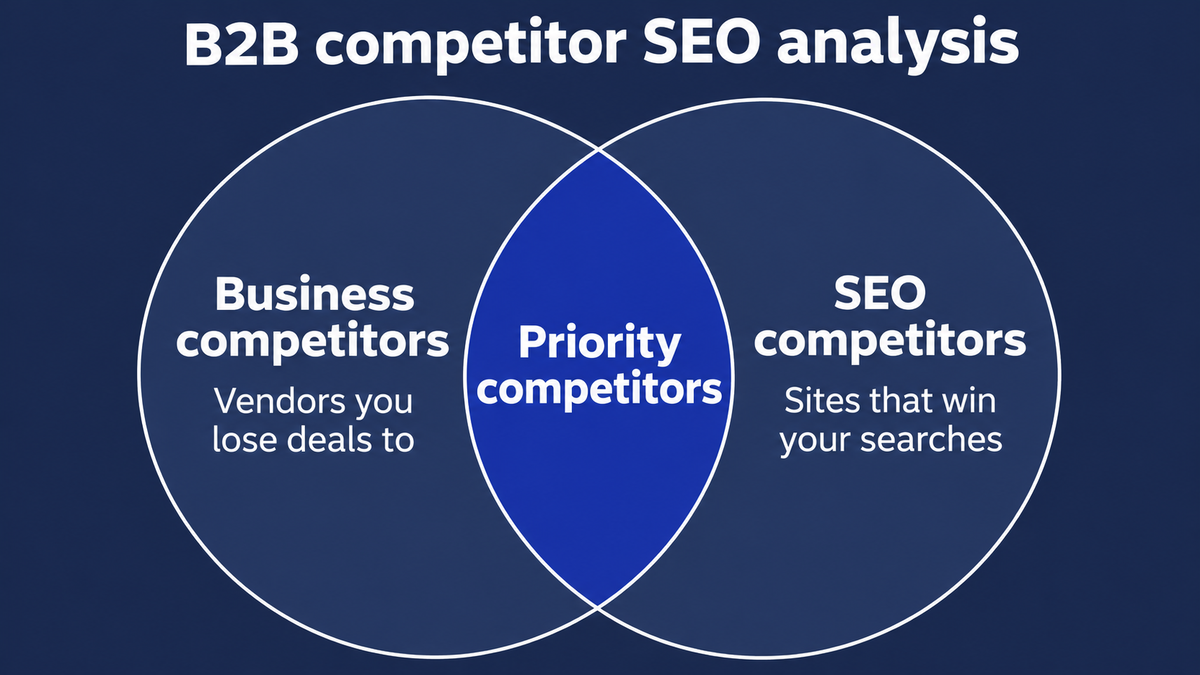
Check which outlets already link to your rivals with a competitor analysis. Those sites have shown they cover your sector. Output: a short list of target pages and topics.
Step 2: Find a Story Your Industry Will Care About
List what your company knows that its market does not: product data, customer patterns, a view on a regulation, a clear contrarian take. Then test each idea against one question: would a trade editor run this even if our name were not on it? Output: one angle and a one-line headline for it.
Step 3: Build the Asset
Put the story on your own site first. That could be a report page, a data page, an expert article or a small tool. Plan its internal links to your service pages before anyone links to it (more on this below). Output: a live page that journalists can cite.
Step 4: Build a List of Outlets and Journalists
Choose media outlets by beat and buyer role, not by domain authority. For each target, note what they covered in recent months and who in your buying committee reads them. Thirty well-chosen contacts beat three hundred pulled from a database. Output: a target list with a reason to pitch each one.
Step 5: Pitch Journalists and Engage With Replies
Keep the pitch short, personal and built around one angle. Put the key finding in the email instead of saying a report exists. Offer an expert for comment, and say who the story could reach in their target audience. Then engage with replies quickly, because a journalist on deadline moves on within hours. Output: pitches sent and a log of replies.
Step 6: Track Media Coverage and Reclaim Links
Monitor your brand name, spokespeople and the research title. When media coverage appears, check that it links. If it names you without a link, ask politely. If a link points to the wrong page, ask for a correction. Output: a coverage log with link status for each piece.
Getting PR Authority to Your Money Pages
Most coverage links to your homepage or the research page, not the pages that sell. Getting that authority to money pages takes deliberate work that most guides skip.
Link From the Campaign Page to Commercial Pages
Internal links pass authority from the page that earned links to the pages that need it. Add contextual links from your research or data page to the relevant service and solution pages, in the body text where they make sense to a reader. A footer full of links does not do the same job.
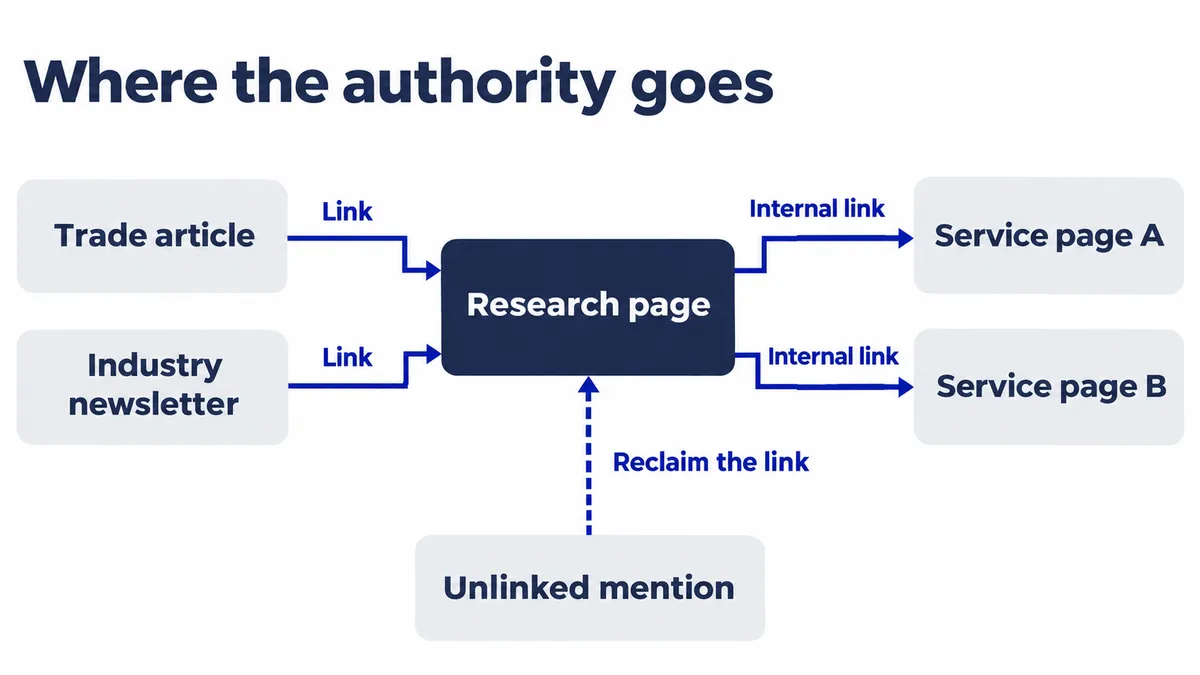
Where it fits, ask journalists to link to the most useful page for their readers. That is sometimes a service page, though more often it is a data page. Either way, you decide where the authority flows from there.
Reclaiming Unlinked Brand Mentions
B2B coverage often names a company without linking to it. Search for your brand, product names and spokespeople, find mentions with no link, and send a short, friendly request that points to the most useful URL. This is the fastest win in the whole process, because the journalist has already decided to cover you.
Social media mentions do not pass links, but they widen your reach and often lead journalists to the story. Keep an eye on them.
Measuring Digital PR Results
Set goals and a baseline before you pitch anyone. Record your rankings, referring domains and branded search for the target pages, so that you can show what changed. Without that, the work becomes a story you tell instead of a result you show.
Measure digital PR with a short list your marketing and leadership teams accept, tied to the pages and clusters you chose in step 1.
- Links from relevant referring domains: count only links from sites in your sector, not total volume
- Links to priority pages: check whether authority landed on the pages that matter
- Rankings for target clusters: compare against your baseline before the campaign
- Referral visits and assisted conversions: the buyers the coverage actually sent
- Branded search: a rise in people searching your company name
- Mentions in AI answers: how often assistants name you for your topics
Practitioners report a similar mix. In BuzzStream’s 2026 State of Digital PR survey, the metrics reported to clients were quality links (85.1%), total mentions (72.3%), total links (70.9%), organic traffic and rankings (63.5%) and AI citation mentions (55.4%). For more on presenting these to leadership, see our write-up on reporting on B2B search results, and for the AI side, see how to track mentions in AI answers.
Where PR Fits in Your Off-Page SEO Plan
Earned coverage is only one part of off-page SEO, and it comes with limits. Knowing them keeps a campaign honest.
Paid Placements and Link Schemes
Paid articles that pass ranking credit break Google’s spam policies. Google’s guidance says paid links should be marked with rel=“sponsored” or rel=“nofollow”. Sponsored content can still be worth buying for audience, just not as a link play. Be clear with yourself which one you are paying for.
How Long Results Take
Expect results to arrive in stages. Coverage lands first, links get picked up next, and ranking movement follows if the pages deserve it.
There is no universal timeline. Links have to be published, found and crawled, and the effect depends on how many relevant links you earn, which pages they point to and how far you are behind your competitors. We do not give a number of months because any number would be a guess. Set a baseline, then track change against it.
How PR Works With the Rest of Your Search Work
Coverage cannot rescue thin content or a site with technical problems. Links bring authority, but the pages they point to still have to answer the query, load properly and be indexable. That is why we treat PR as one workstream inside wider search engine optimization work, not as a replacement for it.
In-House Team or Agency?
You can run this in-house, hire a specialist or combine the two. The right choice depends on who has the story and who has the time.
- In-house: you know the product, you have the experts and you control the message. Pitching time and media relationships are usually the gap.
- Agency: a good digital PR agency brings media lists, pitching capacity and craft, but needs access to your experts and your data.
- Both: many B2B businesses keep experts and approvals in-house and hire out the pitching and list-building.
Whichever route you take, brief the team on your goals and your target pages, agree who approves quotes and decide how fast a reply must be. A partner can only work with the material and access you give them, and journalists do not wait for a legal review that takes a week.
Costs vary widely, and many teams do not track them. In the same BuzzStream survey, the most common reported cost per link was $300 to $500 (19.6% of respondents), and 39.2% did not know their cost per link. Read that as a survey finding, not a price list.
If you want to talk through whether a plan makes sense for your company, talk to us about a digital PR strategy and we will look at your market and your pages before suggesting anything.
Frequently Asked Questions
What is digital PR?
Digital PR means earning coverage, links and brand mentions in online publications through stories, data and expert comment. It differs from older PR because it also cares whether the coverage links to your site and how relevant the outlet is to your buyers. For B2B companies, the most useful coverage usually sits in trade titles, not national news.
Do press releases help with rankings?
Not much on their own. A wire copy of a release is not an editorial link, and Google's spam policies list links with optimized anchor text in releases distributed on other sites as link spam. The value comes when a journalist reads the release, finds it useful and writes their own story that links to you.
How long does PR coverage take to affect rankings?
There is no fixed timeline. It depends on how many relevant links you earn, how quickly they get crawled, which pages they point to and how far behind your competitors you are. Measure against your own baseline instead of a promised number of months.
Can a small B2B company earn press coverage without a big budget?
Yes. Expert commentary, fast reactions to news in the sector and small original data sets aimed at trade titles all work without a large budget. Time from a subject expert matters more than spend.
Do AI assistants like ChatGPT use PR coverage?
Yes, heavily. Muck Rack's analysis of more than 25 million links cited by ChatGPT, Claude and Gemini found that earned coverage made up about 84% of citations. Coverage in trusted publications raises the odds that an AI assistant names your brand.

Written by
Adriaan van Swieten
Adriaan leads Stijg Media and works directly on search, AI visibility, websites, and local growth strategy.
Meet Adriaan