ChatGPT has no fixed ranking. For a B2B company, “ranking in ChatGPT” means being mentioned, cited or recommended when buyers ask relevant questions. ChatGPT SEO aims to improve that visibility alongside traditional SEO, but no tactic guarantees a recommendation.
To improve the chance of a B2B recommendation, map commercial buyer questions, inspect cited sources, check search access, publish precise capability answers and secure accurate third-party coverage. Re-test the same questions after making changes.
Key Takeaways
- Google rankings and ChatGPT recommendations are different outcomes.
- OAI-SearchBot access supports search eligibility, not guaranteed inclusion.
- Inspect the B2B sources cited for real buyer questions before investing in placements.
- Judge changes through repeated, dated tests.
Already ranking on Google but missing from ChatGPT? Start with the diagnosis for that exact gap.
How Does ChatGPT Decide Which Businesses to Recommend, and Where Does It Look?
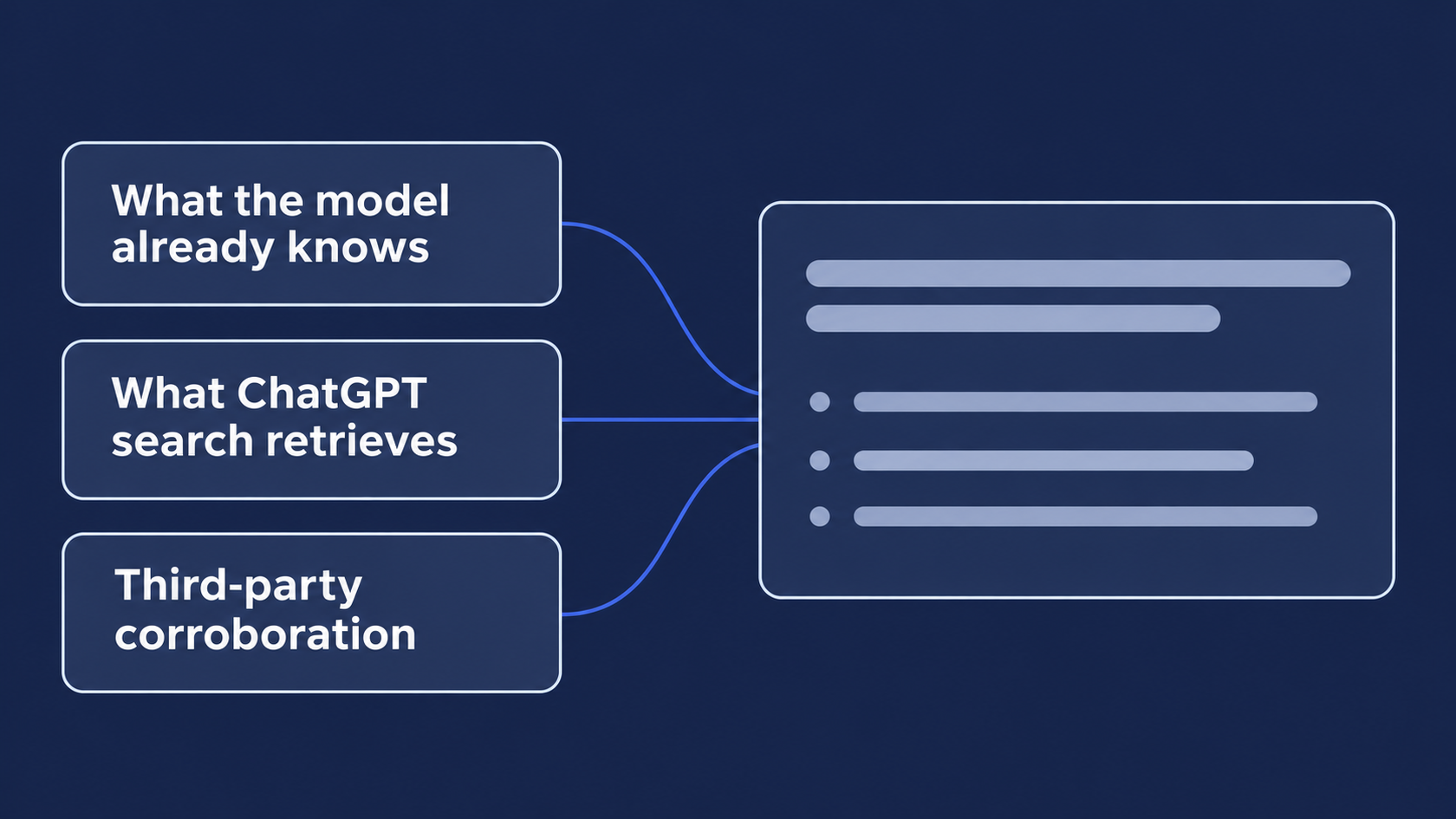
ChatGPT can answer a B2B buying question using model knowledge, web search or both. When ChatGPT search is used, OpenAI says the system may rewrite the question into targeted searches, use third-party search providers and attach source citations. The material retrieved for one question is not necessarily the material retrieved for a differently worded question.
OpenAI documents this in searching the web with ChatGPT.
What ChatGPT already knows. Training gives the model associations between companies, categories and problems. Limited or inconsistent coverage can leave that association weak. New crawler access does not alter past training.
What ChatGPT search retrieves. Retrieved pages may inform the answer, but OpenAI warns that web citations can be incomplete or incorrect. Retrieval is not the same as a citation.
Which B2B sources to investigate. For an established B2B company, the third-party sources worth checking are software review platforms such as G2 and Capterra (where they fit your category), integration partner pages, industry and trade publications, existing comparison articles, conference and podcast pages, your LinkedIn company page and genuine Reddit discussion under real identities. Start with the URLs ChatGPT actually cites for your buyer questions. Record publication, page, named providers, supported capabilities, accuracy and whether the business can contribute legitimate evidence. A listing alone produces no guaranteed recommendation.
Whether ChatGPT can reach your site. OpenAI’s crawler documentation names three agents, and each one is a separate decision:
- OAI-SearchBot surfaces sites in ChatGPT search. Sites opted out of it “will not be shown in ChatGPT search answers,” though they can still show up as plain links to the site itself.
- GPTBot crawls content that may be used to train OpenAI’s models. Blocking it is a training decision, not a search decision.
- ChatGPT-User visits pages when a user asks for something, and OpenAI says it “is not used to determine whether content may appear in Search.”
Check robots.txt, CDN and firewall rules against OpenAI’s published IP ranges. OpenAI says changes to robots.txt can take about 24 hours to reach search; placement is not guaranteed.
The same retrieve, select and attribute pattern applies across other assistants; Stijg Media covers it in how answer engines choose sources to cite.
Why Does My Company Rank on Google but Not Show Up in ChatGPT?
A company can rank on Google and still be absent from ChatGPT because a Google result position is not a ChatGPT recommendation. ChatGPT may answer from existing model knowledge, run different web searches for a conversational question, retrieve a different set of pages or decide that another provider better fits the requested use case.
Check whether your page answers the actual B2B buying question, not just the category keyword. Stijg Media examines whether AI citations follow organic rankings. Organic visibility can help discovery without deciding which business ChatGPT names.
| What to compare | Google organic search | ChatGPT business answers |
|---|---|---|
| Visible outcome | A URL appearing at an observed position for a query | A brand mentioned, a URL cited or a company recommended |
| Query evaluated | The search query entered and its context | The buyer’s wording, conversational context and any searches performed |
| Evidence you can capture | SERP, Search Console queries, landing pages | Full response, cited URLs, recommendation language and date |
| What success means | Qualified visits and conversions from organic search | Relevant recommendation visibility and, where measurable, qualified demand |
| Important limitation | Position varies by location, device and time | Answers may vary between prompts, sessions and runs |
For an established B2B company, check these three failure modes before commissioning more content:
- Question mismatch. Your page targets the category phrase, but the buyer asks which provider can handle a particular implementation, integration, industry or procurement requirement.
- Entity ambiguity. The company says what it sells, but its buyer, capability and relevant markets are absent or inconsistent across its own pages and external references.
- Search access or retrieval gaps. OAI-SearchBot may be blocked by robots.txt or infrastructure, or the page may simply not be among the sources selected for that answer.
Crawlability is an access condition, not evidence of citation or recommendation.
Why Does ChatGPT Recommend My Competitors but Not My Company?
ChatGPT may recommend a competitor because its answer associates that provider more strongly with the requested B2B capability, retrieves more relevant evidence about it or considers it a better match for the buyer’s requirements. You cannot establish the cause from a single answer. Use a paired prompt test to identify what to investigate next.
- Run an unbranded buyer prompt. Ask: “Which [category] providers suit a [buyer type] that needs [capability], [integration] and [constraint]?” Capture every company named, the language used to describe it and any cited URLs.
- Run a branded capability prompt. In a separate fresh session, ask: “Does [company] provide [capability] for [buyer type], and what evidence supports that?” Record whether ChatGPT accurately recognises the capability and which sources it uses.
If ChatGPT misses a capability in the branded answer, check service copy, documentation and external descriptions. If it recognises the capability but omits the company from unbranded suggestions, inspect buyer fit, retrieved sources and competitor evidence. Neither result proves a specific trust or ranking mechanism.
An integration query may surface partner documentation; an evaluation query may surface industry comparisons. Test against the cited pages before spending.
Repeat with representative wording in fresh sessions and compare cited evidence, not just brand presence.
If the competitor is also outperforming you in standard search, separately inspect the reasons a competitor ranks higher on Google.
Google sees your business. Does ChatGPT recommend it?
If competitors keep appearing in AI recommendations and your company doesn’t, the first job is finding out why. Stijg Media reviews your Google and AI visibility, the sources being cited, and the gaps worth fixing first.
Check my Google & AI visibility
Free analysis. No obligation.
How Should B2B Companies Shape Content So Large Language Models Can Use It?
For ChatGPT retrieval, make each important B2B passage stand alone: name the company, buyer, capability, limits and evidence under a descriptive heading. Stijg Media uses three pillars: clear entity, useful answers and verifiable trust.
Clear entity. Write a verifiable positioning statement using the structure: [Company] provides [specific capability] for [buyer or industry] in [markets served]. Verify the claim against product or service documentation, then align the facts across the About page, service pages, Organization schema, LinkedIn and relevant review profiles.
Useful answers. Map each priority buyer question to an existing money page or genuinely distinct supporting page. Answer it in a self-contained passage with the company or subject, capability, qualifying conditions and evidence together. Use buyer language from sales calls, proposals and Search Console. Avoid duplicate intent pages. Only publish real, permissioned and dated original data.
Verifiable trust. Use a verifiable author, current facts and independent coverage. E-E-A-T evidence should be checkable. Organization, Person, BlogPosting and FAQPage markup must match visible content; schema is not a proven ChatGPT recommendation lever.
These pillars support Stijg Media’s generative engine optimization approach.
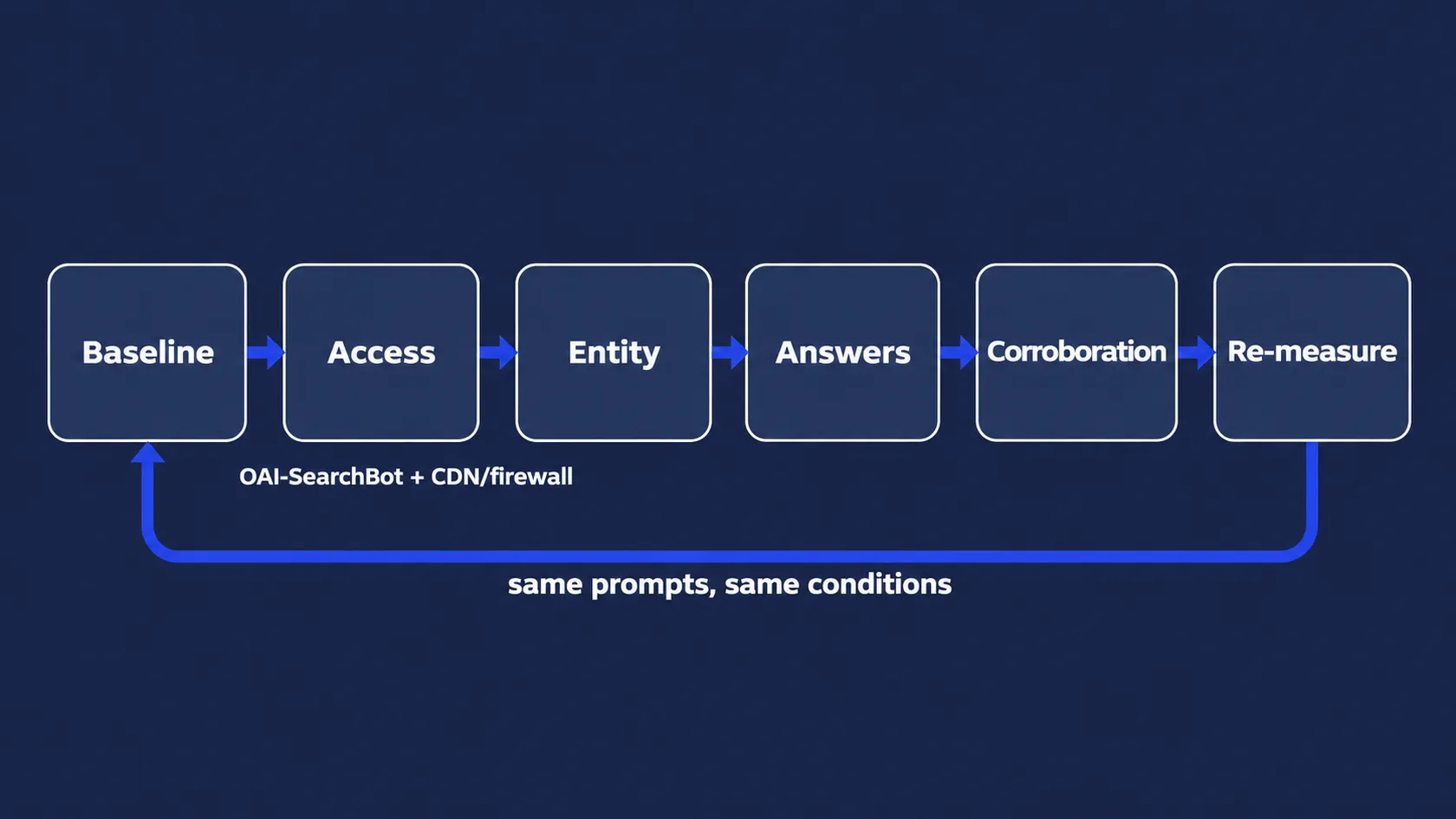
Apply them in this order:
- Baseline. Choose priority buyer prompts by deal relevance, run them before changing anything and save the full answers and cited sources.
- Access. Confirm robots.txt allows OAI-SearchBot and the CDN or firewall accepts OpenAI’s published IP ranges.
- Entity. Fix the positioning sentence everywhere it appears, starting with your own site.
- Answers. Rewrite or create passages for the buyer questions where your company is missing.
- Corroboration. Prioritise accurate, attainable placements or corrections on relevant third-party pages that your query tests actually surface.
- Re-measure. Repeat the same prompts under the same conditions and compare against the baseline.
Keep updates substantive rather than changing dates alone. Avoid near-duplicate pages and seeded forum threads; use genuine participation under real identities.
Adriaan van Swieten, founder of Stijg Media, is a former mechanical engineer who has worked in SEO since 2017. He connects this work to search rankings in Stijg Media’s B2B SEO and AI search approach.
How Can You Tell Whether ChatGPT Recommends Your Company?
Measure ChatGPT recommendations by testing a fixed panel of commercially relevant B2B buyer questions over time. For each test, record whether the company is mentioned, whether its website is cited, whether the company is actively suggested as an option and whether the description is accurate. These are different outcomes, not a single ranking position.
Use questions from sales and procurement across category, capability, integration, comparison and trust checks. Record market, ChatGPT surface, test conditions and date; repeat in fresh sessions where feasible.
Track prompt, query class, date, surface, mention, citation, recommendation, cited URL, competing brands and accuracy. Separate branded from unbranded discovery.
Google Search Console and Bing’s AI Performance report can inform other search surfaces, but neither measures ChatGPT recommendations. Referral traffic is incomplete evidence of influence, and increases in direct or branded visits should not be assigned to AI without lead-level corroboration. Measure qualified enquiries and assisted pipeline as well as visibility where tracking allows.
See how to track AI visibility and run the same test under the same conditions. Apply separate panels to Gemini, Perplexity or Microsoft Copilot where buyers use them.
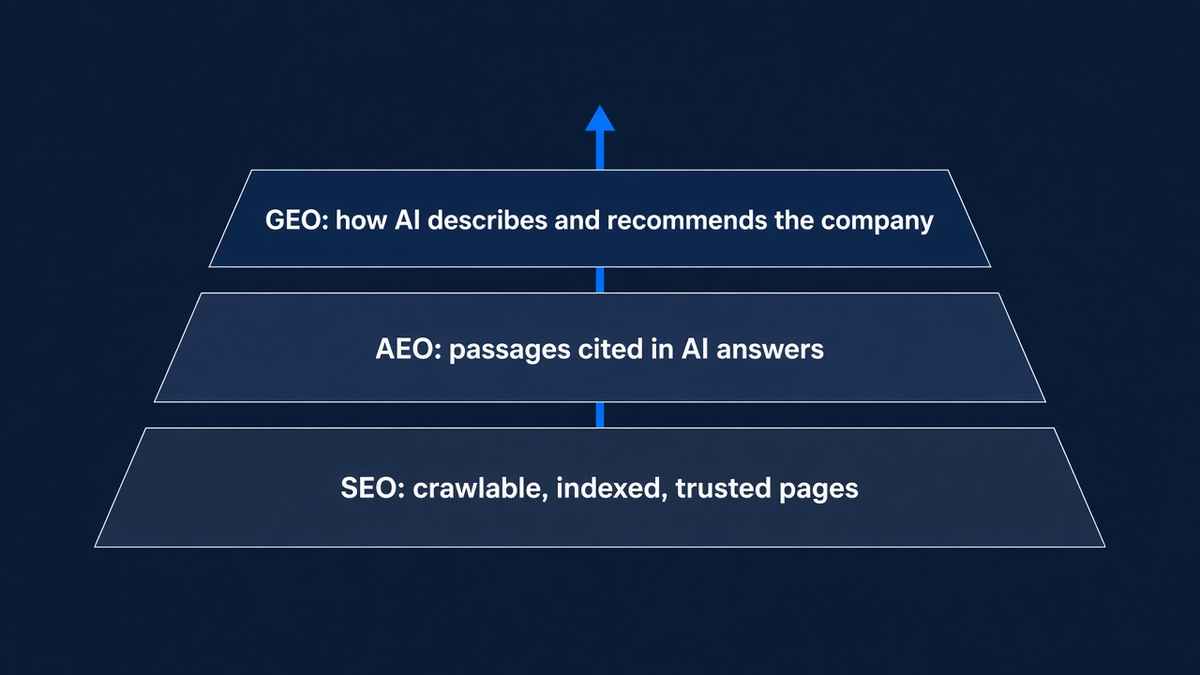
SEO remains the foundation; answer engine optimization and generative engine optimization extend it rather than replace it. Stijg Media explains how SEO, GEO and AEO connect, what answer engine optimization covers and what none of the three can promise. For implementation, see how Stijg Media approaches generative engine optimization.
Frequently Asked Questions
Can you submit your business to ChatGPT or an OpenAI business directory?
No public submission form or business directory for ChatGPT recommendations appears in OpenAI's help documentation as of November 2, 2026. OpenAI says a website becomes eligible for ChatGPT search when OAI-SearchBot can crawl it and the host or CDN allows OpenAI's published crawler IP addresses. Eligibility does not guarantee placement.
How do you rank on SearchGPT?
SearchGPT was OpenAI's search prototype, announced in July 2024. OpenAI brought it into ChatGPT as ChatGPT search on October 31, 2024, so ranking on SearchGPT now means appearing in ChatGPT's web answers. To be considered in current web answers, make relevant pages accessible to OAI-SearchBot and document your capabilities clearly.
Is SEO dead now with AI?
No. SEO is the foundation that AI search builds on. ChatGPT search sometimes sends rewritten queries to third-party search providers and reads pages its crawler can reach, so crawlable, useful and trusted pages still matter. B2B teams should measure AI recommendations alongside organic performance.
How do you do SEO for ChatGPT?
SEO for ChatGPT, often called ChatGPT SEO, makes a company easier for ChatGPT to find, understand, trust and recommend. Start with buyer prompts, accessible pages, specific answers and accurate independent coverage. Measure recommendations across repeated tests.

Written by
Adriaan van Swieten
Adriaan leads Stijg Media and works directly on search, AI visibility, websites, and local growth strategy.
Meet Adriaan