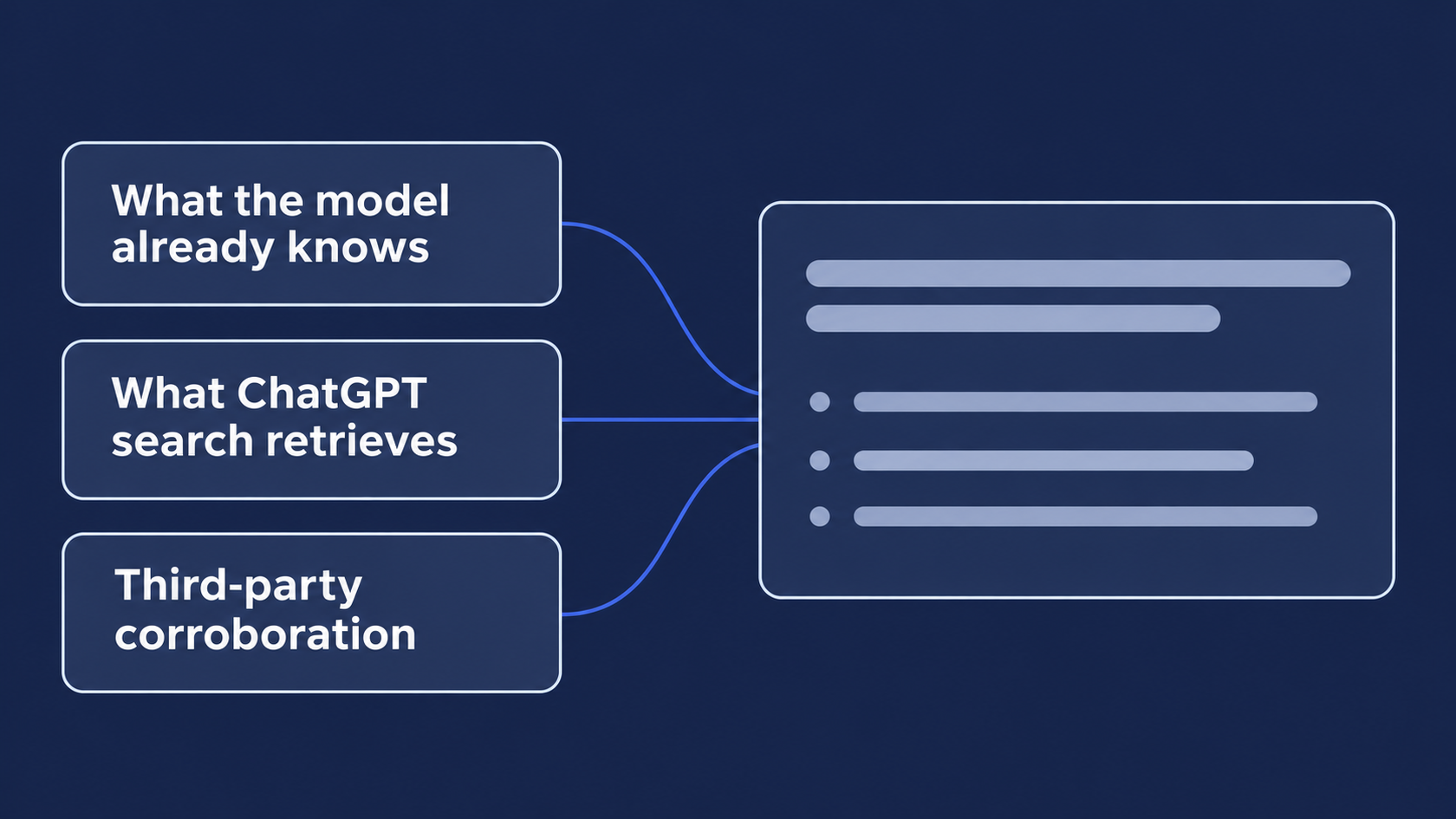
Answer engine optimization (AEO) helps AI-powered answer systems find, interpret and use accurate information about a business when responding to buyer questions. It combines retrievable content, consistent company facts and credible third-party references. The outcome may be a brand mention, a cited URL or a recommendation - none is guaranteed.
On October 29, 2026, a Stijg Media desktop SERP capture for “answer engine optimization” in Norwood, Massachusetts, showed 10 URLs cited in Google’s AI Overview and no matching URLs in organic positions 1-9. This is one query in one location, not a universal citation rule. It demonstrates why organic rankings and AI citations need separate tracking.
Key Takeaways
- SEO helps a page become discoverable; AEO adds the work of making its information usable in direct answers.
- A mention, a citation and a recommendation are different outcomes and need separate measurement.
- In Stijg Media’s October 29 capture, none of the 10 AI Overview citations overlapped organic positions 1-9.
- Search-grounded AI systems, model training and answer generation work differently; optimise and measure the relevant surface.
- No provider can guarantee that an answer engine will recommend a business.
What Is Answer Engine Optimization (AEO)?
Answer engine optimization (AEO) is the on-site and off-site process of improving how accurately and frequently a business appears in AI-generated answers. It builds on search engine optimization (SEO) but measures additional outcomes: whether a company is named, whether a page is cited and whether the business is presented as a suitable option.
Answer-focused content is not new. Featured snippets, People Also Ask results and voice assistants such as Siri and Alexa already favoured concise responses. Large language models (LLMs) expand the format by generating answers from multiple sources or their existing model knowledge. Some products link to supporting pages; others name companies without sending a click.
What Does AEO Stand For?
In digital marketing, AEO stands for answer engine optimization. In international trade, AEO also means Authorized Economic Operator, a customs accreditation for eligible supply-chain businesses. Those are distinct entities with different search intents. Google’s AI Overview for “what is aeo” displayed both meanings in the October 29, 2026 capture.
Which Answer Engines Does AEO Cover?
AEO applies to systems that provide direct answers, including ChatGPT and ChatGPT Search, Google AI Overviews and AI Mode, Gemini, Microsoft Copilot, Perplexity and Claude. Their retrieval and citation behaviour differs. A B2B programme should weight platforms by actual buyer usage rather than assuming one engine represents them all.
Why Does AEO Matter for B2B Companies?
AEO matters commercially because AI-generated answers can influence which vendors buyers investigate before they contact sales. If competitors appear in a relevant shortlist and your company does not, you may lose consideration without ever seeing a missed enquiry. That is a risk to visibility, not proof that a specific deal was lost.
Call it the Shortlist Problem. B2B buyers ask category, comparison and trust-validation questions such as:
- “Which [software/service] providers suit a mid-market manufacturing company?”
- “How does [Vendor A] compare with [Vendor B] for [use case]?”
- “What evidence supports [Provider]‘s experience in [sector]?”
These are example prompt patterns, not recorded Stijg Media customer queries. The effect is related to zero-click searches: an answer can influence a decision even when the user never visits a source website.
AEO belongs alongside a B2B SEO programme because the same website, content and third-party reputation underpin both. For commercial implementation, see Stijg Media’s answer engine optimization services.
What Is the Difference Between AEO, SEO and GEO?
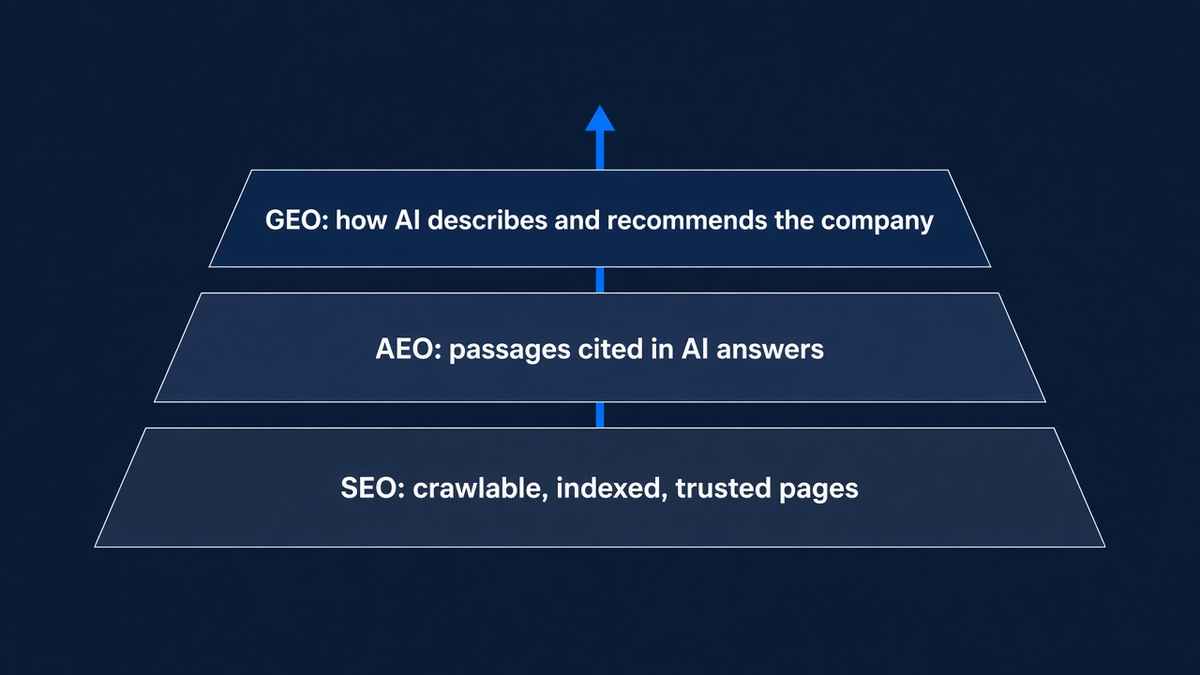
SEO, AEO and GEO describe overlapping work with different outcomes. SEO improves visibility and acquisition through search results. AEO concentrates on accurate mentions and citations in direct answers. Generative engine optimization (GEO) is used here for broader brand and source visibility in generative AI recommendations. These are working definitions, not universally standardised categories.
| SEO | AEO | GEO | |
|---|---|---|---|
| Primary question | Can buyers find the page in search? | Will the answer use or cite the information? | How is the brand represented and recommended? |
| Typical unit | Page and search intent | Question and self-contained passage | Company entity and corroborating sources |
| Main evidence | Organic rankings, clicks, conversions | Mentions, cited URLs, answer accuracy | Brand associations, comparative mentions, recommendation context |
| Shared foundations | Crawlability, relevance, internal links, backlinks | SEO plus answer structure and source access | SEO and AEO plus consistent external brand evidence |
Google’s AI features documentation says supporting links in AI Overviews and AI Mode must be indexed and snippet-eligible. That is a requirement for Google’s AI search features, not proof that every AI response uses the same index. Traditional SEO remains foundational; generative engine optimization (GEO) covers the wider entity and recommendation layer.
The supplied Ahrefs report estimates 1,900 monthly US searches for “aeo vs geo” as of October 29, 2026. That is a tool estimate, not observed search demand.
How Do Answer Engines Choose Sources to Cite?
For search-grounded AI answers, the practical model is retrieve → select → attribute. A system retrieves candidate sources, selects useful evidence and may attribute claims to supporting URLs. The precise mechanisms differ between platforms; a response generated from existing model knowledge may not involve live retrieval at all.
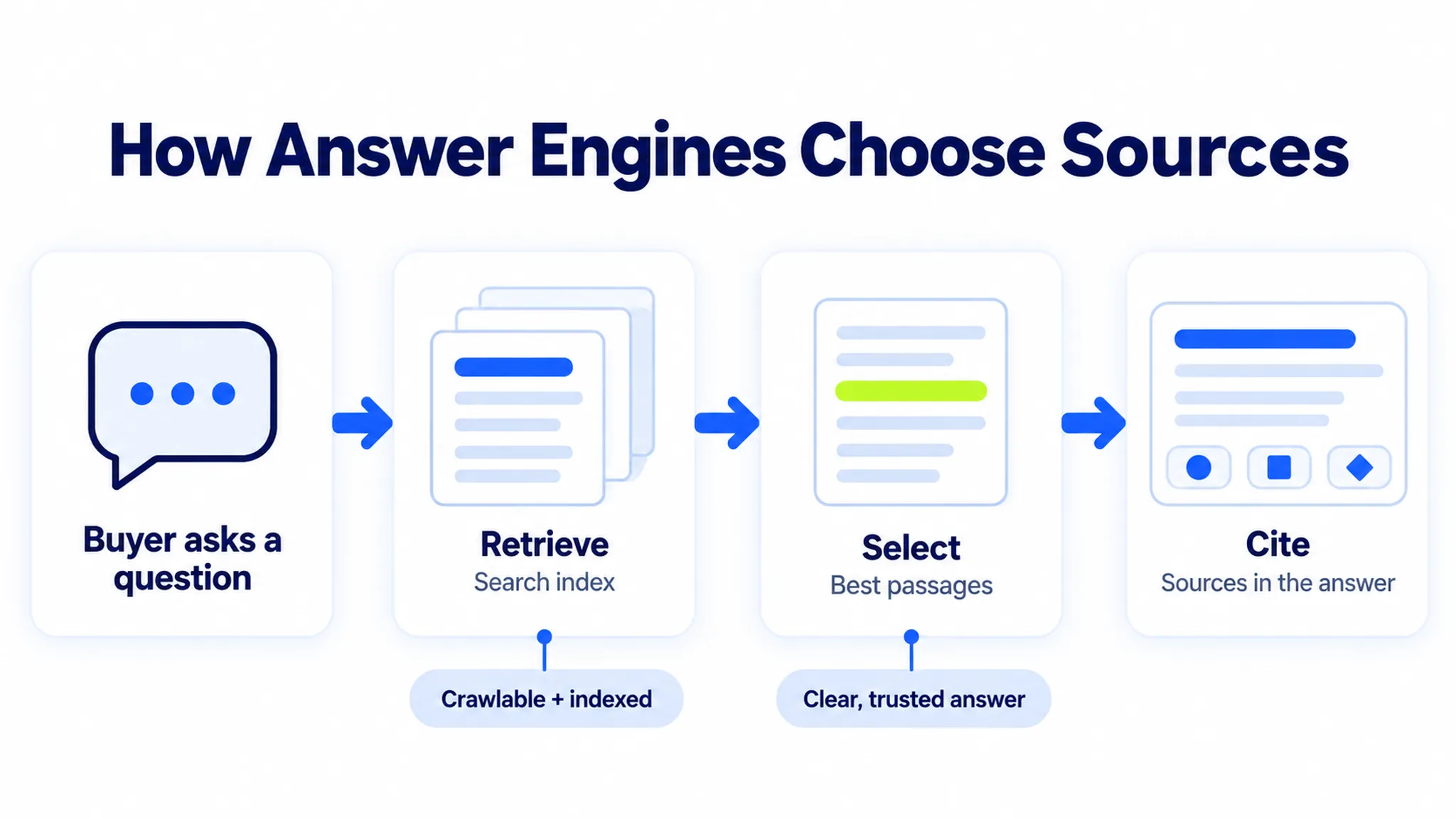
Retrieve: Search engines and AI retrieval systems surface candidate documents. Google describes query fan-out, where complex questions can produce related searches. Indexation, crawl access and relevance influence which pages are available, but a blocked crawler does not prove a brand is absent from an engine’s knowledge.
Select: Natural language processing and machine learning can connect a question with a relevant passage. An answer that identifies its subject, states a complete fact and uses a descriptive heading is easier to interpret. A 40-60-word answer is a useful editorial test, not a universal ranking threshold.
Attribute: Some products cite source URLs; some mention businesses without links. Third-party corroboration, context and source quality may matter, but no universal citation weighting is publicly established.
For a closer look at how AI citations relate to organic rankings, see our analysis of whether AI citations follow organic rankings.
What Did Stijg Media’s October 29 SERP Capture Show?
The October 29, 2026 Google AI Overview for “answer engine optimization” (US desktop, Norwood, Massachusetts) defined AEO, compared it with SEO and highlighted answer formatting, schema, off-site authority and consistent brand facts. Its 10 cited sources spanned software, education, publishing, video, community and agency content.
None of those 10 cited URLs appeared in organic positions 1-9 in that capture. Eight of the top 10 organic results were articles. The useful conclusion is methodological: log the organic results and AI citation set separately for the same query, time and market.
How Do You Optimise a Website for AEO?
AEO execution has four components: publish passages that directly answer buyer questions, make those passages accessible to relevant retrieval systems, earn independent references and keep company facts consistent. Start with existing commercial pages and real buyer questions before commissioning more generic content. This complements on-page and off-page SEO.
Write Self-Contained Answers Around Real Buyer Questions
Combine sales calls, demo objections, support conversations, Google Search Console queries and keyword research. Group questions by learning, comparison, vendor selection and trust validation. For each high-value question:
- Use a descriptive heading that accurately names the subject.
- Give the direct answer before qualifications and examples.
- Include the relevant entity and relationship in the passage itself rather than relying on “it” or “they”.
- Use genuine tables for comparisons and structured lists for procedures.
- Connect the supporting explanation to the correct commercial page with a contextual link.
The semantic triple is a useful editing test: subject → relationship → object. For example, “Google AI Overviews → displays → supporting links to eligible indexed pages” is a concrete relationship. The published copy should express these naturally, not print an artificial list of triples.
Check Retrieval Access and Appropriate Schema
A search-grounded system needs access to useful evidence, but crawler controls vary by provider. Audit robots.txt, CDN and firewall rules alongside the rendered HTML.
OpenAI’s crawler documentation distinguishes OAI-SearchBot for ChatGPT search from GPTBot for model training. Perplexity’s documentation identifies PerplexityBot and Perplexity-User. Google’s search features rely on Googlebot and relevant snippet controls. Treat training access and live-search access as different decisions.
Keep definitions, facts and comparisons in accessible HTML. Diagnose indexing problems before polishing extraction format; the crawled, currently not indexed guide covers one common failure mode.
Use BlogPosting, Organization, Person, BreadcrumbList and, where appropriate, FAQPage schema to represent facts already visible on the site. Structured data helps describe entities; it does not guarantee AI citations. FAQ markup must agree with the visible questions and answers.
Earn Relevant Third-Party References
Look first at the sources the target answers already cite. For B2B categories, useful candidates may include trade publications, industry-specific directories, review platforms, partner pages, conferences, podcasts and genuine LinkedIn or Reddit discussions.
In the October 29 captures, Reddit appeared among the cited sources for both tested queries. That is a specific observation, not a universal reason to invest in Reddit. Avoid fabricated discussions and focus on useful contributions under real identities.
Backlinks can help search discovery and authority; unlinked, contextual brand mentions can also associate a company with its category and expertise. These are not interchangeable inputs or a single measurable trust score. For adjacent trust signals, see E-E-A-T and the evidence behind it.
Make Company Facts and Entity Relationships Consistent
AEO needs clear, verifiable relationships such as company → service, company → buyer category and founder → company. Contradictory business information across site pages, listings and external articles can contribute to incorrect answers, although models can still make mistakes when facts are consistent.
For Stijg Media, the core relationship set is:
- Stijg Media → provides → answer engine optimization services.
- Stijg Media → serves → US B2B organisations.
- Adriaan van Swieten → founded → Stijg Media.
Represent the same verified facts across the site’s About and service pages, suitable Organization/Person schema, LinkedIn and relevant business profiles. For national B2B positioning, prioritise sources with actual category relevance, rather than building local citations merely to increase their count.
How Do You Measure AEO Without Fooling Yourself?
Measure answer engine optimization through a fixed buyer-prompt panel, repeated runs and saved source-level evidence. Record whether a brand appears, whether its own URL is cited, how it is described and which competitors are presented as alternatives. A single screenshot cannot establish a stable trend because answers vary by prompt, model, market and run.
- Build the panel. Include informational, comparison, shortlist and brand-validation queries. Keep a frozen core plus a separate exploratory set. Stijg Media’s default frozen panel is 20 to 30 prompts.
- Capture comparable runs. Record prompt, product, date, location/account conditions, full response and cited URLs. Repeat prompts rather than choosing the most flattering answer.
- Separate metrics. Brand mention rate = responses naming the brand ÷ valid responses in the same segment. Track citation rate, recommendation context, competitors and factual errors separately.
- Connect to revenue. Examine AI referrals and conversions, branded-search trends and lead-source answers. Branded traffic alone does not prove AI influence.
Google includes AI Overviews and AI Mode activity in the Search Console Web search reporting rather than a standalone AI row. Microsoft’s AI Performance report in Bing Webmaster Tools provides additional citation visibility for its search products.
Analytics may miss buyers who see an AI answer and later arrive through branded search or direct navigation. Treat such traffic as context unless there is corroborating lead-level evidence. Our AI visibility tracking guide covers the monitoring process in more depth.
What Do AEO Monitoring Tools Actually Measure?
AEO monitoring tools automate a sample of prompts and record mentions, citations, competitor appearances and answer context. Before purchasing, ask whether they use the public interface or a model API, whether they repeat prompts, whether custom queries can be frozen and whether raw answers can be exported. A vendor’s score describes its sampling method, not the share of every real buyer’s answers.
Is AEO Legit, and What Can It Not Promise?
AEO is legitimate optimisation work, not a guaranteed placement product. Improving retrieval access, answer quality and independently verifiable brand information is useful. Promises of a permanent “#1 ranking in ChatGPT”, guaranteed citations from schema or fixed visibility within 30 days are not defensible.
Robert Rose’s Answer Engine Optimization Is a Familiar Trap (Content Marketing Institute, June 23, 2025) is a useful counterpoint: brands should not build their entire acquisition strategy on interfaces they cannot control. The practical response is to improve owned assets and measure the answer layer without abandoning SEO.
What Should the First 90 Days of AEO Look Like?
A 90-day AEO plan should establish a defensible baseline, fix obvious access and content gaps, then test third-party source improvements. The phases describe work completed, not a promised citation timeline. Search systems may respond on different schedules, just as SEO results take time.
Days 1-30: Establish the Baseline
Freeze commercial and branded prompt groups; capture responses across priority engines; inspect indexation and crawler access; log incorrect company descriptions. Rank opportunities by buyer value and the ability to make a verifiable improvement.
Days 31-60: Repair the Evidence
Improve answer passages on the pages that already serve important buyer intents. Correct factual inconsistencies and missing entity relationships. Add content only where the query demands a distinct page or evidence that the site genuinely lacks.
Days 61-90: Test Distribution and Re-Measure
Approach relevant third-party sources with useful expertise or verifiable information. Update appropriate business profiles and review listings. Re-run the baseline conditions and compare mentions, citations, accuracy and conversions. Scale the workstreams that move business-relevant metrics; stop low-signal activity.
When Does a B2B Business Need an AEO Specialist?
An AEO specialist is useful when your team cannot reliably diagnose citation gaps, inconsistent company descriptions or missing commercial visibility across AI products. The deliverable should be a source-level baseline and executable fixes, not just a dashboard.
Adriaan van Swieten is the named founder of Stijg Media and has worked in SEO since 2017.
For implementation scope and the commercial engagement, see Stijg Media’s AEO services.
Frequently Asked Questions
Does AEO replace SEO?
No. Answer engine optimization (AEO) complements SEO. Google requires indexing and snippet eligibility for a URL to be shown as a supporting link in its AI search features. AEO adds clear answers, entity consistency, measurement and relevant off-site corroboration to the existing search foundation.
How long does AEO take to show results?
AEO has no fixed timeline. A fix such as unblocking an AI crawler can matter once pages are recrawled, while earning mentions across trade media and review platforms takes months. Because AI answers vary from run to run, judge AEO progress over several months of repeated, dated checks against a frozen prompt set, never on one test.
Do backlinks still matter for AEO?
Backlinks remain relevant to SEO and can support the discovery and visibility of pages used by search-grounded answers. AEO also looks at brand mentions, relevant third-party sources and accurate descriptions. No backlink guarantees a citation, and different AI systems use different retrieval mechanisms.
Does schema markup guarantee AI citations?
No. Structured data can clarify the meaning and relationships of information already present on a page. Schema should accurately reflect visible content. It is not a citation switch, and the relative importance of crawl access, relevance and third-party evidence varies by answer engine.
Which answer engines matter most for B2B buyers?
That depends on where your buyers research. For a US B2B company, a sensible initial test set includes Google AI Overviews and AI Mode, ChatGPT, Microsoft Copilot, Perplexity and Gemini. Ask recent customers and your sales team which tools came up during their research, then weight your AEO prompt set toward those engines first.
Is AEO only for big brands?
No. Big brands get named often because they are written about everywhere, but answer engines also cite specific, well-structured pages from smaller companies when those pages answer the question clearly. A focused B2B company can test whether specific, verifiable answers earn visibility for questions in its niche.
Is AEO the same as AI SEO?
The terms overlap and have no universal industry boundary. In this guide, AI SEO is the umbrella term, AEO focuses on direct-answer visibility and GEO describes broader brand and source visibility in generative AI. All three remain connected to traditional SEO.
How much does AEO cost?
The cost of AEO depends on scope. A company that needs crawl fixes and a few rewritten pages needs far less work than one that needs new content, technical changes, digital PR and ongoing measurement across several answer engines. At Stijg Media, scope determines pricing, so the honest first step is an assessment of where you stand.

Written by
Adriaan van Swieten
Adriaan leads Stijg Media and works directly on search, AI visibility, websites, and local growth strategy.
Meet Adriaan