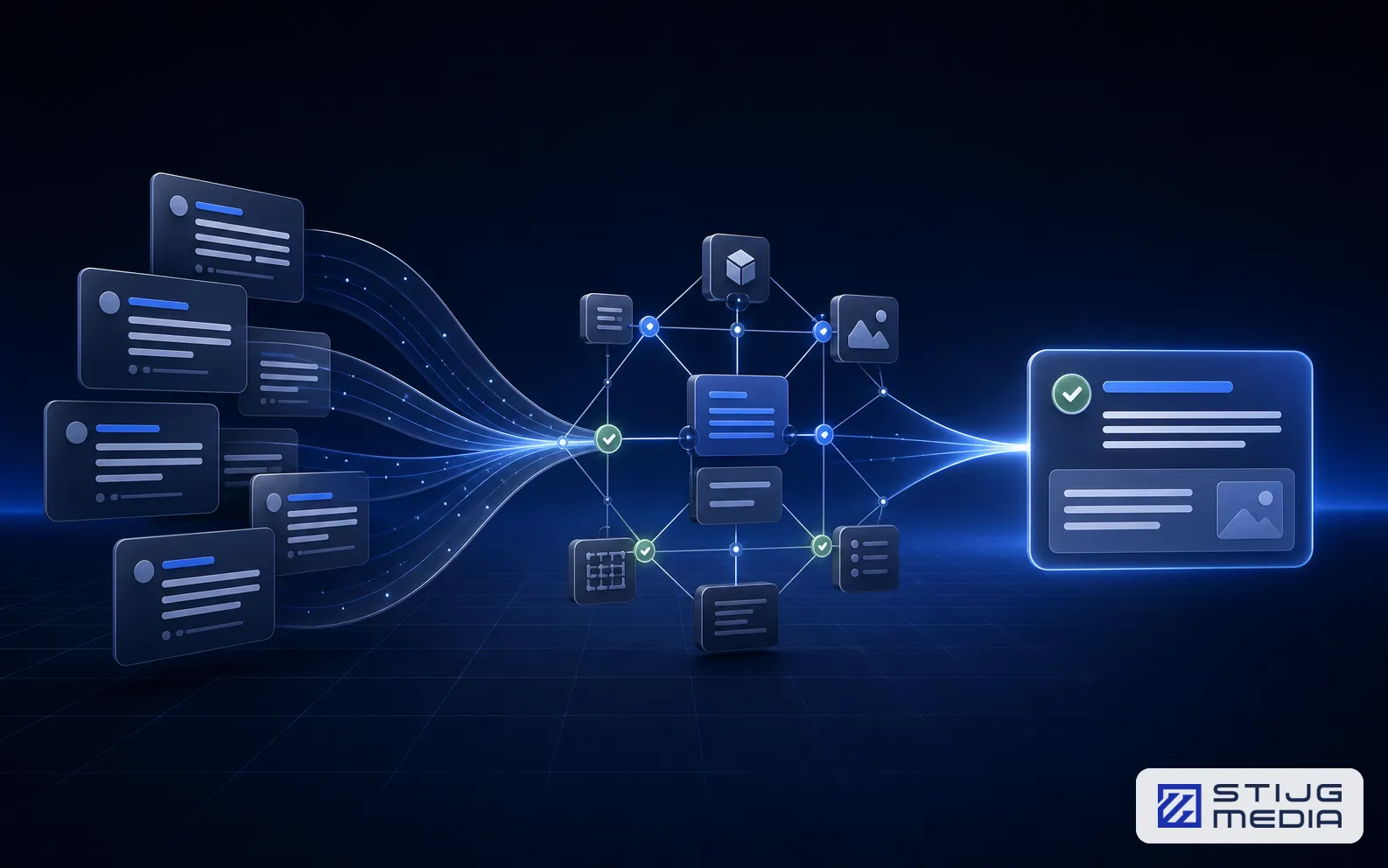
No, Artificial Intelligence is not replacing SEO; it is fundamentally transforming it into Answer Engine Optimization (AEO). The core objective is no longer about ranking a webpage in a list of links. Instead, the new imperative is to structure your content to directly feed and become the cited authority within AI-generated summaries and conversational answers, securing your visibility in a world of zero-click searches.
The End of an Era: Why the Ten Blue Links Are Disappearing
For over two decades, the game was simple. You had a question, you typed it into a search engine like Google, and you were presented with a Search Engine Results Page (SERP)—a neatly organized list of ten blue links. Success in digital marketing was measured by your ability to climb that list. But that era is definitively over. The SERP as we knew it is becoming a relic.
The change is driven by a fundamental shift in user behavior, accelerated by the widespread adoption of Generative AI. Users today don’t want a list of research options; they want a direct, definitive answer. This has given rise to two powerful trends that are dismantling the old model: zero-click searches and AI-driven overviews.
Zero-click searches, where a user’s query is answered directly on the results page via a Featured Snippet or Knowledge Graph panel, have been chipping away at organic traffic for years. But the introduction of Large Language Models (LLMs) like Google Gemini and Microsoft Copilot directly into the search experience has turned this gradual erosion into a landslide. Now, instead of a list of links, users are often met with a comprehensive, AI-generated summary that synthesizes information from multiple sources. While this provides a fantastic user experience, it poses an existential threat to businesses relying on organic traffic.
The data paints a stark picture of this paradigm shift. We are not on the cusp of a change; we are in the middle of it. Industry experts forecast that brands’ organic search traffic will decrease by 50 percent or more by 2028 as consumers switch to search powered by generative AI, according to a Gartner survey. This isn’t a distant, abstract prediction. The impact is already being felt, with many publishers bracing for significant disruption. In fact, publishers expect traffic from search engines to decline more than 40% over the next three years, according to the Reuters Institute’s 2026 trends and predictions report.
This new reality demands a new approach. Clinging to old SEO strategies focused solely on ranking for a keyword is like trying to win a chess match by only playing checkers. The board has changed, the pieces are different, and the rules of engagement have been rewritten by AI.
The Great Debate: Is SEO Dead or Evolving in 2026?
Every few years, a new technology emerges that leads to panicked declarations that “SEO is dead.” Yet, the discipline has always adapted. The question for 2026 is, is this time different? Is AI going to take over SEO for good?
The answer is a nuanced “yes and no.” Traditional SEO, defined as the practice of optimizing web pages to rank in a list of ten blue links, is dying. Its relevance is fading as the interface through which users find information changes. The tactics that defined SEO for a generation—meticulous keyword density, aggressive link building for the sake of “link juice,” and trying to game search algorithms—are becoming less effective by the day.
However, the principles of optimization are not dead. They are evolving into something more sophisticated and integrated. The future of search visibility lies in optimizing not for a list, but for comprehension by an AI. The real shift is toward redistribution. AI is accelerating parts of the workflow, raising the bar for execution, and changing where human expertise matters most, as noted by industry analysts.
This evolution redefines the entire field. The core task is no longer just about making a machine understand what your page is about; it’s about structuring your expertise in a way that an AI can parse, trust, and present as the definitive answer. This is the transition from Search Engine Optimization to Answer Engine Optimization (AEO). It’s a move away from suggestion to assertion. Instead of your site being suggested as a possible answer, the goal is for your content to become the answer itself.
Defining the New Landscape: A Comparison of SEO, AEO, and GEO
To navigate this new terrain, businesses and marketing agencies must understand the distinctions between the old, the new, and the next frontier of optimization. The conversation has expanded beyond just SEO to include two critical new concepts: Answer Engine Optimization (AEO) and Generative Engine Optimization (GEO).
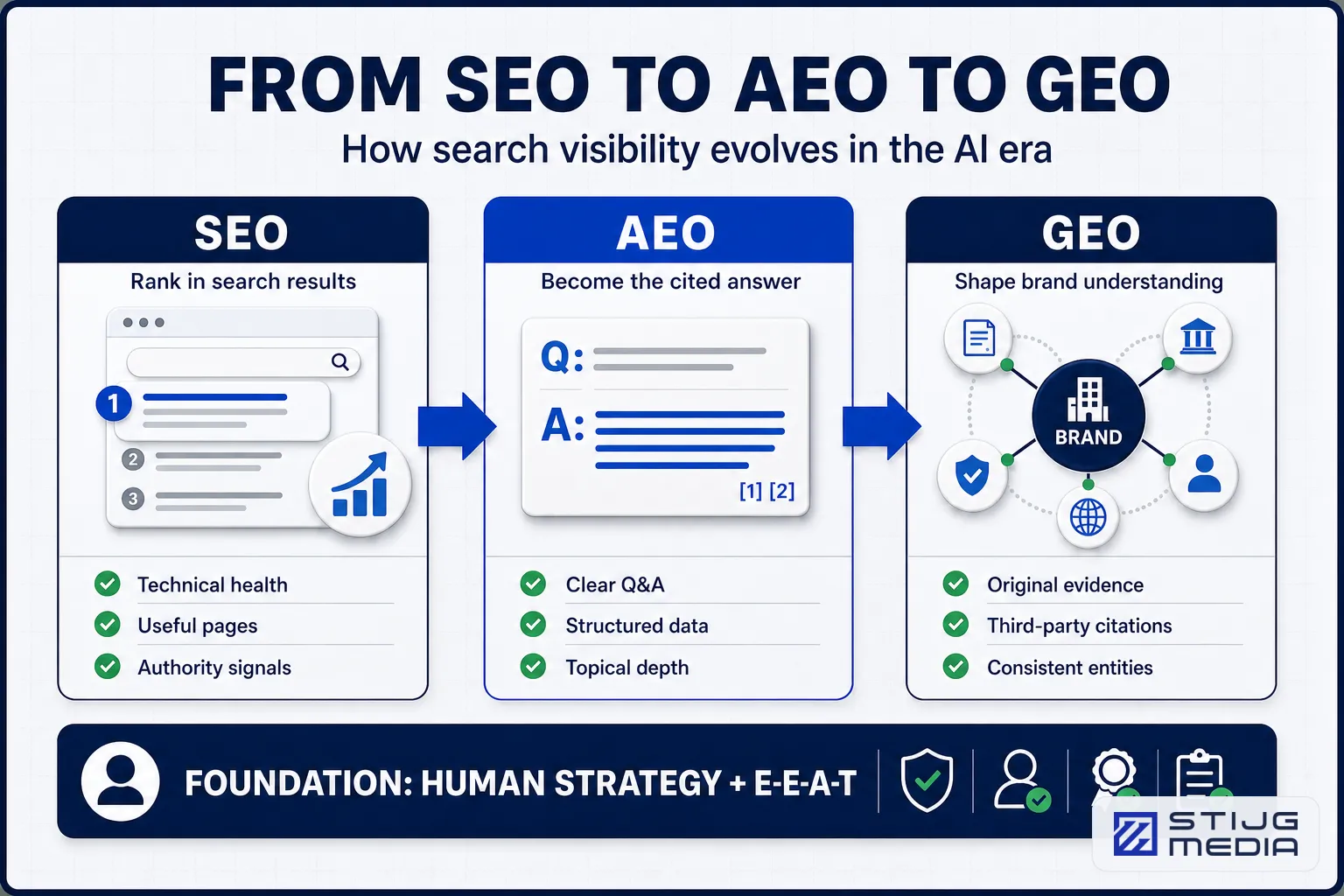
Search Engine Optimization (SEO)
- Primary Focus: Ranking specific URLs as high as possible on a traditional search engine results page (SERP) for target keywords.
- Core Tactics: Technical SEO audits, on-page SEO (title tags, meta descriptions), keyword research focused on volume and difficulty, and link building to accrue domain authority.
- Pros: A well-established discipline with clear metrics (rank tracking, organic traffic). It remains a foundational element of a healthy web presence and is crucial for discoverability in the parts of the search experience that haven’t been fully replaced by AI.
- Cons: Its core deliverable—a high rank—is rapidly losing value. It’s highly susceptible to disruption from zero-click searches and AI-generated summaries, leading to a diminished return on investment.
Answer Engine Optimization (AEO)
- Primary Focus: Structuring content to be the direct, citable source for answers provided by AI-powered search engines, voice assistants, and chatbots.
- Core Tactics: Heavy emphasis on structured data (schema markup), building comprehensive FAQ sections, optimizing for People Also Ask (PAA) boxes, writing in a clear Q&A format, and cultivating deep topical authority on a subject.
- Pros: Directly addresses the shift in user behavior. It positions a brand as the definitive authority, capturing high-intent users at the moment of their query. Success here can lead to direct recommendations from AI engines.
- Cons: AEO requires a more sophisticated content strategy that moves beyond simple blog posts. Measuring direct ROI can be more complex than tracking a simple keyword rank, requiring new analytics approaches.
Generative Engine Optimization (GEO)
- Primary Focus: Influencing how generative Large Language Models (LLMs) like ChatGPT, Google Gemini, and others perceive, interpret, and represent your brand and its expertise across their entire knowledge base, even without a direct search query.
- Core Tactics: This is the most advanced form of optimization. It involves creating foundational, data-rich content, getting cited in authoritative third-party sources (like academic papers or industry reports) that LLMs are trained on, and ensuring brand information is consistent and accurate across the entire digital ecosystem, from Wikipedia to industry databases.
- Pros: GEO is the ultimate long-term strategy for building a durable, defensible brand moat in the age of AI. Success means your brand becomes synonymous with expertise in the “mind” of the AI, leading to unprompted recommendations.
- Cons: It is the most complex and least defined of the three. GEO is a long-term, high-investment play, and the tactics are still emerging. It is incredibly difficult to measure direct results in the short term.
For most businesses in 2026, the strategic imperative is to master the transition from SEO to AEO, while laying the groundwork for GEO. This is not about abandoning SEO entirely, but reallocating resources and shifting the strategic focus to where users are actually going for information.
The AEO Playbook: How to Become the Authoritative Source for AI
Making the pivot to Answer Engine Optimization requires a deliberate and tactical shift in how you create and structure information. It’s less about chasing algorithms and more about becoming the most clear, helpful, and authoritative teacher on a given subject. Here is the playbook we implement for clients to achieve this.
Foundational Principle: Shift from Keywords to Intent Clusters
The first step is to stop thinking in terms of isolated keywords. Thanks to Natural Language Processing (NLP) and semantic search, AI-powered engines understand context and user intent far better than their predecessors. Instead of targeting “best personal injury lawyer,” you must build a cluster of content that comprehensively answers every conceivable question a person might have after an accident. This includes topics like “what to do after a car accident,” “how to calculate settlement,” “average lawyer fees,” and “statute of limitations.” By building out this topical authority, you signal to the AI engine that you are a comprehensive resource, making your content a prime candidate for summarization.
Tactic 1: Architecting Content for AI Consumption
AI models do not “read” a webpage like a human. They parse it for data, structure, and clear signals of information. To optimize for this, your content strategy must prioritize clarity and machine-readability. Write in direct, unambiguous language. Use hierarchical headings (H2, H3, H4) to create a logical flow that an AI can easily follow. Break down complex topics into simple, digestible blocks of text.
A powerful tactic is to create dedicated, robust FAQ sections on your key service or product pages. Answer questions directly and concisely, starting with the question itself (e.g., “What is the average cost of…”). This Q&A format is the native language of answer engines and makes your content exceptionally easy for an AI to extract and present as a direct answer.
Tactic 2: Mastering Structured Data and Schema Markup
If content is the what, structured data is the how. Schema markup is a vocabulary of code that you add to your website to explicitly tell search engines what your content is about. It’s like creating a detailed index for the AI, leaving no room for misinterpretation. For AEO, this is not optional; it is essential.
Key types of schema to implement include:
- FAQPage Schema: Marks up your FAQ sections, explicitly telling the engine, “Here is a list of questions and their corresponding answers.”
- Person Schema: Identifies the authors of your content, linking them to their credentials and building E-E-A-T (Experience, Expertise, Authoritativeness, Trustworthiness).
- LocalBusiness Schema: Provides critical information for local businesses, including address, phone number, hours, and services offered, making you a prime candidate for local AI-driven recommendations.
- HowTo Schema: Structures step-by-step instructions for processes, perfect for DIY or instructional content.
Proper implementation of schema turns your unstructured text into structured data that an AI can ingest with confidence, dramatically increasing the likelihood of being featured.
Tactic 3: Optimizing for “People Also Ask” and Featured Snippets
The “People Also Ask” (PAA) boxes and Featured Snippets on Google are the public training grounds for its AI models. The content that wins these placements has already been vetted by the algorithm as a clear, authoritative, and helpful answer. Dominating these SERP features is a direct line to influencing AI-generated results.
The strategy is straightforward: use SEO tools to identify the most common PAA questions related to your core topics. Then, create the best, most concise, and most helpful answer to that question on your website. Structure the answer clearly under a heading that matches the question and, whenever possible, mark it up with the appropriate schema. This creates a powerful feedback loop, where your high-quality answers get surfaced in traditional search features, which in turn trains the AI to see you as a trusted source.
Tactic 4: Building Unshakeable E-E-A-T
In an ocean of AI-generated content, proving your humanity and genuine expertise is the ultimate differentiator. Google’s algorithm updates, especially the Helpful Content Update, have placed immense value on E-E-A-T. AI models are being explicitly trained to prioritize information from sources that demonstrate real-world experience and trustworthiness.
This is where you showcase your credentials. Include detailed author bios with links to social profiles and publications. Publish original research, case studies, and data-driven analysis. Secure mentions and backlinks from genuinely authoritative sites in your industry. This focus on authority is what leads to tangible business outcomes in the AEO world. As one of our clients, a licensed therapist, shared with us: “I’ve received multiple calls from people telling me that AI recommended me as the best couples therapist in my city. Now those are results!” This kind of direct, high-value referral is the holy grail of Answer Engine Optimization, and it’s built on a foundation of demonstrable expertise.
The Human Element: Why AI Won’t Replace the SEO Expert
With the rise of powerful AI-powered tools for keyword research, content creation, and technical audits, some wonder if the human SEO expert is becoming obsolete. A common question we hear is, “What jobs will AI not replace?” The answer is any job that requires strategic thinking, creative problem-solving, and nuanced judgment. The role of the SEO professional is not disappearing; it’s elevating.
The job title is shifting from “SEO Specialist” to “AI Information Architect.” The work is no longer about finding and exploiting loopholes in an algorithm. It’s about designing and structuring a company’s entire digital knowledge base to be the most reliable and useful resource for both humans and AI. Here are five core functions that AI cannot replicate:
- Strategic Oversight and Business Context: AI tools like Surfer SEO or MarketMuse can provide a mountain of data on content gaps and keyword opportunities. But they cannot understand a business’s unique value proposition, target audience, or long-term goals. A human expert is required to interpret that data and build a cohesive content strategy that drives business results, not just vanity metrics.
- Creative Diagnosis and Problem-Solving: When organic performance declines, an AI can report the data, but it can’t understand the “why.” A human expert performs deep competitive analysis, conducts nuanced SEO audits, and connects dots between algorithm updates, competitor actions, and shifting market dynamics to diagnose the root cause and devise a creative solution.
- Ethical Judgment and Brand Alignment: An AI might suggest a tactic that is technically sound but completely off-brand or ethically questionable. The human-in-the-loop is essential for ensuring that every optimization strategy aligns with the company’s voice, values, and long-term reputation. This is where brand authority is protected.
- Genuine Relationship Building: The most valuable backlinks and authoritative citations come from genuine human relationships, public relations, and collaborative partnerships. AI cannot replicate the trust and rapport needed to secure these powerful signals of authority.
- Nuanced Performance Interpretation: An AI might see declining organic click-through rates and flag it as a failure. A human AI Information Architect sees that same data but correlates it with a sharp increase in “brand name + service” searches, realizing that the AI overviews are successfully building brand awareness that converts later. They understand the new definition of ROI in an AEO world.
The future of SEO professionals lies in their ability to orchestrate the tools, interpret the data, and build the overarching strategy. As another one of our long-term partners put it, “He doesn’t just recommend, he implements effectively and on a timely basis.” That fusion of high-level strategy and hands-on implementation is where human experts will continue to provide immense value.
Understanding the Real-World Impact: Key Factors for Your Decision
Making the strategic shift from a pure SEO focus to an AEO-first approach requires understanding the tangible business challenges this new reality presents. Here are the key decision factors every business owner and marketing manager must consider.
The need to adapt to declining organic click-through rates from traditional search
The data is clear: the number of users clicking through to websites from search is falling. Traditional searches are expected to drop 25% by next year due to the rise of AI summaries, according to government digital analysts. An AEO strategy addresses this head-on by changing the goal. Instead of fighting for a click, you’re competing to be the cited source within the answer itself. Success is measured not by traffic volume alone, but by brand impressions, citations in AI overviews, and direct recommendations. The value shifts from a visit to authoritative visibility.
The desire to be directly recommended by AI assistants like ChatGPT and Google AI
This is the new frontier of lead generation. When a user asks an AI, “Who is the best provider for X service in my area?” being the top result is a game-changer. This is already happening at scale in some industries. For example, during the 2024 holiday season, AI search referrals for U.S. retail sites increased by 1,300%, a study found. This type of high-intent referral is driven by the AEO tactics discussed earlier: deep topical authority, positive sentiment across the web, and perfectly structured data that makes you the AI’s most confident choice.
Ensuring long-term visibility as user search behavior shifts from keywords to conversational queries
Will SEO exist in 5 years? Yes, but it will be almost entirely encompassed by AEO and GEO. Users are increasingly using voice search optimization and typing full, conversational sentences into search engines. A classic SEO strategy focused on short-tail keywords will completely miss this traffic. An AEO strategy, built around answering questions and covering entire topics, is inherently designed to capture these long-tail, high-intent conversational queries. This isn’t just a minor adjustment; it’s a long-term investment in the future of how people will find information for the next decade.
Finding an expert who can both strategize for and implement new AEO/GEO tactics
This paradigm shift is creating a significant skills gap in the digital marketing industry. Many marketing agencies are still selling outdated SEO packages. Executing a true AEO strategy requires a partner with a hybrid skillset: the technical SEO knowledge to handle complex schema implementation, the content strategy expertise to build topical authority, and the forward-thinking vision to navigate the rapidly changing AI landscape. The challenge for many small businesses is finding a trusted expert who can not only create the roadmap but also handle the complex technical journey.
Making the Right Choice for Your Needs
The transition from SEO to AEO is not a one-size-fits-all process. The right strategy depends on your business model, resources, and long-term goals. Here is our tailored advice for three common profiles we work with.
For the Proactive Local Business Owner
If you’re a service provider—a plumber, dentist, lawyer, or therapist—you are on the front lines of this change. Your opportunity is immense. While your competitors are still focused on old-school local SEO tactics, you can gain a powerful first-mover advantage by embracing AEO. Your focus should be on dominating local, conversational queries. Start by completely optimizing your Google Business Profile with every possible detail. Then, build out service pages and blog posts that answer the specific questions your customers ask. Implement LocalBusiness and FAQPage schema to make it easy for AI to recognize you as the best local option. Your goal is to be the name that Google Assistant or ChatGPT recommends when someone asks, “Who can fix a leaky pipe near me?”
For the Worried Marketing Manager
You’re seeing the key performance indicators that used to bring you praise—organic traffic, keyword rankings—begin to stagnate or decline. You need a future-proof strategy to present to leadership. Our recommendation is a hybrid approach. Do not abandon your existing SEO efforts wholesale, as they still provide foundational value. Instead, propose a strategic reallocation of your marketing investment. Begin by shifting 30-40% of your SEO budget and team’s focus toward building a robust AEO foundation. Use the Gartner and Reuters Institute data points to build a compelling case for this proactive pivot. Start tracking new metrics: brand mentions in AI overviews, number of PAA boxes won, and leads that report being referred by an AI. This demonstrates that you are not just reacting to a downturn but are strategically leading your company into the future of search.
For the Overwhelmed Entrepreneur
You’re running your business, managing operations, and trying to handle marketing on the side. The pace of change with AI feels impossible to keep up with, and terms like “schema markup” and “semantic search” are intimidating. Your most valuable asset is your time, and the return on investment of trying to become an AEO expert overnight is low. Your best move is to find a trusted partner. Look for a specialist or a boutique agency that is explicitly focused on this transition from SEO to AEO. They can handle the complex technical implementation and content strategy, freeing you to do what you do best: serve your customers and grow your business. The right partner won’t just be a vendor; they’ll be an extension of your team, navigating this new landscape for you.
Navigating the evolution from search engines to answer engines requires a partner who understands both the technical foundations of SEO and the strategic future of AI-driven search. At Stijg Media, we don’t just write reports about the future of search; we build it for our clients. Our team of seasoned SEO experts has evolved into dedicated AI Information Architects, focused on implementing the AEO and GEO strategies that drive tangible, long-term results in this new landscape. For a clear, no-obligation assessment of how your business can thrive in the age of AI, contact our Austin-based team for a personalized strategy session today.