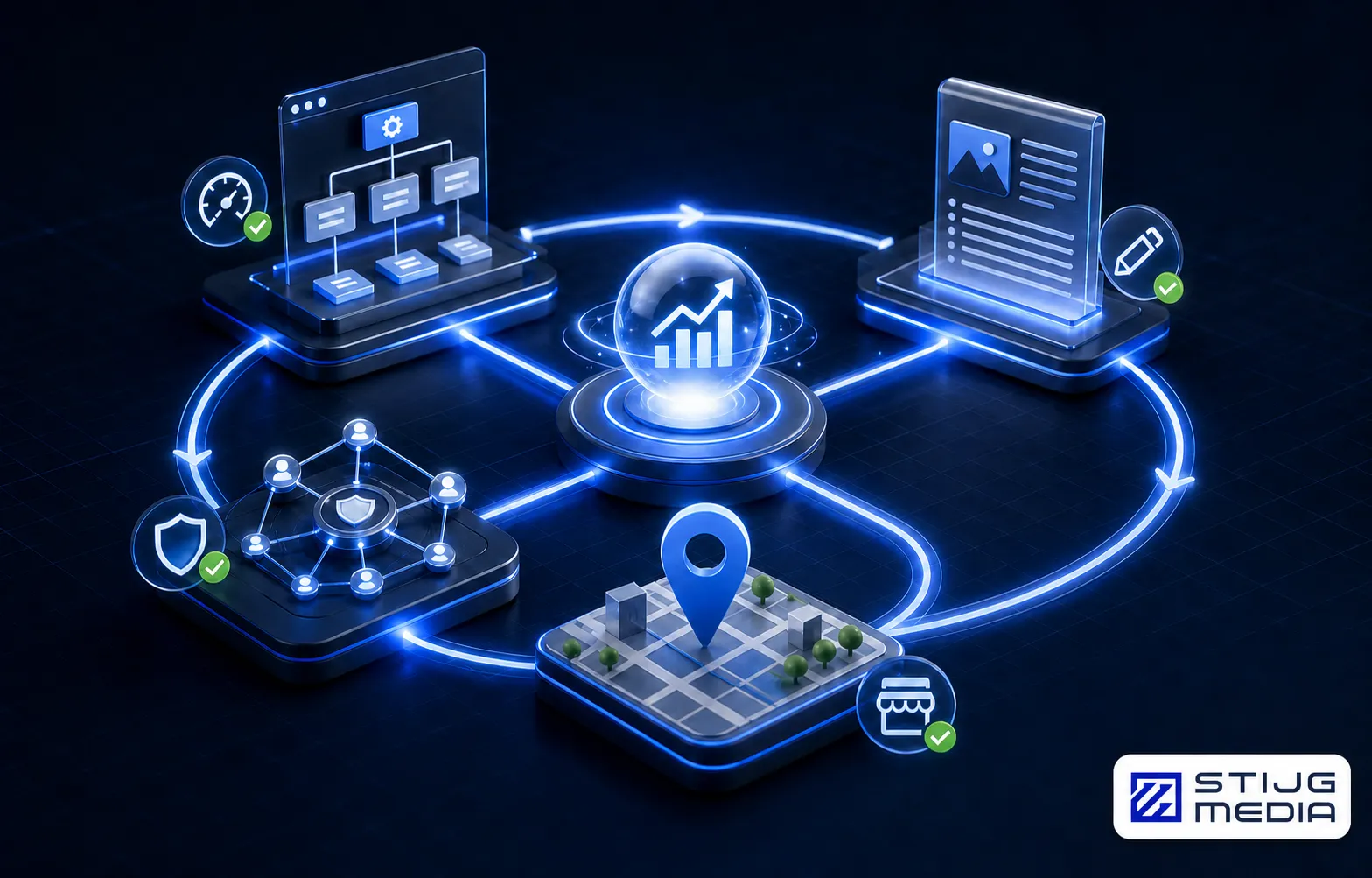
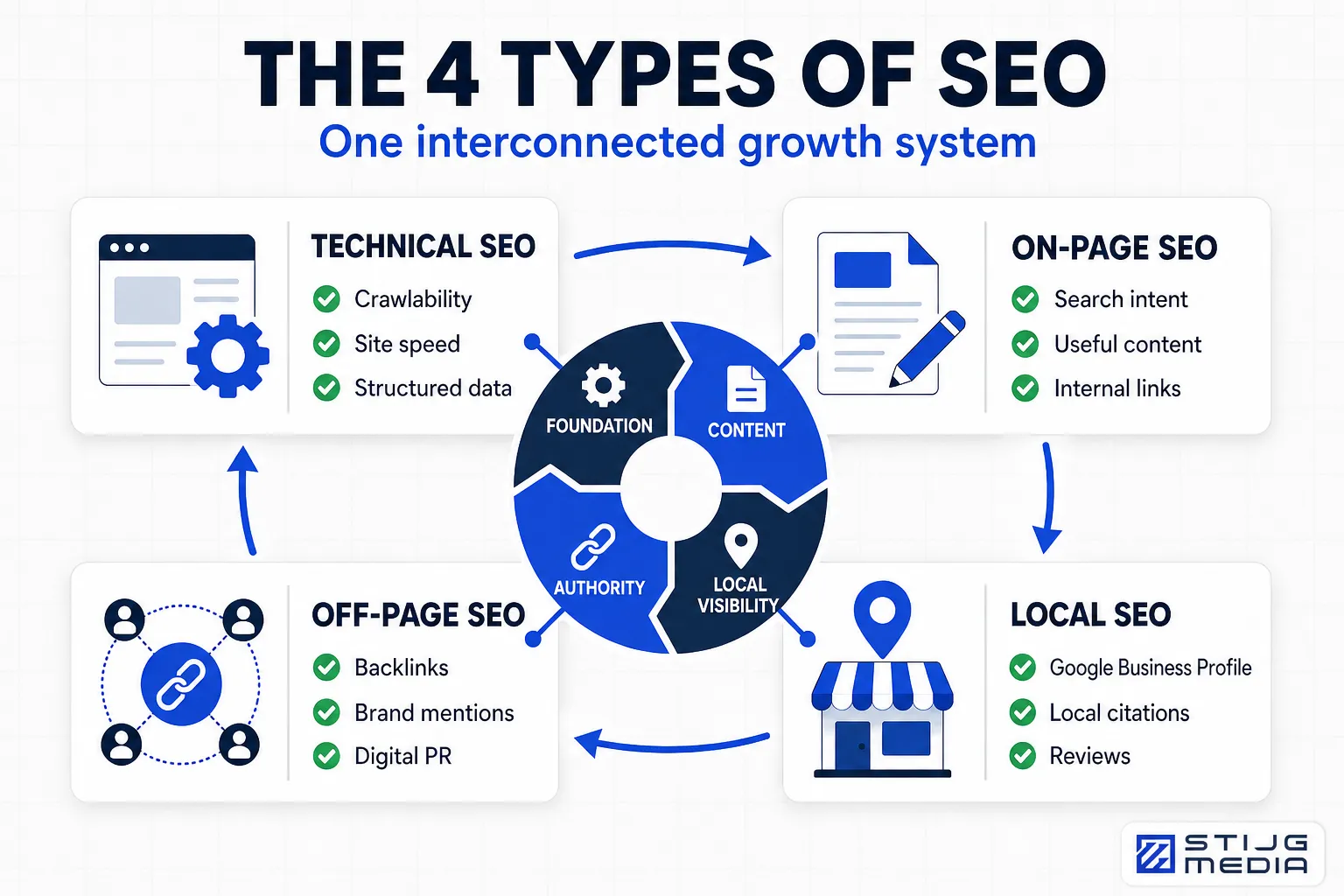
The four primary types of SEO are Technical SEO, On-Page SEO, Off-Page SEO, and Local SEO. While often treated as a checklist, they are an interdependent system. A solid technical foundation is required for on-page content to be seen, which in turn fuels the off-page authority needed for competitive rankings.
Stop Using an SEO Checklist. Start Building an SEO System.
For over a decade, I’ve had countless conversations with business owners who feel like they’re doing everything right in their search engine optimization efforts, yet see no meaningful results. They’ve followed the guides and ticked the boxes: optimized title tags, written blog posts, even claimed their Google Business Profile. But their organic traffic remains flat.
The problem isn’t a lack of effort. It’s a flawed approach. Most online advice presents the four types of SEO as a simple to-do list, a series of disconnected tasks to complete. This is a critical strategic error. Viewing SEO as a checklist is like trying to build a car by randomly assembling parts; you might have a great engine and perfect tires, but without a chassis connecting them in the right order, you have a pile of junk, not a vehicle for growth.
The core thesis of a successful SEO strategy is this: the types of SEO function as an interdependent system. A strong technical foundation is the non-negotiable prerequisite for effective on-page content, which in turn is the necessary fuel for earning authoritative off-page signals. Neglect one part, and the entire system falters.
SEO as a Checklist vs. SEO as an Interdependent System
Understanding the difference between these two mindsets is the first step toward building a strategy that delivers sustainable long-term growth instead of frustrating, temporary fixes.
The Checklist Approach (Siloed Tasks)
This approach treats each type of SEO as a separate, one-and-done project. You might hire a developer to fix site speed (technical), a writer to create content (on-page), and a different agency for link building (off-page). The tasks are completed in isolation, with little to no communication or strategic alignment between them. The result is often wasted effort, as one team’s work may be undermined by unaddressed issues in another area.
The System Approach (Integrated Strategy)
This approach recognizes that each element of SEO directly impacts the others. The SEO strategist understands that optimizing crawl budget (technical) ensures that new content (on-page) gets indexed quickly. They know that creating a truly exceptional, data-driven article (on-page) is the only white hat way to attract high-authority backlinks (off-page). This integrated strategy creates a compounding flywheel effect where each success amplifies the next.
Let’s break down each component of this system to see how they connect and build upon one another.
The Foundation First Principle: Technical SEO
Technical SEO is the work you do to help search engines find, crawl, understand, and index your website. If On-Page SEO is the quality of the house you build, Technical SEO is the foundation it sits on. If the foundation is cracked, unstable, or inaccessible, it doesn’t matter how beautiful the house is; no one will ever see its value.
Many business owners are tempted to jump straight to creating content because it’s tangible and exciting. But launching a content marketing campaign on a technically flawed site is like shouting into a soundproof room. Your message, no matter how brilliant, won’t be heard. An SEO audit should always begin here. The goal of technical SEO is to ensure a search engine like Google is “crawling, indexing, and serving your results,” making your site visible in the first place according to industry experts.
Key Components of a Strong Technical Foundation:
- Crawlability & Indexability: At its core, search engines need to be able to access and read your site. This involves a clean site architecture, a functional XML sitemap to provide a roadmap, and a properly configured robots.txt file to guide search engine bots. If there’s a problem with crawl budget or incorrect canonical tags, pages may never even make it into Google’s index.
- Site Speed & Core Web Vitals: User experience (UX) is a major ranking factor. Google’s Core Web Vitals measure how users perceive the speed, responsiveness, and visual stability of a page. A slow-loading site frustrates users and signals a poor experience to search engines, directly impacting your ability to rank.
- Mobile-Friendliness: With Google’s move to mobile-first indexing, your website’s mobile version is the primary one used for ranking. A site that is not responsive or easy to use on a smartphone is at a severe disadvantage for gaining any organic traffic.
- Security: Using HTTPS to secure your website is not just a best practice for protecting user data; it’s a confirmed, albeit lightweight, ranking signal. It builds trust with both users and search engines.
- Structured Data (Schema Markup): This is code that helps search engines understand the context of your content more deeply. Implementing schema markup can help you earn rich results in the SERP, like review stars or FAQ dropdowns, improving your click-through rate (CTR).
Without a solid technical SEO foundation, any investment in content is built on sand. You must fix the foundation before you can build the house.
The Content-to-Authority Bridge: On-Page SEO
Once your website is technically sound and accessible to search engines, the focus shifts to On-Page SEO. This is the practice of optimizing individual web pages to rank higher and earn more relevant traffic. On-page SEO is defined as the process of optimizing both the visible content on a webpage and its ‘invisible’ metadata to be “searchable” as outlined in digital best practices. This is where you create the valuable assets that will serve as the bridge to earning off-page authority.
This stage is about more than just stuffing a target keyword into a page. It’s about deeply understanding search intent and creating the single best resource on the internet for a given query. Search engine crawlers collect information to rank websites by following links and cataloging on-page identifiers like “text, URL, and title tags to discern the focus of every page,” which is a fundamental concept in SEO education.
Understanding the 4 Types of Search Intent
Before you write a single word, you must understand what a user is trying to accomplish. This is search intent, and it generally falls into four categories:
- Informational: The user is looking for information. (e.g., “how to improve site speed”)
- Navigational: The user is trying to get to a specific website. (e.g., “Google Analytics login”)
- Commercial: The user is researching before a purchase. (e.g., “best SEO software for small business”)
- Transactional: The user is ready to buy. (e.g., “hire SEO consultant”)
Your content must match the dominant intent for your target keywords. Creating a blog post for a transactional keyword will likely fail, just as a product page won’t rank for a purely informational query. Mismatched intent is a primary reason why perfectly good content never ranks.
Key Components of World-Class On-Page SEO:
- Keyword Research & Strategy: Identifying the terms and phrases your audience uses to find solutions you provide. This goes beyond simple volume, focusing on relevance, intent, and competitive difficulty to build topical authority.
- Content Optimization: Creating comprehensive, high-quality content that thoroughly answers the user’s query. This includes optimizing header tags (H1, H2, H3), using semantic search principles, and naturally incorporating your primary and secondary keywords. Image SEO, including descriptive file names and alt text, is also critical.
- Title Tags & Meta Descriptions: These are your digital storefront in the search results. A compelling title tag and meta description can dramatically improve your CTR, even if you aren’t in the #1 position.
- Internal Linking: Strategically linking to other relevant pages on your website helps search engines understand your site structure, distributes link equity (page authority), and keeps users engaged longer. A strong internal linking structure is a hallmark of a well-optimized site.
Great on-page SEO creates content so valuable, helpful, and insightful that other websites want to reference it. These are your “link-worthy assets,” and they are the only sustainable fuel for the next stage of the system.
The Compounding Flywheel Effect: Off-Page SEO
Off-Page SEO refers to all the actions taken outside of your own website to impact your rankings within search engine results pages. While On-Page SEO is about what your site says, Off-Page SEO is about what the rest of the web says about your site. It’s the digital equivalent of word-of-mouth marketing and is a massive trust signal for engines like Google and Bing.
This is where the flywheel starts to spin. As you earn authoritative signals from other sites, your website’s overall Domain Authority grows. This increased authority doesn’t just help the page that earned the link; it lifts the ranking potential of your entire website. Every new piece of content you publish starts from a higher baseline, making it easier and faster to rank.
The primary goal of off-page SEO is to build credibility through external factors, including backlinks from authoritative websites and brand mentions, which signals to search engines that your content is trustworthy and valuable as noted by marketing academics. This is why a white hat SEO approach is crucial. Tactics that violate search engine guidelines (black hat SEO) might offer short-term gains but inevitably lead to penalties. The sustainable path involves earning these signals, not manipulating them.
Key Components of an Effective Off-Page Strategy:
- Link Building: This is the cornerstone of off-page SEO. A backlink from a relevant, high-authority website is like a vote of confidence. Quality trumps quantity. One link from a major industry publication is worth more than hundreds of low-quality directory links.
- Digital PR: This involves creating compelling stories, studies, or data-driven content (your link-worthy assets from the on-page phase) and promoting them to journalists and bloggers. When they cite your work and link to it, you earn powerful, editorially-given backlinks.
- Guest Blogging: Writing for other reputable websites in your niche not only builds brand awareness but also allows you to earn a relevant backlink to your site within the content or author bio.
- Brand Mentions: Even unlinked mentions of your brand can be a positive signal. Search engines are getting smarter at associating brand names with topics, contributing to your overall authority.
The flywheel is simple: A strong technical site allows great on-page content to be found. Great on-page content earns powerful off-page backlinks. Powerful off-page backlinks raise the authority of the entire site, making it easier for all future content to rank. This is the compounding growth system you should be aiming for.
The Ultimate Synthesis: Local SEO
So, where does Local SEO fit in? Many treat it as just another box to check, but that’s a mistake. Local SEO is not a fourth, separate pillar; it is the focused application and synthesis of technical, on-page, and off-page SEO for a specific geographic result.
It’s where the entire system comes together to produce a tangible business outcome: getting a local customer to find you and walk through your door (or call you, or visit your website). It’s about dominating the SERP, including the Local Pack, for searches with local intent.
For one of my clients, a couples therapist, we implemented this exact integrated system. We fixed the technical issues, created hyper-local on-page content for her specific services, and built local off-page authority through citations and reviews. The result? She told me, “I’ve received multiple calls from people telling me that AI recommended me as the best couples therapist in my city. Now those are results!” This demonstrates how a holistic strategy leads to success in modern search environments, including AI-driven answer engines.
How the System Applies to Local SEO:
- Technical Synthesis: Mobile-friendliness and site speed are paramount for “near me” searches conducted on the go. Schema markup for local businesses helps Google understand your address, hours, and services, which can directly influence your Local Pack visibility.
- On-Page Synthesis: Content is optimized with location-specific keywords (e.g., “plumber in [City]”). Service pages are created for each distinct neighborhood or service area. Your website’s URL structure might even reflect this local focus.
- Off-Page Synthesis: Link building shifts to earning backlinks from local news outlets, community organizations, and other local businesses. A huge focus is placed on building local citations, meaning mentions of your Name, Address, and Phone number (NAP consistency) across relevant online directories. Online reviews on platforms like Google become one of the most powerful off-page ranking factors.
Putting It All Together: The 4 Stages of a Real SEO Strategy
Now that we see how the types of SEO are interconnected, we can frame them within a practical workflow. This is often referred to as the 4 stages of SEO:
- Audit & Research: This is the discovery phase. It starts with a comprehensive SEO audit to identify all technical issues. Simultaneously, deep keyword research and competitive analysis are performed to understand the landscape and identify opportunities.
- Planning & Strategy: Based on the audit, a roadmap is created. This involves prioritizing technical fixes, developing a content strategy based on keyword research and search intent, and planning an off-page campaign to build authority. This is where you decide which levers to pull and in what order.
- Execution: This is where the plan is put into action. Technical fixes are implemented, content is written and optimized, and the digital PR or link building outreach begins. This is the “doing” phase.
- Monitoring & Reporting: SEO is not set-and-forget. Using tools like Google Search Console and Google Analytics, we track rankings, organic traffic, and conversions. This data feeds back into the strategy, allowing for continuous refinement and adaptation to algorithm updates and market changes.
Key Factors for Choosing Your SEO Partner
When you’re ready to move beyond checklists and build a real SEO system, choosing the right partner is critical. The decision often comes down to their approach and capabilities.
Integrated Strategy vs. Siloed Tasks
Does your potential partner talk about SEO as one cohesive plan, or do they sell services a la carte (e.g., “a link building package”)? A true strategist understands that without a technical audit, a link building campaign might be a complete waste of money. Look for someone who insists on seeing the full picture before starting any work.
Implementation vs. Recommendation
Many agencies deliver a 50-page audit full of recommendations and then leave it to you or your overwhelmed development team to implement. This creates a massive bottleneck. The most effective partners are those who can both strategize and execute. As one of my clients put it, “He doesn’t just recommend, he implements effectively and on a timely basis.” This hands-on approach ensures that the strategy actually gets deployed and starts delivering results.
Sustainable Long-Term Growth vs. Quick Fixes
Be wary of anyone promising “guaranteed #1 rankings” or immediate results. Real SEO is a long-term investment that builds a compounding, defensible asset for your business. It’s about creating a system that can withstand algorithm updates and consistently generate leads for years to come, not about chasing short-lived tricks or black hat tactics.
Making the Right Choice for Your Needs
There is no single “best” path for every business. The right choice depends on your resources, your goals, and your past experiences. Here’s how to think about it based on who you are:
For the ‘DIY Overwhelmed’ Business Owner
You’ve downloaded the checklists, read the blogs, and tried to piece it all together yourself. You’re intelligent and capable, but you’re seeing that the parts aren’t adding up to a whole. Your challenge is a lack of an integrated framework. You need an expert who can connect the dots you’ve already gathered, audit your current efforts, and build the strategic system that turns your hard work into tangible results.
For the ‘Hands-Off Delegator’
You’re a practice manager, a CEO, or an owner who needs SEO to just work. You don’t have the time or interest to become an expert yourself. You need a trusted partner who can take full ownership of the strategy and execution, from technical fixes to content creation. Your ideal partner communicates clearly, delivers results without burying you in jargon, and functions as an extension of your team.
For the ‘Skeptical Marketer’
You’ve been burned before. You’ve hired agencies that delivered impressive-looking reports but no actual business growth. They recommended changes but didn’t help implement them, leaving you stuck. You need a partner who is both a strategist and a builder, someone who gets their hands dirty. You’re looking for transparency, a focus on implementation, and a clear connection between SEO activities and business KPIs.
Ultimately, a successful SEO campaign is not about mastering four separate disciplines. It’s about understanding a single, unified system where a technically sound website allows exceptional content to shine, which in turn earns the authority needed to dominate the search results. By shifting from a checklist mentality to a system-based approach, you move from simply “doing SEO” to building a powerful, long-term engine for business growth.
At Stijg Media, we specialize in building these integrated SEO systems. We don’t just provide recommendations; we partner with you to implement a cohesive strategy from the technical foundation up. If you’re ready to stop checking boxes and start building a real growth engine for your business, contact us for a personalized assessment of your needs. We are based in Norwood, Massachusetts, and help businesses nationwide achieve their goals.