
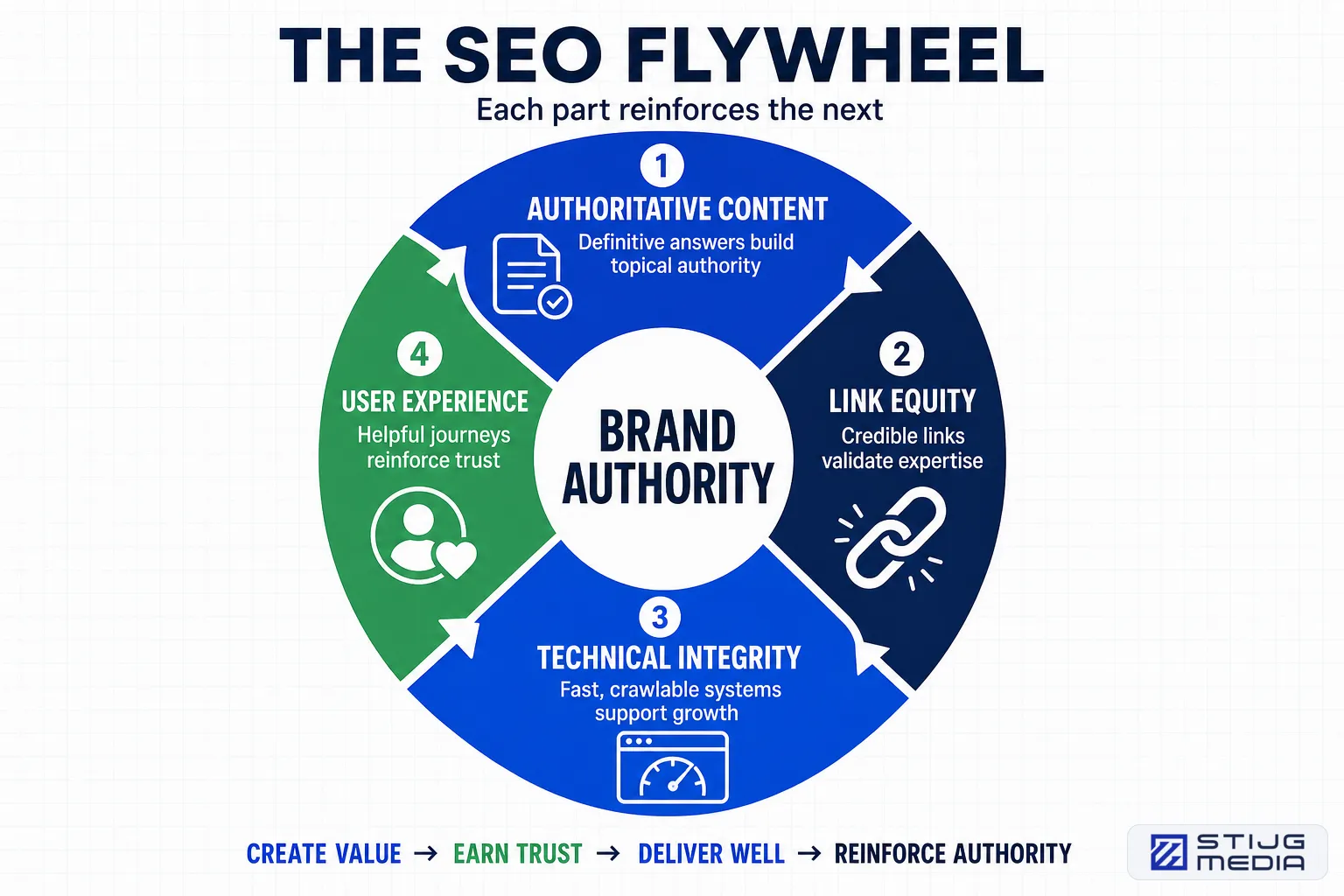
The 4 pillars of SEO are traditionally defined as Technical SEO, Content (On-Page), Backlinks (Off-Page), and User Experience. However, a modern strategy treats these not as separate columns, but as a reinforcing flywheel where each element builds momentum for the others, establishing dominant brand authority that is resilient to algorithm and AI shifts.
The Conventional Wisdom is Holding You Back: Debunking the ‘Pillar’ Myth
For years, anyone asking “What are the 4 pillars of SEO?” received a simple, digestible answer. The framework was presented as four distinct columns holding up your digital presence: get your technical house in order, write good content with keywords, get some links, and make sure the site is easy to use. This checklist approach was logical and, for a time, sufficient. But the search landscape of today is a different beast entirely. Search engines like Google and Bing have evolved from simple information retrieval systems into complex answer engines, and the rise of the Search Generative Experience (SGE) has accelerated this shift exponentially.
Viewing SEO components as separate, static pillars leads to fragmented efforts and stalled growth. A business might invest heavily in a technical SEO audit, fixing crawlability issues and improving page speed, only to see minimal impact because the content remains mediocre. Another might produce a fantastic series of blog posts that fail to rank because the underlying site architecture is a mess and it has no authority from backlinks. This siloed approach creates a rickety structure, not a powerful engine for growth. You fix one pillar, and another starts to wobble. This is the fundamental flaw in the old model.
In fact, this compartmentalization misses the entire point of what search engines are trying to achieve. They want to connect users with the most authoritative and trustworthy answers. As experts have noted for years, SEO methods are broadly categorized into three classes: Technical (semantic HTML), Copywriting (using visitors’ vocabulary), and Popularity (acquiring links from other established sites). While this description is accurate, the magic happens not in executing these categories in isolation, but in understanding how they dynamically interact.
Static SEO Checklist
This approach treats SEO as a series of boxes to be ticked. Technical audit? Check. Keyword research? Check. A few blog posts? Check. The goal is completion of tasks. The problem is that it lacks synergy; the efforts don’t build on each other. It’s a linear, finite process that requires constant, manual restarts and is highly susceptible to stalling when one area underperforms. It’s reactive and often feels like patching leaks in a sinking boat.
Reinforcing SEO Flywheel
This model treats SEO as a continuous, self-perpetuating system. Each component feeds and accelerates the others. Great content earns links naturally. The authority from those links signals to search engines that your site is important, justifying a deeper crawl. This increased visibility demands a flawless user experience to retain and satisfy visitors, and the positive user signals generated (like high dwell time) further boost the authority of your content. It’s a virtuous cycle that builds momentum over time, making your brand stronger and more resilient with every rotation.
Introducing the SEO Flywheel: A Self-Perpetuating System for Growth
Imagine a heavy flywheel. Getting it to spin takes significant initial effort, but once it’s moving, each push adds to its momentum, requiring less energy to achieve greater speed. The same principle applies to a modern SEO strategy. The initial push is creating genuinely valuable content, but once the wheel starts turning, each element reinforces the others, creating an unstoppable force that solidifies your brand’s authority.
Pillar 1: Authoritative Content as the Engine
Everything begins with content. But we’re not just talking about blog posts sprinkled with keywords. Authoritative content is the engine of the flywheel. It’s about deeply understanding search intent and creating the definitive resource on a topic. This involves a comprehensive content strategy built around topic clusters. You have broad pillar pages covering a core subject, supported by more specific cluster content that addresses long-tail keywords and niche questions, all connected through a robust internal linking structure.
This approach demonstrates E-E-A-T (Experience, Expertise, Authoritativeness, Trustworthiness) to both users and search engines. When you comprehensively cover a subject, you are not just targeting individual keywords; you are building topical authority. Your website becomes the go-to resource, the one place users can find everything they need to know. This requires meticulous content optimization, focusing on readability, structured data via schema markup, and clear header tags (H1, H2, H3) to organize information logically. You’re not just writing for bots; you’re creating a genuinely helpful experience for people, which is precisely what algorithm changes like the Helpful Content Update reward.
Pillar 2: Link Equity as the Fuel
Exceptional content is the catalyst for the most powerful element of off-page SEO: earning high-quality backlinks. When you create the best resource on a topic, other authoritative sites will naturally want to reference and link to it. This is the heart of digital PR and modern link building. It’s not about begging for links; it’s about creating content so valuable that it becomes a magnet for them. As noted by industry experts, off-page SEO focuses on actions outside the website to improve its credibility and authority, with high-quality backlinks acting as signals of trust. Each of these links passes link equity to your pages, significantly boosting your domain authority.
These external signals—from backlinks with relevant anchor text to unlinked brand mentions—validate the expertise you claim in your content. This validation is the fuel for the flywheel. It tells search engines that the authority you’re building is recognized by others in your field, accelerating the visibility of all your related pages and making it easier for future content to rank.
Pillar 3: Technical Integrity as the Chassis
As your content gains traction and earns links, traffic to your site increases. This is where technical SEO becomes mission-critical. A slow, clunky, or confusing website will bring the flywheel to a grinding halt. The technical integrity of your site is the chassis—the foundational structure that must be strong enough to handle increasing speed and load.
This means ensuring flawless crawlability and indexability so search engines can easily find and understand your content. It means optimizing your crawl budget, using a logical site architecture, and managing potential issues like keyword cannibalization. Critically, it involves obsessive focus on page speed and Core Web Vitals (Largest Contentful Paint (LCP), Cumulative Layout Shift (CLS)). With mobile-first indexing being the standard, a flawless, responsive design is non-negotiable. Elements like an SSL certificate (HTTPS) and clean use of robots.txt and canonical tags are table stakes. A comprehensive SEO audit, often using tools like Semrush or Ahrefs alongside Google Search Console, is necessary to keep the chassis in perfect working order.
Pillar 4: User Experience as the Destination
Finally, the user experience (UX) is what completes the loop and gives the flywheel another powerful push. When a user lands on your technically sound, fast-loading page and finds the authoritative content they were seeking, they stay. They engage. This positive user behavior sends powerful signals back to Google. High dwell time, low bounce rate, and a strong click-through rate (CTR) from the search engine results page (SERP) all tell the algorithm, “This is a great result.”
This is where technical performance and great content converge to create a superior experience. A user who has a positive interaction is more likely to remember your brand, return in the future, and convert. This reinforcement of your authority makes your rankings more durable and less susceptible to minor algorithm fluctuations. It’s the ultimate validation that your system is working, creating a seamless journey from search query to satisfied user.
From Tactical Rankings to Strategic Dominance: Redefining the Goal of SEO
The distinction between a static checklist and a dynamic flywheel fundamentally changes the objective of your SEO efforts. The old model was about chasing tactical wins. The new model is about achieving strategic dominance.
Tactical Rankings
The primary goal is to rank #1 for a specific list of keywords. Success is measured by position tracking reports. This approach is brittle; a single algorithm update can wipe out gains. It also suffers from a narrow focus, often ignoring the user’s broader journey and failing to build a lasting asset. You might rank for a term, but if the user doesn’t see your brand as an authority, the click provides little long-term value.
Strategic Brand Positioning
The primary goal is to make your brand synonymous with its category. Success is measured by share of voice, growth in branded search, and becoming an entity in Google’s Knowledge Graph. Instead of just ranking for “best running shoes,” the goal is for users to start searching for “Brand X running shoes.” This is achieved by using the integrated SEO system to become the definitive online answer. A recent 2024 study highlighted this very issue, noting that gaps remain in understanding the relationship between SEO strategy and online brand positioning, suggesting many businesses are leaving immense value on the table by focusing only on tactics.
When you build a brand that people trust, you win not just on the SERP, but in the mind of the consumer. This is the ultimate competitive moat.
Future-Proofing Your Brand: Why the Flywheel Thrives in the Age of AI Search
Perhaps the most compelling reason to adopt a flywheel approach is its inherent resilience. An SEO strategy built on isolated tactics is fragile. It breaks with the next major Google algorithm update. A system built on the flywheel model, however, is anti-fragile. It actually gets stronger with the very updates that crush tactical players.
Why? Because for years, updates have consistently rewarded the core tenets of the flywheel: authoritative content, a great user experience, and genuine authority signals. Furthermore, this approach is perfectly aligned with the trajectory of search toward AI-driven answers. The rise of answer engines is a reality; research shows they are increasingly driving web traffic to content that is structured, branded, and easy for systems to interpret. AI models like those powering SGE don’t just look for keywords; they look for entities, for demonstrated expertise, and for content that provides clear, unambiguous answers. They are designed to synthesize information from the most trustworthy sources.
The flywheel model is, in essence, a strategy for becoming one of those sources. It’s about building a brand so authoritative that AI assistants recommend you directly. This isn’t theoretical; it’s already happening. As one of our clients, a couples therapist, shared with us:
“I’ve received multiple calls from people telling me that AI recommended me as the best couples therapist in my city. Now those are results!”
This is the future of search. It’s not about tricking an algorithm; it’s about proving you are the best answer so that both humans and AI agree.
Choosing Your Strategic Partner: Key Factors for Implementation
Understanding the flywheel model is one thing; implementing it is another. It requires a different kind of partner—one that moves beyond simple recommendations and becomes an integrated part of your growth engine. This is particularly true when you consider that a 2023 survey found that 50% of global marketing professionals cited SEO as a significant contributor to their firm’s marketing goals and performance, highlighting the need for expert execution.
Here are the key factors to consider when choosing a partner:
Direct Implementation vs. Receiving Recommendations
Many agencies deliver a 100-page audit filled with recommendations, leaving the difficult and technical work of implementation to you or your already-overburdened development team. A true partner has the integrated expertise to both devise the strategy and execute it. As one client put it, “He doesn’t just recommend, he implements effectively and on a timely basis.” This closes the gap between strategy and results.
Proactive Strategy for AI Search (AEO) vs. Traditional Google SEO
Is your partner still exclusively talking about “ranking on Google,” or are they discussing Answer Engine Optimization (AEO)? A forward-thinking partner understands that the future is about being the source for AI-generated answers and is actively structuring your content and authority signals to win in SGE and beyond. They are preparing you for the search landscape of tomorrow, not just today.
Integrated Expertise (Development and Strategy) vs. Siloed Services
The flywheel model requires seamless integration between technical SEO, content strategy, and off-page efforts. A partner who can handle both the strategic content planning and the complex web development required to implement technical fixes (like improving Core Web Vitals or implementing advanced schema markup) is invaluable. This eliminates the friction and miscommunication that often occurs between separate marketing and development teams.
Direct Access to a Senior Expert vs. Working with Junior Account Managers
The person who sells you the service should be the person executing the strategy. Many large agencies pass clients off to junior account managers who are following a playbook. A boutique, expert-led model ensures that you have direct access to the senior strategist who understands the nuances of your business and can make high-level decisions to keep the flywheel accelerating.
Frequently Asked Questions About SEO Frameworks
What are the 4 stages of SEO?
The four primary stages of an SEO campaign are typically: 1) Research and Analysis (keyword research, competitive analysis, SEO audit), 2) On-Page Optimization (content creation, title tags, internal linking), 3) Off-Page Optimization (link building, digital PR), and 4) Monitoring and Iteration (tracking rankings, analyzing traffic with Google Analytics, and refining the strategy).
What are the 4 intents of SEO?
Search intent, or the “why” behind a query, is generally categorized into four types: 1) Informational (user wants to know something), 2) Navigational (user wants to go to a specific website), 3) Commercial Investigation (user is comparing options before a purchase), and 4) Transactional (user wants to buy something now).
What are the 5 components of SEO?
While often simplified, a comprehensive view of SEO includes five key components: 1) Technical SEO (site health and performance), 2) On-Page SEO (content and relevance signals), 3) Off-Page SEO (authority and trust signals), 4) User Experience (UX) (how users interact with your site), and 5) Local SEO (for businesses targeting a specific geographic area, involving elements like Google Business Profile optimization).
What are the 4 pillars of digital marketing?
The four pillars of digital marketing are a broader concept. While components can vary, a common framework includes: 1) Search Engine Optimization (SEO) for organic visibility, 2) Pay-Per-Click (PPC) Advertising for paid visibility, 3) Content Marketing as the foundation for engaging audiences, and 4) Social Media Marketing for community building and brand awareness.
Making the Right Choice for Your Needs
Adopting a modern, flywheel-based approach to SEO is a strategic imperative, but the right partner depends entirely on your business’s specific context and goals. There is no single “best” solution, only the right fit for you.
For the Local Service Business Owner:
You are an expert in your trade, whether you’re a therapist, plumber, or consultant, but you are not an SEO expert. Your primary need is a trusted, hands-on partner who can take ownership of your online visibility from start to finish. You need someone who focuses on tangible business outcomes—more phone calls, more form fills, more customers—not just traffic reports. Your ideal partner handles everything, from optimizing your Google Business Profile for local SEO to ensuring your website content establishes you as the top expert in your service area.
For the Growth-Focused Marketing Manager:
You work within an established business or a growing e-commerce brand. You understand the fundamentals of SEO but need a high-level strategic partner to scale your efforts and integrate them with other marketing channels. Your focus is on gaining a competitive edge. You need a partner with deep technical expertise who can collaborate with your development team, build a sophisticated content strategy that drives measurable growth, and keep your brand ahead of major trends like AI search.
For the Forward-Thinking Entrepreneur:
You are building a brand for the long term and understand that future visibility will be won or lost in AI-powered answer engines. You aren’t just thinking about ranking #1 on Google; you’re focused on becoming the source that AI assistants cite. You need a specialist in ‘Answer Engine Optimization’ (AEO) who can structure your digital presence to build unassailable brand authority, making you the definitive entity in your niche for years to come.
Ultimately, the choice hinges on finding a partner whose model aligns with your goals for growth, implementation, and future-readiness. For businesses in Denver and across the nation ready to move beyond outdated checklists and build a self-perpetuating engine for brand authority, Stijg Media offers the integrated strategic and technical expertise required to win. To discuss how the flywheel model can be applied to your business, contact our team for a personalized assessment.