
The most honest search engine is not merely the one with the strongest privacy policy. True honesty lies in algorithmic transparency and the integrity of its search rankings. Since users overwhelmingly trust and click the top few results, the unbiased presentation of information is the ultimate ethical benchmark for any search engine.
Redefining “Honesty”: Why Privacy Is Only Half the Story
For years, the debate over search engine ethics has revolved almost exclusively around user privacy. The conversation is dominated by critical questions about data collection: What search history is stored? Is my IP address anonymization guaranteed? How is my user data handled in the face of government requests? This focus on anonymous browsing and private search is valid and necessary. The Electronic Frontier Foundation (EFF) has documented cases where government agencies have sought user search records, a chilling prospect for personal liberty. In a widely reported instance from 2013, Google was required to hand over information about tens of thousands of user accounts, a stark reminder that what we search for is not always private.
However, this intense focus on data tracking and digital fingerprinting has obscured a more profound and influential measure of honesty: the integrity of the search engine results page (SERP) itself. True honesty in information retrieval is not just about what a company doesn’t take from you; it’s about the fairness and neutrality of what it gives you. When we ask, “Is there a more honest search engine than Google?” we must expand our criteria beyond the privacy policy. We need to question the very structure of the search algorithm and the commercial pressures that shape it.
The First-Click Trust Crisis: The Hidden Power of Ranking Number One
The fundamental currency of a search engine is trust. Users approach a search query with the implicit belief that the machine will return the most relevant, authoritative, and useful results in descending order. This trust is not just a passive feeling; it dictates behavior in a predictable and powerful way. Academic research has consistently shown just how profound this belief is. In one comprehensive study of web search behavior, it was found that over 50% of users clicked on the first search result, with over 97% of all clicks occurring on the first page.
This statistic is the bedrock of the multi-billion dollar search engine optimization industry and the reason why search engine market share is so fiercely contested. With Google holding a staggering 91.27% of the worldwide market as of June 2026, its ranking factors hold immense power to make or break a business. This is a responsibility we see firsthand when working with clients. As one of our partners noted, “So knowledgeable and thorough in his evaluation, plan, and action of getting more eyes on my business.” Getting those eyes requires navigating a complex system where the top positions are king.
When a single position on a page commands the majority of user attention, any manipulation, bias, or lack of search neutrality in that ranking constitutes a significant ethical breach. An honest search engine, therefore, must be one that curates its top results with unimpeachable integrity, free from self-serving promotion and undisclosed commercial bias.
The New Deception: How Generative AI Obscures Truth
The landscape of information retrieval is undergoing a seismic shift with the integration of generative AI and large language models (LLMs). Engines like Google, Microsoft Bing, and You.com are no longer just providing a list of links; they are synthesizing information into a single, definitive-sounding answer at the top of the page. This presents a new and complex challenge to the concept of search honesty.
On one hand, these AI features can be incredibly powerful. We have clients who have benefited directly. One therapist told us, “I’ve received multiple calls from people telling me that AI recommended me as the best couples therapist in my city. Now those are results!” This demonstrates the authority these AI-generated summaries command. However, this authority is also their greatest danger. By collapsing a multitude of sources into one block of text, these systems can create an artificial consensus, obscuring dissenting views and making it difficult for users to evaluate source credibility. The subtle art of discerning a quality source from a poor one is replaced by the polished, confident prose of an AI, which may present information bias as objective fact.
An honest search experience should empower users to compare sources and think critically. The rise of the singular AI answer risks creating an echo chamber on a scale never before seen, where the nuance of a topic is lost and the algorithm’s version of the truth becomes the only one that matters.
An Honesty Scorecard: Evaluating Search Engines Beyond the Privacy Policy
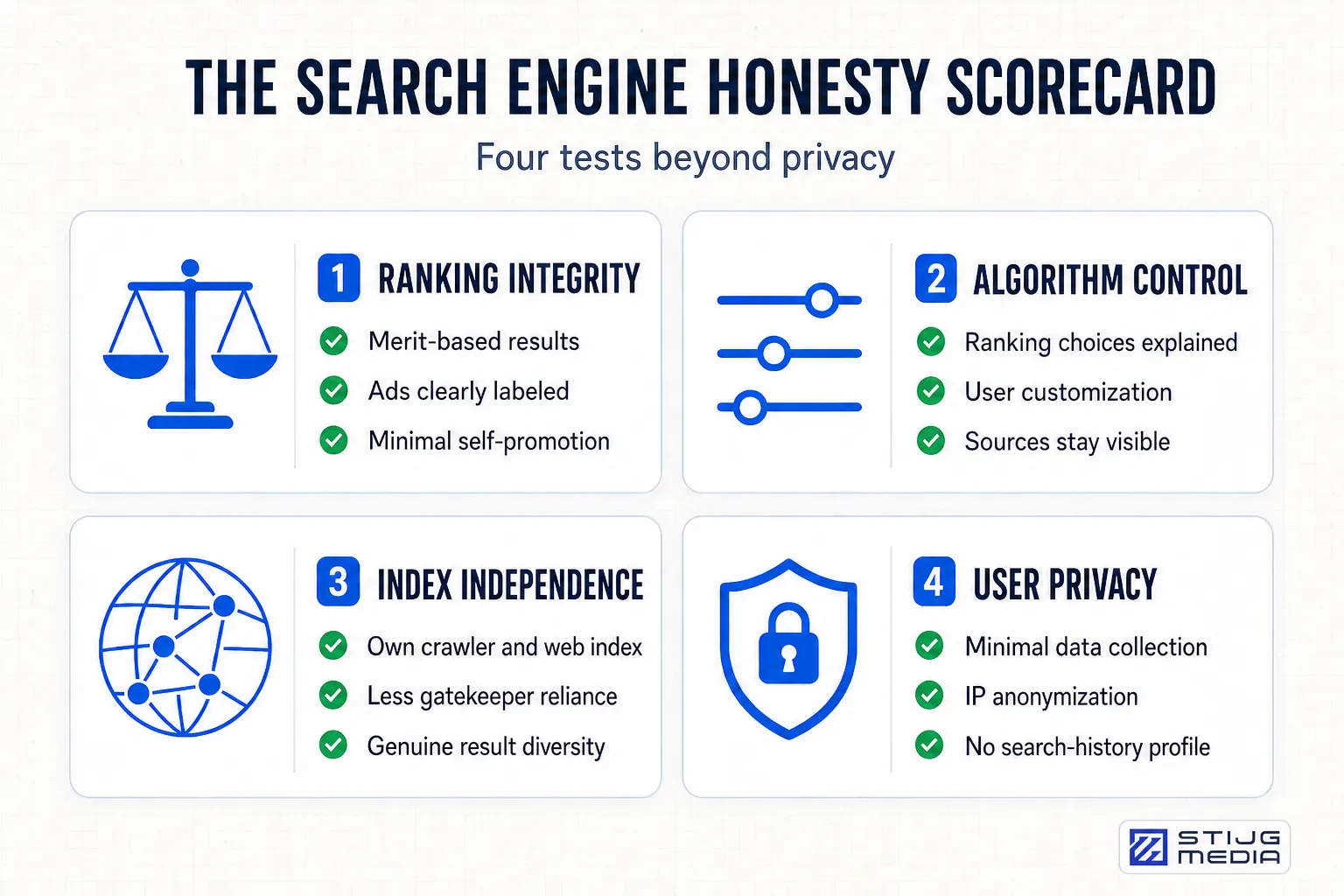
To properly answer the question “Which is the most trusted search engine?”, we must evaluate them on a more holistic set of criteria. We propose an “Honesty Scorecard” that moves beyond a simple privacy audit to assess the integrity of the results themselves.
Prominence of Ads and Self-Promotion
The most immediate test of a SERP’s integrity is how it presents paid versus organic content. How many of the top results are ads? Does the engine clearly distinguish them? Furthermore, does the engine use its prime real estate to promote its own products and services? The extensive use of a Knowledge Panel, shopping carousels, and integrated flight or hotel finders by giants like Alphabet Inc. and Microsoft can be seen as a form of self-dealing that pushes organic, merit-based results further down the page. This practice has been a central point in many antitrust discussions globally.
Algorithmic Transparency and Customization
The search algorithm of major engines is a closely guarded secret. This “black box” approach demands blind faith from users. A more honest approach involves greater algorithmic transparency. Some alternative search engines are moving in this direction. Brave Search, for example, offers a feature called Goggles, which allows users to create or apply custom ranking models to their searches, providing an unprecedented level of control. Similarly, DuckDuckGo’s Bangs feature allows users to search directly on other websites, bypassing its own ranking system. These features represent a philosophical shift from a single, paternalistic algorithm to a more open and user-directed model.
Independence of the Web Index
This is arguably the most important and least understood factor. A web index is the library of the internet that a search engine consults to answer a search query. Building and maintaining one via a web crawler is a monumental task. Only a few companies, including Google, Microsoft, and the smaller Mojeek, have a truly independent, global-scale web index. Many privacy-focused engines, including DuckDuckGo and Startpage, are metasearch engines, meaning they lease their core results from larger players, primarily Microsoft Bing. While they add a crucial layer of privacy, they do not control the fundamental ranking of information. Their results are still susceptible to any inherent information bias or censorship present in Bing’s index. An engine with its own index, like Brave Search, offers a genuine alternative to the Google/Bing duopoly, which is essential for true search neutrality.
Data Collection and User Anonymity
While not the only factor, user privacy remains a cornerstone of honesty. An honest engine should be transparent in its privacy policy, minimize data collection, and resist handing over user data. Engines like Swisscows and Startpage build their entire brand on this promise, offering features like full IP address anonymization and a commitment not to log any search query. This stands in stark contrast to the incumbents. The history of government requests, such as the 2006 demand for Google to turn over search records for the defense of the Child Online Protection Act (COPA), shows that user data held by major corporations can become a target. An engine that doesn’t collect the data in the first place offers the only foolproof protection from such search leakage.
A Comparative Look at Alternative Search Engines
Using this scorecard, we can analyze the landscape of search engines, from privacy-focused alternatives to the independent challengers and the established incumbents.
The Privacy Vanguard: DuckDuckGo, Startpage, and Ecosia
DuckDuckGo has become the default choice for millions seeking a private alternative to Google. Its commitment to not tracking users or storing search history is commendable. Ecosia operates on a similar model but uses its ad revenue to fund tree-planting projects. Startpage goes a step further by paying Google to use its results but anonymizing the user’s identity, offering Google’s search quality with robust privacy. The primary weakness of these engines is their reliance on a third-party web index (mostly Bing for DuckDuckGo and Ecosia, Google for Startpage). They provide a private window into someone else’s library, but they don’t curate the library itself. They offer strong user anonymity but limited influence over the core unbiased results.
The Index Independents: Brave Search and Mojeek
Brave Software, Inc. has invested heavily in creating its own independent web index for Brave Search. This is a game-changer. It means Brave is not beholden to the ranking decisions of Google or Microsoft. This independence, combined with its Goggles feature and a growing subscription model for a completely ad-free search experience, makes it one of the strongest contenders for the title of “most honest.” Mojeek, a UK-based company, is another pioneer in this space, having built its own index from the ground up with a strict pro-privacy, no-tracking policy. While its index is smaller than its competitors, its commitment to offering a genuinely different set of results is philosophically pure.
The Incumbents: Google and Microsoft Bing
It’s impossible to deny the power and utility of Google and Microsoft Bing. Their vast resources and decades of data allow them to provide incredibly comprehensive and feature-rich results. For many queries, they are simply the best tool for the job. However, their honesty score is poor when judged on algorithmic transparency and self-promotion. Their business models are built on user data and advertising, creating an inherent conflict of interest. While they provide a functional service, users must remain aware that they are navigating a commercial ecosystem designed to serve the business interests of Alphabet Inc. and Microsoft, not just the user’s quest for information.
Making the Right Choice for Your Needs
Ultimately, there is no single search engine that is “100% accurate” or universally the “best.” The most honest choice depends on your specific needs and your personal definition of trust. We can guide your decision by profiling three common user types.
The Privacy-Conscious User
For this user, the primary concern is preventing any form of data tracking or government surveillance. The priority is user anonymity. The best choice would be a search engine like Startpage, which uses high-quality Google results but completely severs the link between you and your search query, or Swisscows, which operates out of Switzerland under strict data protection laws and does not log any personal data. For these users, the reliance on another index is an acceptable trade-off for ironclad privacy.
The Small Business Owner
This user needs a level playing field. Their goal is to have their content discovered based on merit, not just the ability to compete with massive corporate ad budgets. For this persona, exploring and optimizing for an independent index like Brave Search is a strategic move. It represents a different, potentially less crowded ecosystem where quality content might have a better chance to achieve top rankings. Understanding this new web landscape offers a competitive advantage.
The Academic Researcher
This user’s highest priority is avoiding a filter bubble and finding comprehensive, unbiased results with clear source authority. No single engine is sufficient. The best strategy is a multi-pronged approach. Use Brave Search with its Goggles feature to create custom search parameters focused on academic journals and trusted sources. Simultaneously, use Google to leverage its massive index for finding obscure or legacy documents, while remaining critically aware of its potential for personalized results and commercial bias. This combination mitigates the risk of an echo chamber and ensures maximum coverage.
Navigating the complex world of search algorithms and digital visibility is a formidable challenge, but understanding the true meaning of honesty in a search engine is the first step. At Stijg Media, a Norwood, Massachusetts-based consultancy, we have dedicated years to mastering these systems to deliver tangible results. If you are looking for a strategic partner to enhance your visibility and ensure your business is found on merit, contact our expert team today for a personalized assessment.