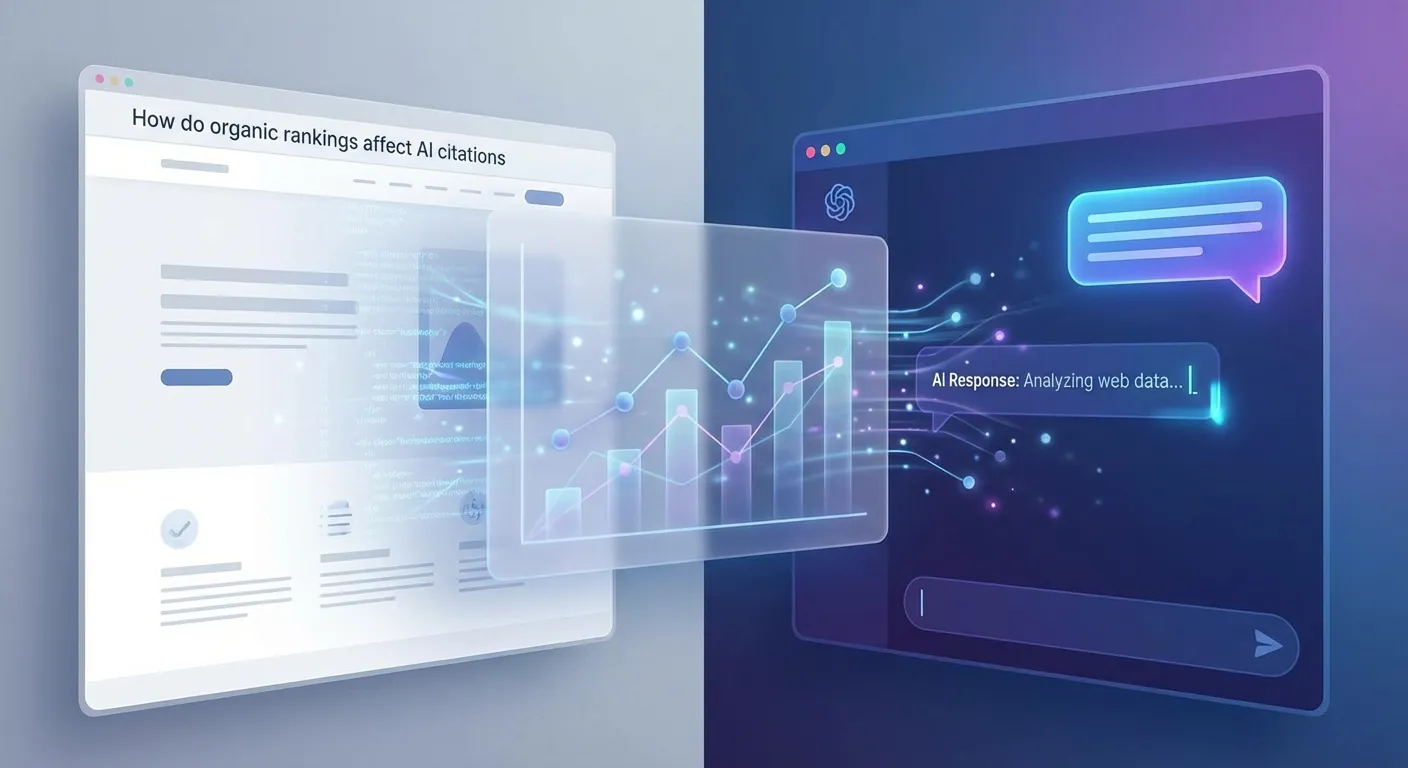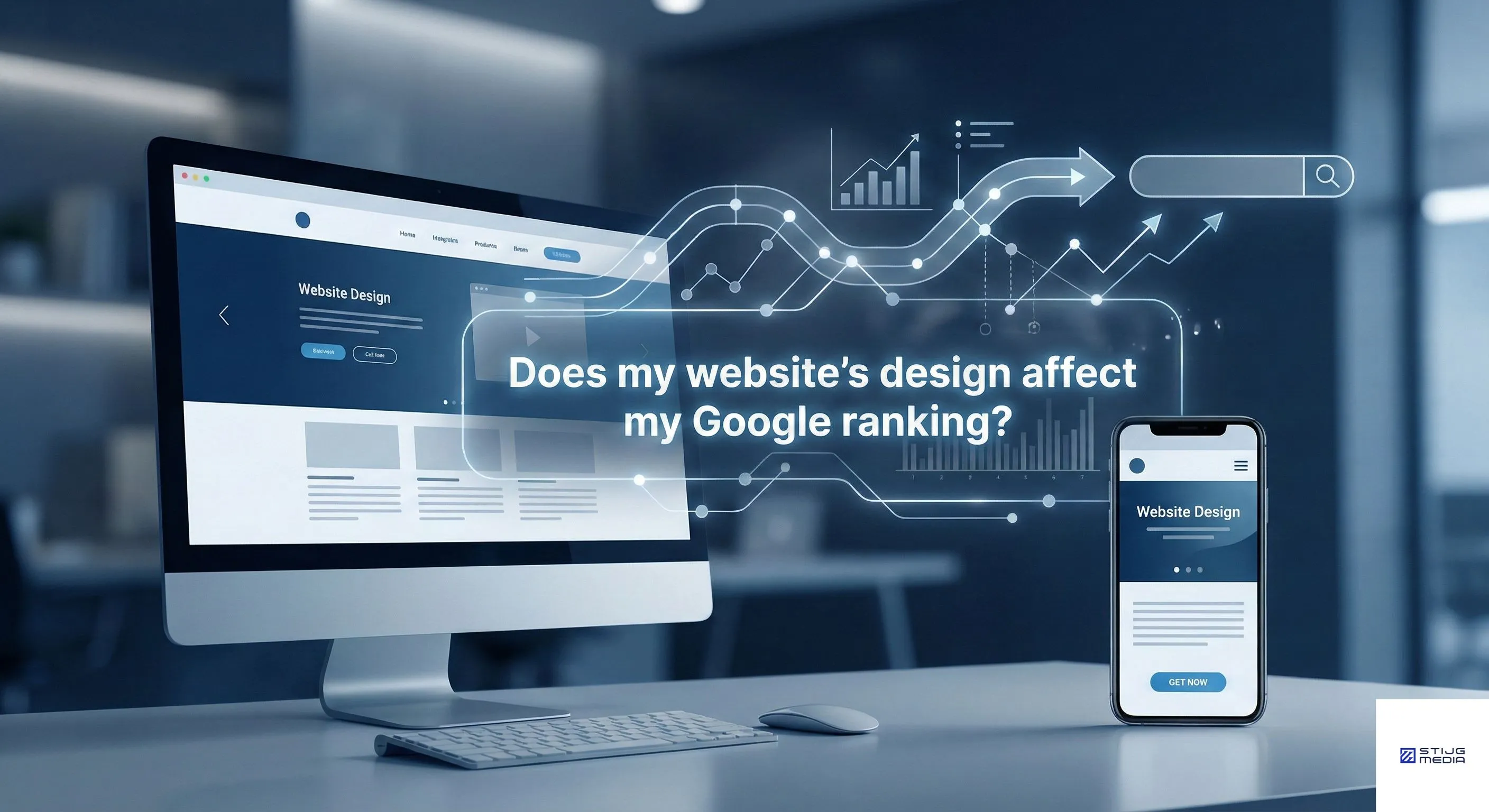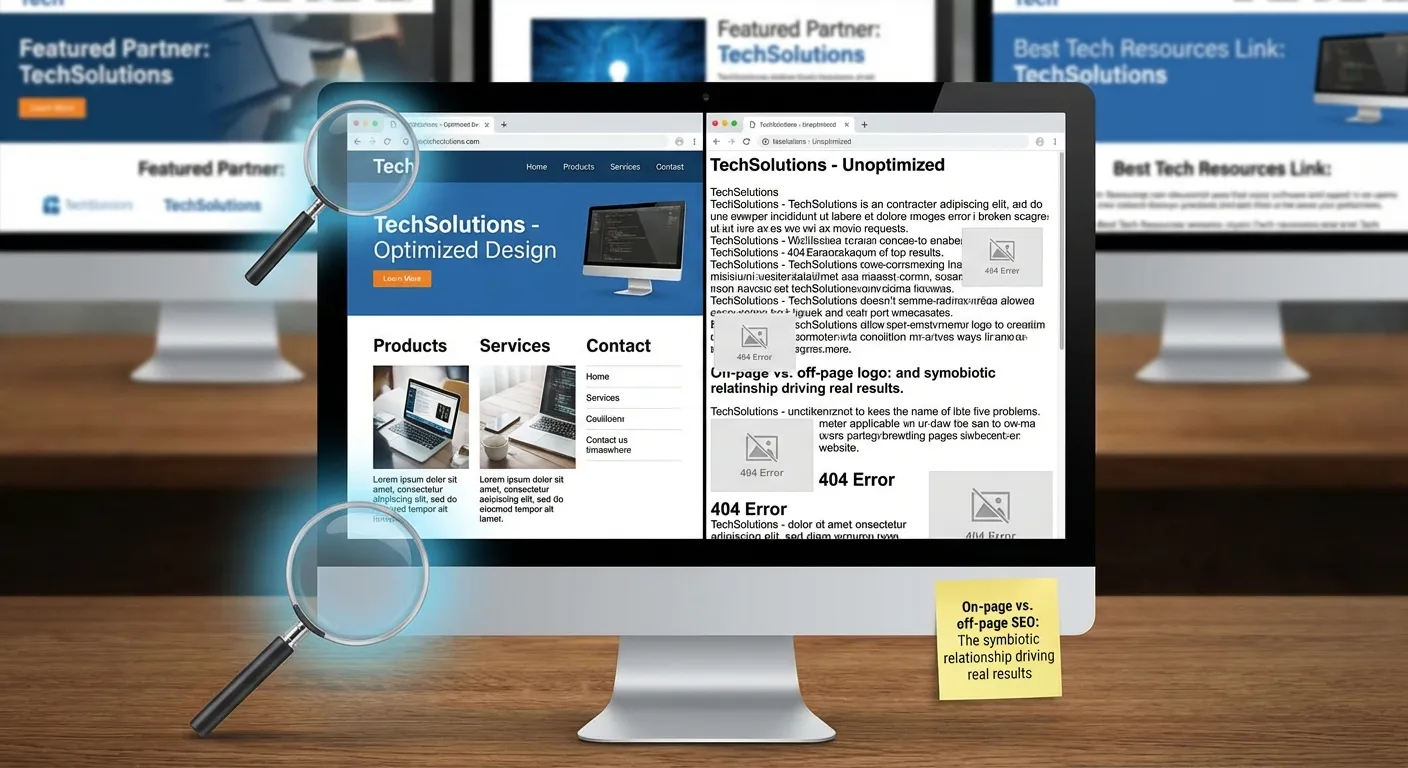
The core difference is that on-page SEO involves optimizing elements on your website to prove your content’s relevance to search engines. Off-page SEO involves actions taken outside your website to build its authority and trust. Rather than competing, they form a crucial feedback loop for top search rankings.
Moving Beyond the ‘Versus’: Understanding the SEO Ecosystem
For years, the digital marketing world has framed the conversation as “on-page SEO vs. off-page SEO,” as if a business must choose a side in a strategic battle. This is a fundamental, and costly, misunderstanding of how search engines like Google actually work in 2026. The reality is far more nuanced and interconnected. A successful organic search strategy doesn’t treat them as a choice; it treats them as two halves of a powerful, symbiotic whole.
Instead of a duel, think of it as a dialogue. On-page SEO is how you speak the search engine’s language, clearly communicating your content’s relevance and purpose. Off-page SEO is how you build your reputation in the wider digital world, providing the social proof and authority that validates your claims. Both are essential, and they work in a continuous feedback loop to improve your standing in the search engine results page (SERP).
To clarify, when people discuss “onsite SEO,” they are referring to on-page SEO. Likewise, “offsite SEO” is simply another term for off-page SEO. While we’re defining terms, it’s also helpful to understand the broader landscape. SEO is often categorized into four main types: on-page, off-page, technical SEO (the foundational health of your site), and local SEO (for geographically-focused businesses). Each plays a distinct but overlapping role.
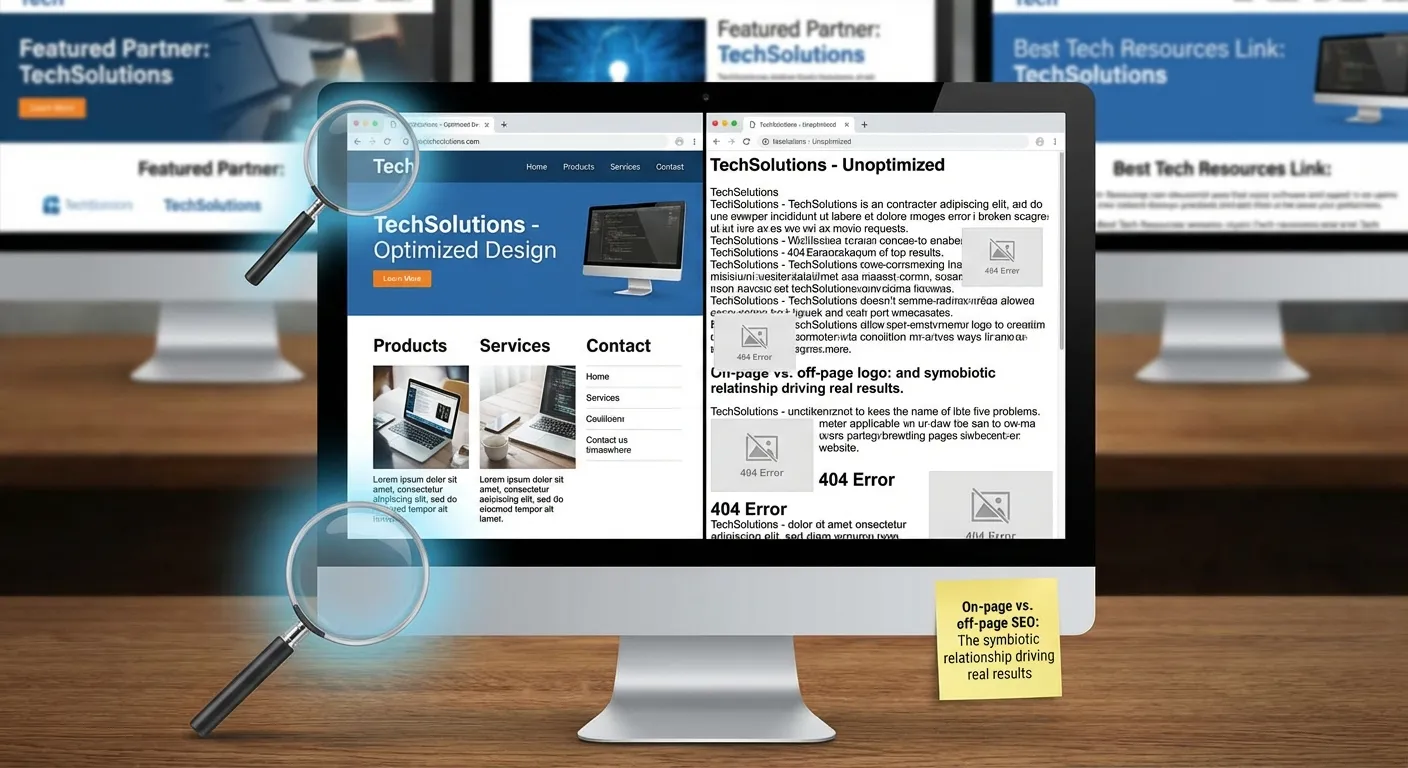
On-Page SEO: Proving Your Relevance
On-page SEO encompasses every optimization tactic you can directly control on your own website. This is your foundation. Its purpose is to make your content undeniably clear to both users and search engine crawlers. As Stanford University explains, search bots scan page elements like Page Titles, URLs, and Headers to determine what terms represent the content on that page. Essentially, you’re creating a perfectly organized file for the search engine’s massive library.
Key elements of on-page SEO include:
- Content Quality: Creating in-depth, valuable content that satisfies search intent and demonstrates E-E-A-T (Experience, Expertise, Authoritativeness, Trustworthiness).
- Keyword Research: Identifying the terms and phrases your audience uses to find solutions you provide.
- Title Tags and Meta Descriptions: Crafting compelling headlines (H1 tags) and summaries that improve click-through rate (CTR) from the SERPs.
- Header Tags (H2, H3): Structuring your content logically to improve readability for users and provide semantic context for search engines.
- Internal Linking: Strategically linking to other relevant pages on your site to distribute authority (link equity) and help users and crawlers navigate.
- URL Structure: Creating clean, descriptive URLs that are easy to understand.
- Image Alt Text: Describing images for visually impaired users and providing search engines with more context about your page content.
Off-Page SEO: Validating Your Authority
If on-page SEO is what you say about yourself, off-page SEO is what the rest of the internet says about you. It involves all the activities you do away from your website to raise its profile and build its reputation. These external signals are critical validators, telling search engines that your site is not just relevant, but also authoritative and trustworthy.
According to a breakdown in Forbes, on-page SEO examines what a page is about, while off-page SEO determines the authority and popularity of the site. The most powerful off-page signal is the backlink. A backlink, or inbound link, is a link from another website to yours. Search engines view high-quality backlinks as votes of confidence.
Key elements of off-page SEO include:
- Link Building: The proactive process of acquiring backlinks from reputable websites. As noted by experts in Entrepreneur, link building is one of the most effective techniques for optimizing off-page SEO. This can involve guest blogging, digital PR, and broken link building.
- Brand Mentions: Even unlinked mentions of your brand across the web can be a positive signal.
- Social Signals: Shares, likes, and engagement on social media platforms can indirectly influence visibility and drive traffic that leads to links.
- Online Reputation Management: Encouraging and managing reviews on third-party sites.
- Influencer Marketing: Collaborating with influencers who can expose your content and brand to a new audience, often generating valuable links and mentions.
The On-Page Foundation for Off-Page Success
This is the first half of the feedback loop, and it’s why most successful strategies begin with on-page optimization. It’s a simple, logical progression: you cannot build a strong reputation on a weak foundation. Attempting to build backlinks to a page that is slow, poorly written, or irrelevant is like trying to fill a leaky bucket. You might get some authority flowing in, but it will be wasted on a poor user experience.
A key insight from Forbes Agency Council advises that it’s best to maximize on-page SEO before focusing on off-page. This is because strong on-page and technical SEO creates what we call a “linkable asset.” This is a piece of content or a tool on your website so valuable, well-structured, and easy to use that other websites want to link to it.
This involves not just the content itself but also the technical scaffolding that supports it. Elements like fast page speed, a healthy Core Web Vitals score, mobile-friendliness, and a logical website architecture are crucial. These ensure that when a user clicks a link to your site, they have a positive experience. Without this, your bounce rate will be high, user engagement metrics will suffer, and search engines will quickly devalue those authoritative signals.
How Authority Amplifies Relevance: Closing the Feedback Loop
Once you have a technically sound website with high-quality content, off-page signals act as a powerful amplifier. A dofollow link from a website with high Domain Authority doesn’t just send referral traffic; it passes what’s known as link equity, a core component of Google’s ranking algorithms since the days of PageRank.
This external validation tells Google, “Hey, this content isn’t just well-structured and relevant—it’s also trusted by an established authority in this space.” This validation makes all your on-page signals more potent. Your well-researched keywords carry more weight. Your title tag is more likely to be featured prominently. Your entire page is seen as a more credible answer to a user’s query.
This is how brands achieve dramatic ranking improvements. That kind of sustained jump doesn’t happen from just tweaking meta descriptions; it happens when a strong on-page foundation is amplified by a powerful off-page link profile.
The Unifying Goal: A Superior User Experience
Ultimately, Google’s complex algorithm, with its hundreds of ranking factors, is designed to do one thing: predict and deliver the most satisfying user experience. Both on-page and off-page SEO are simply different sets of signals that help the search engine make this prediction.
On-page factors like page speed and logical header tags directly impact the user’s journey on your site. Off-page factors, like a backlink from a trusted industry publication, are an endorsement that a user clicking that link will find valuable information.
A key best practice, as highlighted by Stanford’s web guidelines, is to avoid distorting the user experience for the sake of SEO. This is the unifying principle. Every optimization, whether on-page or off-page, should serve the end user first. Practices that manipulate rankings without adding user value fall under the category of black hat SEO and are penalized by the Google algorithm, violating webmaster guidelines.
Strategic Application: Pros, Cons, and the Misunderstood 80/20 Rule
You may have heard of the “80/20 rule for SEO,” often misinterpreted as spending 80% of your time on one type of SEO. This is a dangerous oversimplification. True success comes from a balanced, integrated approach. Focusing too heavily on one area creates significant vulnerabilities.
Focusing Only on On-Page SEO
Pros: You have 100% control over the variables. It’s foundational and can deliver initial results cost-effectively. It’s essential for establishing relevance for your target keywords.
Cons: In a competitive market, you will hit a ranking ceiling. Without the external authority signals from off-page SEO, you’ll struggle to outrank competitors who have a similar level of on-page optimization but a much stronger backlink profile.
Focusing Only on Off-Page SEO
Pros: Can build authority signals relatively quickly and can be effective for brand visibility.
Cons: It’s the “leaky bucket” problem. Driving authoritative links to a website with poor content, slow page speed, or a confusing user experience is a complete waste of resources. Users will leave, your bounce rate will skyrocket, and search engines will quickly devalue those authoritative signals.
Key Factors for Your SEO Strategy in the AI Era
As search engines integrate more AI, the principles of this symbiotic relationship become even more critical. Here’s how a balanced strategy impacts the factors that matter most to your business.
Achieving measurable business results (traffic, leads, ROI)
On-page SEO gets you in the game by targeting the right audience with relevant content. Off-page SEO gets you to the top of the rankings where the majority of organic traffic is. This combination drives highly qualified organic search results to your site. Using tools like Google Analytics and Google Search Console allows you to track this entire funnel, connecting your SEO efforts directly to business outcomes.
Building long-term brand authority and trust
True, lasting authority isn’t a trick; it’s earned. On-page SEO earns it with your users by consistently providing expert content. Off-page SEO earns it with search engines by collecting endorsements from other respected players in your industry. This dual approach is the only way to build sustainable E-E-A-T that withstands algorithm updates.
Gaining a competitive advantage by adapting to new technology (AI search)
AI-powered search experiences will rely even more heavily on understanding content semantically and validating its credibility. On-page elements like schema markup and structured data will become even more important for communicating context to AI. Simultaneously, the firehose of AI-generated content will make off-page signals of human trust and authority—like a link from a reputable journalist—more valuable than ever. A balanced strategy is inherently future-proof.
Making the Right Choice for Your Needs
The “best” strategy isn’t a universal formula; it’s a matter of prioritizing and sequencing actions based on your specific business model and goals. The question isn’t if you need both, but how you should blend them right now.
For the local service business owner struggling with unpredictable revenue and inconsistent lead flow
Your immediate priority is a rock-solid on-page and technical foundation. Your website must be fast, mobile-friendly, and clearly state what you do and where you do it. Once that’s established, your off-page efforts should be hyper-focused on local SEO. This means optimizing your Google Business Profile, building consistent citations (NAP: Name, Address, Phone Number), and earning links from local community sites and business directories.
For the ecommerce brand manager facing stalled traffic growth and rising customer acquisition costs
Your on-page SEO is mission-critical, particularly technical elements like faceted navigation, canonical tags to avoid duplicate content, and rich schema markup for products. Your off-page strategy should move beyond basic links and focus heavily on digital PR and content marketing. Earning placements in gift guides, product review blogs, and industry publications will build the brand authority needed to compete for broad, high-value commercial keywords.
For the ambitious business owner who is serious about growth and wants to dominate their market
You need a fully integrated, aggressive, and continuous feedback loop. This means investing in creating pillar content and topic clusters to establish topical authority (on-page). Simultaneously, you must have a sophisticated off-page strategy involving digital PR, relationship-based link building, and potentially influencer marketing to promote that content and build an unimpeachable link profile. For you, on-page and off-page SEO are not sequential steps but parallel, always-on workstreams.
Ultimately, building a powerful presence in organic search results isn’t about choosing on-page or off-page SEO; it’s about mastering how they work together to create a superior user experience. Since our founding, the team at Stijg Media in Norwood, MA, has been architecting these comprehensive strategies to deliver sustainable growth. To understand how this symbiotic approach can be tailored to your specific business goals, contact our team for a strategic consultation today.