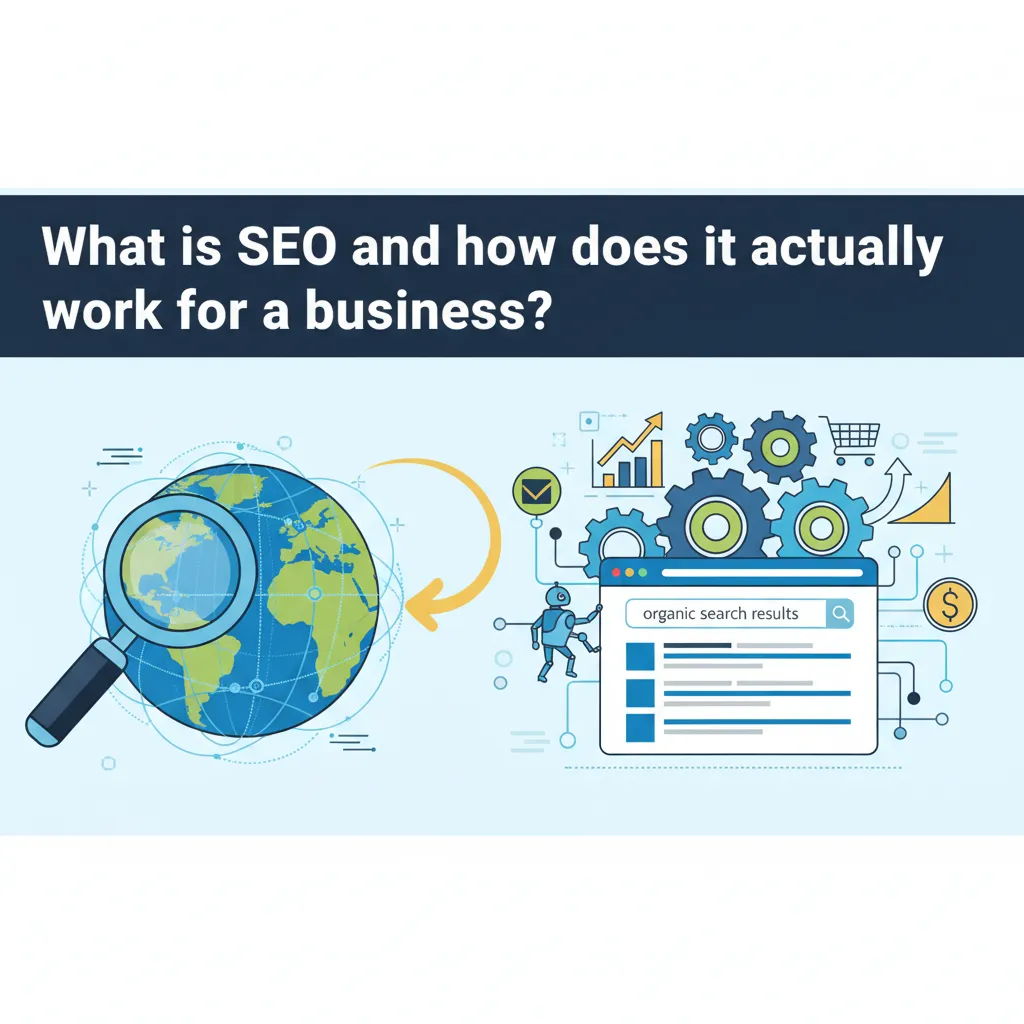
In business terms, SEO is the strategic process of making your website the most relevant, trustworthy, and authoritative answer to questions your target customers ask search engines and AI assistants. It works by optimizing your digital presence—your website’s content, technical structure, and industry reputation—to align with how search algorithms understand and prioritize information, ultimately driving high-quality, organic traffic that converts into leads and revenue.
The Great Redefinition: Why Your Old SEO Playbook Is Obsolete
For over two decades, the answer to “What is SEO?” has been deceptively simple. Most would tell you search engine optimization (SEO) is the practice of increasing both the quality and quantity of “organic” (unpaid) traffic to a website by improving its ranking in the indexes of search engines. The goal was clear: get to the top of the “10 blue links” on a Google results page. This singular focus created an entire industry dedicated to climbing a ladder.
But that ladder has been kicked over. The finish line is gone.
The rise of generative AI, answer engines like ChatGPT, and Google’s own AI-powered summaries has fundamentally broken the old model. Simply ranking #1 is no longer a guarantee of visibility or traffic. The new objective is not to rank, but to be the answer. For a business to win in 2025 and beyond, SEO must be redefined. It is no longer a game of ranking manipulation; it is the rigorous practice of becoming the definitive, authoritative source that both classic search engines and modern AI assistants trust to solve user queries directly.

This isn’t a subtle shift; it’s a seismic event for digital marketing. The cat-and-mouse game between marketers and search engines is as old as the internet itself. In fact, as early as 1997, search engine providers began adjusting their algorithms to prevent web content providers from manipulating their search rankings. That dynamic is now accelerating at an unprecedented pace. The business value of organic search is higher than ever, but accessing it requires a completely new strategy.
Beyond the ‘10 Blue Links’: The New Finish Line in the Age of AI
Remember the classic Google search engine results page (SERP)? It was a predictable, linear list. You clicked a link, visited a page, and hoped it had your answer. That journey is now a relic. Today’s search experience is a dynamic, interactive conversation where the search engine itself often provides the answer directly, pulling information from various sources without requiring a user to click through to any single website.
This is the world of “zero-click searches.” It’s driven by a proliferation of SERP features like:
- AI Overviews (formerly SGE): AI-generated summaries that sit at the very top of the results, answering complex questions by synthesizing information from multiple websites. If you’re not one of the cited sources, you’re invisible.
- Featured Snippets: A specific block of text pulled from a webpage to directly answer a question, often displayed in a box with a link to the source.
- “People Also Ask” (PAA) Boxes: An expanding list of related questions and their short answers, keeping users on Google’s platform longer.
- Knowledge Panels: Information boxes that appear for specific entities (like companies, people, or concepts), pulling data from various trusted sources.
Related: Zero-Click Searches Rising? Here’s How to Adapt (Before Your Competitors Do)
Each of these features is designed to provide an immediate solution, turning the search engine from a directory into a destination. For a business, this presents a critical threat and a massive opportunity. If your SEO strategy is still singularly focused on climbing the organic rankings for a few keywords, you are fighting a battle that is already over. The new question is not “How do I get a business on the first page of Google?” but “How do I make my business the source of truth that powers these direct answers?”
From ‘Keyword Optimization’ to ‘Query-to-Answer’ Structuring
The old SEO model was built on keywords. You would find keywords your customers are searching for, create a page for each one, and “optimize” it by including the keyword in the title, headings, and text. This led to robotic, unnatural content that was written for a machine, not a human. While keywords are still important, the focus has shifted from the word itself to the intent behind it.
Modern search and AI engines don’t just match strings of text; they work to understand concepts, relationships, and context. This is the foundation of semantic search. To be chosen as the definitive answer, your content must be structured not around a single keyword, but around comprehensively solving a user’s entire problem. This is the ‘Query-to-Answer’ model.
Building a Topic, Not Just a Page
Instead of creating one page for “best running shoes,” a Query-to-Answer strategy involves building a keyword cluster around the central topic of “choosing running shoes.” This might include a comprehensive pillar page supported by articles on:
- How to determine your foot arch type
- The difference between trail and road running shoes
- Comparing minimalist vs. maximalist cushioning
- How to prevent common running injuries with proper footwear
- Reviews of specific B2C or B2B products (if applicable)
This approach demonstrates deep topical authority. You’re not just trying to rank for a term; you’re aiming to own the entire conversation. You’re building a resource that a user—and therefore an AI—can trust to have all the answers in one place. An essential tool in this process is schema markup. This is a form of microdata that you add to your website’s code to help search engines understand your content more effectively. Think of it as labeling your content for the machine, explicitly stating, “This is a product review,” “This is a recipe,” or “This is an FAQ page.” This structuring makes your information far easier for Google and AI to parse and present as a rich result or a direct answer.
E-E-A-T is for Machines, Too: The New Currency of Trust
For years, Google has emphasized the importance of E-A-T—Expertise, Authoritativeness, and Trustworthiness—as a guiding principle for content quality. Recently, they added a crucial first “E” for Experience. E-E-A-T is the bedrock of how Google’s human quality raters evaluate search results, and it’s rapidly becoming the primary filter for what AI models will cite as a source.
Think about it: an AI model is designed to provide correct and reliable information. To do so, it must be trained on data it can trust. An anonymous, poorly written blog post has no signals of trustworthiness. In contrast, an in-depth analysis written by a recognized industry professional, published on a reputable website with a clear author bio and citations, is packed with positive E-E-A-T signals. These signals are no longer just for human readers; they are machine-readable indicators of credibility.
One of our partners in the AI space noted:
“Adrian has been a highly valuable contributing member of our community, where we focus on artificial intelligence, search engine optimization… I would strongly recommend anyone in this space to consider Adrian an authority on these…”
This kind of third-party validation and demonstrated expertise is precisely what search and AI engines are looking for. Building E-E-A-T is how you demonstrate that your business is a reliable source of information. This is achieved through both on-page and off-page efforts. Off-Page SEO focuses on building credibility through external factors like backlinks from authoritative websites, guest blogging, and social signals, according to West Virginia University’s marketing experts. Each high-quality backlink is a vote of confidence from another site, telling search engines that your content is valuable and trustworthy.
A Tale of Two Strategies: Traditional SEO vs. Modern Answer Engine Optimization
Understanding the difference between the old and new models is critical for any business owner looking to invest in a sustainable marketing strategy. One is a short-term tactic; the other is a long-term asset-building strategy.
| Factor | Traditional SEO (Ranking-Focused) | Modern AEO (Authority-Focused) |
|---|---|---|
| Primary Goal | Achieve a high ranking on the traditional “10 blue links” SERP. | Become the definitive, cited source for answers across AI, SERP features, and voice search. |
| Core Tactic | Keyword optimization on individual pages. Technical tweaks to “game” the algorithm. | Building topical authority through content clusters. Demonstrating E-E-A-T. Structuring data for machines (schema). |
| Key Metrics | Keyword rankings, organic traffic volume. | Branded search volume, SERP feature ownership, lead quality, share of voice, brand authority. |
| Pros | Can provide quick wins for specific terms. Simpler to measure and understand. | Durable and future-proof against AI disruption. Builds a powerful brand asset. Generates higher-quality traffic. |
| Cons | Extremely vulnerable to algorithm updates and AI Overviews. Generates lower-intent traffic. Fosters a short-term mindset. | Requires a significant upfront investment in high-quality content. Results take longer to materialize. More complex to execute. |
Introducing ‘Search Experience Optimization’ (SXO): Your Blueprint for the New Web
The modern approach, which we call Search Experience Optimization (SXO), is the holistic practice of ensuring your brand provides the best, most consistent, and most correct answer across a customer’s entire, non-linear journey. This journey no longer starts and ends on a Google results page. It might begin with a voice search on a smart speaker, continue with a query in ChatGPT, lead to a video on YouTube, and finally end on your website.
SXO integrates several key digital marketing disciplines:
- Content Marketing: Creating genuinely helpful articles, guides, videos, and tools that solve customer problems. This is the foundation. Does my business need a blog for SEO? Absolutely, but it must be a resource center, not a keyword-stuffing ground.
- Technical SEO: Ensuring your website is fast, mobile-friendly, and easy for search engine crawlers to index. This includes optimizing for Core Web Vitals, submitting an XML sitemap, and using a clean site structure with logical internal links.
- User Experience (UX): The relationship between user experience and SEO is now direct. A site that is confusing or slow to load will be abandoned, sending negative signals to Google that your page is not a good answer. The importance of page speed for Google rankings cannot be overstated.
- Off-Page Authority Building: Proactively earning high-quality backlinks, mentions, and positive reviews that signal to the entire web that you are a trusted entity in your field.
The goal of SXO is to achieve durable, long-term visibility by being the most reliable resource. It future-proofs your marketing against the AI revolution because you are no longer dependent on a specific format of search results. Instead, you are focused on becoming the raw material that all answer engines—present and future—will rely on.
Practical Application: Answering Your Core SEO Questions
To ground this new strategy in reality, let’s address some of the most common questions business owners have about how SEO works.
What are the 3 C’s of SEO?
The most important parts of SEO can be broken down into three core pillars. This framework helps organize what can feel like a chaotic process.
- Content: This is the “what” of your website. It’s the information that answers your customers’ questions. High-quality content is well-researched, expertly written, and structured to be easily understood by both humans and the search bots that are programmed to meet requirements for showing up first. It goes beyond simple blog posts to include comprehensive guides, case studies, and original research.
- Code (Technical): This is the “how” of your website. It’s the technical foundation that allows search engines to find, crawl, and understand your content. Key areas affecting a website’s SEO efforts include not just keywords, but also the metadata, which is the back-end code of your website. This pillar covers site speed, mobile-friendliness, schema markup, and having a secure site (HTTPS). A technically flawed website can make even the best content invisible.
- Credibility (Authority): This is the “why” someone should trust you. It’s your website’s reputation on the internet, primarily measured by the quality and quantity of backlinks from other reputable sites. This is where you build your E-E-A-T and prove to search engines that you are a legitimate authority in your field.
What is the 80/20 rule for SEO?
The Pareto Principle, or 80/20 rule, applies perfectly to SEO. It suggests that roughly 80% of your results will come from 20% of your efforts. In a modern SEO context, this means focusing on the vital few activities that drive the most impact, rather than getting lost in a sea of minor tweaks. For most businesses, that 20% includes:
- Creating and promoting a small number of truly exceptional, “pillar” content pieces that target your most important customer problems.
- Earning a handful of highly authoritative backlinks from industry-leading websites.
- Ensuring your most critical pages (homepage, service pages, top blog posts) are technically perfect and offer a flawless user experience.
Avoid spending 80% of your time on low-impact tasks like constantly tweaking meta descriptions for pages that get no traffic or chasing hundreds of low-quality links.
Is paying someone to do SEO worth it?
The question of whether to invest in professional SEO services often comes down to ROI. While it’s possible to learn and “do SEO myself for my business,” the complexity and rapid evolution of the field make it a full-time job. A professional or agency brings expertise, specialized tools, and a proven process that can dramatically accelerate results and help you avoid costly mistakes, like actions that could lead to a Google penalty.
The ROI of SEO, when done correctly, is one of the highest in digital marketing because it builds a long-term, sustainable asset. Unlike paid search, where your visibility disappears the moment you stop paying, organic traffic from a strong authority-based SEO strategy can deliver leads for years. Many of our clients find the investment pays for itself many times over. As one happy client shared:
“We went from page 8 to page 1 in six months and have stayed there ever since.”
This kind of durable visibility creates predictable growth, transforming a business’s lead generation from a rollercoaster into a reliable engine. The key is finding a partner who understands the modern, authority-first approach, not one still selling outdated ranking reports.
Making the Right Choice for Your Needs
The right SEO strategy is not one-size-fits-all. It depends entirely on your business model, your market, and your goals. The choice isn’t necessarily between “traditional” and “modern” as mutually exclusive options, but about finding the right blend and focus for your unique situation.
For Local Service Business Owners
If you’re a plumber, lawyer, or dentist struggling with unpredictable lead flow, your primary battleground is local. Your strategy should be a potent blend of foundational local SEO and modern authority building. This means:
- Master the Basics: Flawlessly optimize your Google Business Profile. Aggressively pursue customer reviews. Ensure your name, address, and phone number (NAP) are consistent across all local directories.
- Build Hyper-Local Authority: Create content that answers questions your local customers have. Instead of “how to fix a leaky pipe,” create “A homeowner’s guide to fixing leaky pipes during a harsh New England winter.” Sponsor a local little league team and get a link from their site. Be a guest on a local podcast. Become the trusted local expert that Google and local residents recommend.
For Ecommerce Brand Managers
If you manage an e-commerce brand and are facing stalled traffic and rising customer acquisition costs from paid ads, you need to lean heavily into the modern Answer Engine Optimization (AEO) approach. Your goal is to intercept customers at every stage of their buying journey with helpful content. This means:
- Go Beyond Product Pages: Your product pages are for converting, but your content is for attracting. Build out a comprehensive resource center with ultimate buying guides, product comparison tools, and “how-to” articles related to your product category. If you sell high-end coffee makers, become the internet’s most trusted resource on brewing techniques, bean selection, and grinder maintenance.
- Target Problem-Aware, Solution-Unaware Customers: Use content gap analysis to find the questions your customers are asking before they know your product is the solution. This top-of-funnel content is what AI will reference and is your key to breaking free from the expensive cycle of paid advertising. This is how SEO drives business growth for e-commerce in the new era.
Ultimately, the path forward is clear: the future of being found online is not about tricking an algorithm, but about earning genuine trust—from both your customers and the machines that guide them. It requires a commitment to quality, a deep understanding of your audience, and a strategy built for the new reality of search. By shifting your focus from chasing rankings to building authority, you create a durable competitive advantage that will pay dividends for years to come.
From our headquarters in Norwood, MA, Stijg Media helps businesses nationwide navigate this complex transition. We build future-proof SEO strategies centered on establishing your brand as the definitive authority in its space. If you are ready to move beyond outdated tactics and build a sustainable engine for organic growth, contact our expert team today for a personalized assessment.