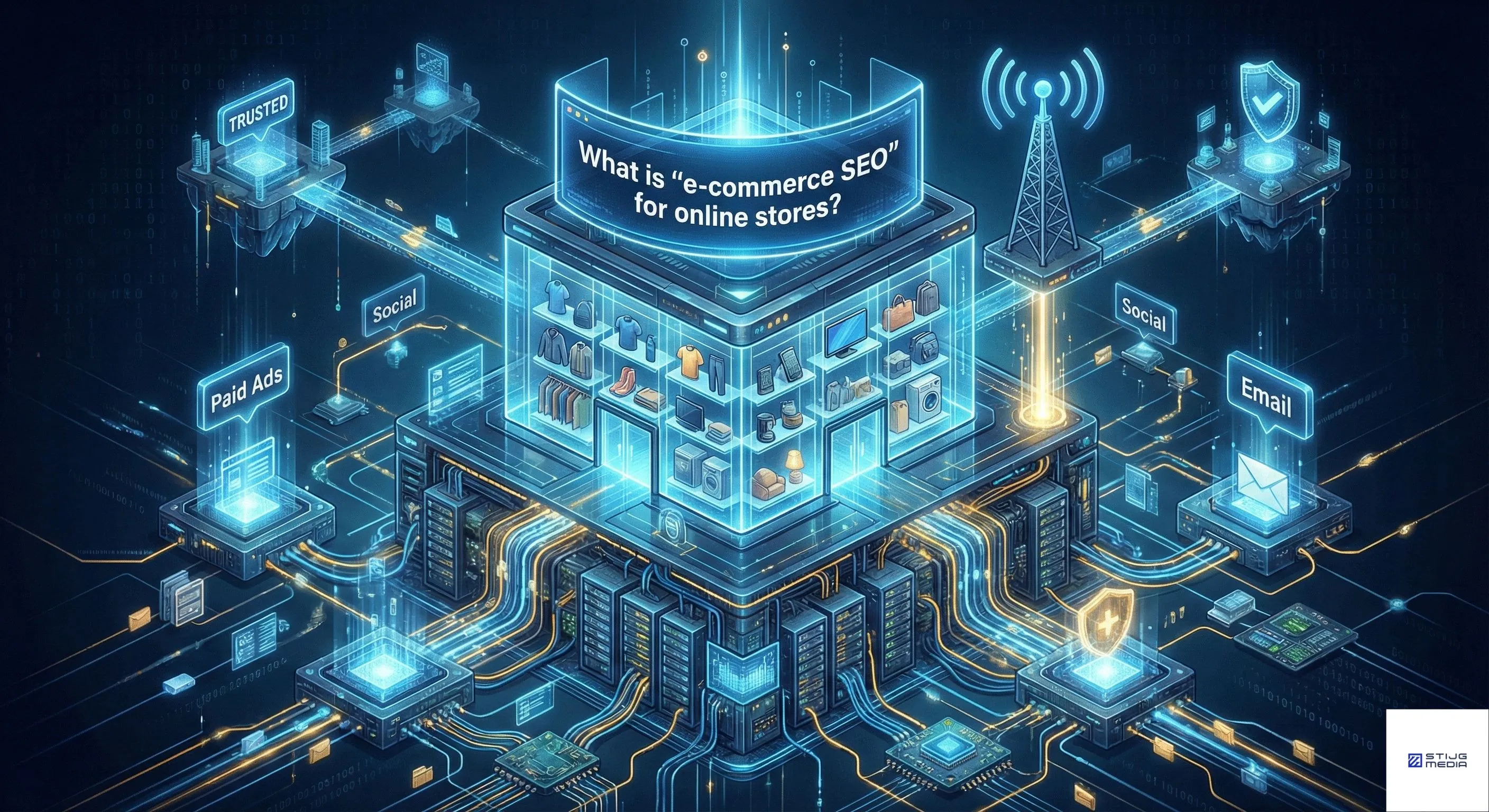
E-commerce SEO is the strategic process of making your online store more visible in the organic, or unpaid, search engine results pages (SERPs). The goal is not merely to drive “free traffic,” but to build a foundational business asset that attracts high-intent customers, lowers acquisition costs across all channels, and creates a long-term, defensible competitive advantage for your brand.
The Critical Misconception About E-commerce SEO
Ask ten marketers “what is SEO in eCommerce?” and you will likely get ten similar answers. They will talk about keywords, rankings, and organic traffic. They will frame it as a channel—one of many spokes on the marketing wheel, sitting alongside PPC, social media, and email. For years, this has been the accepted definition. And for years, it has been fundamentally wrong.
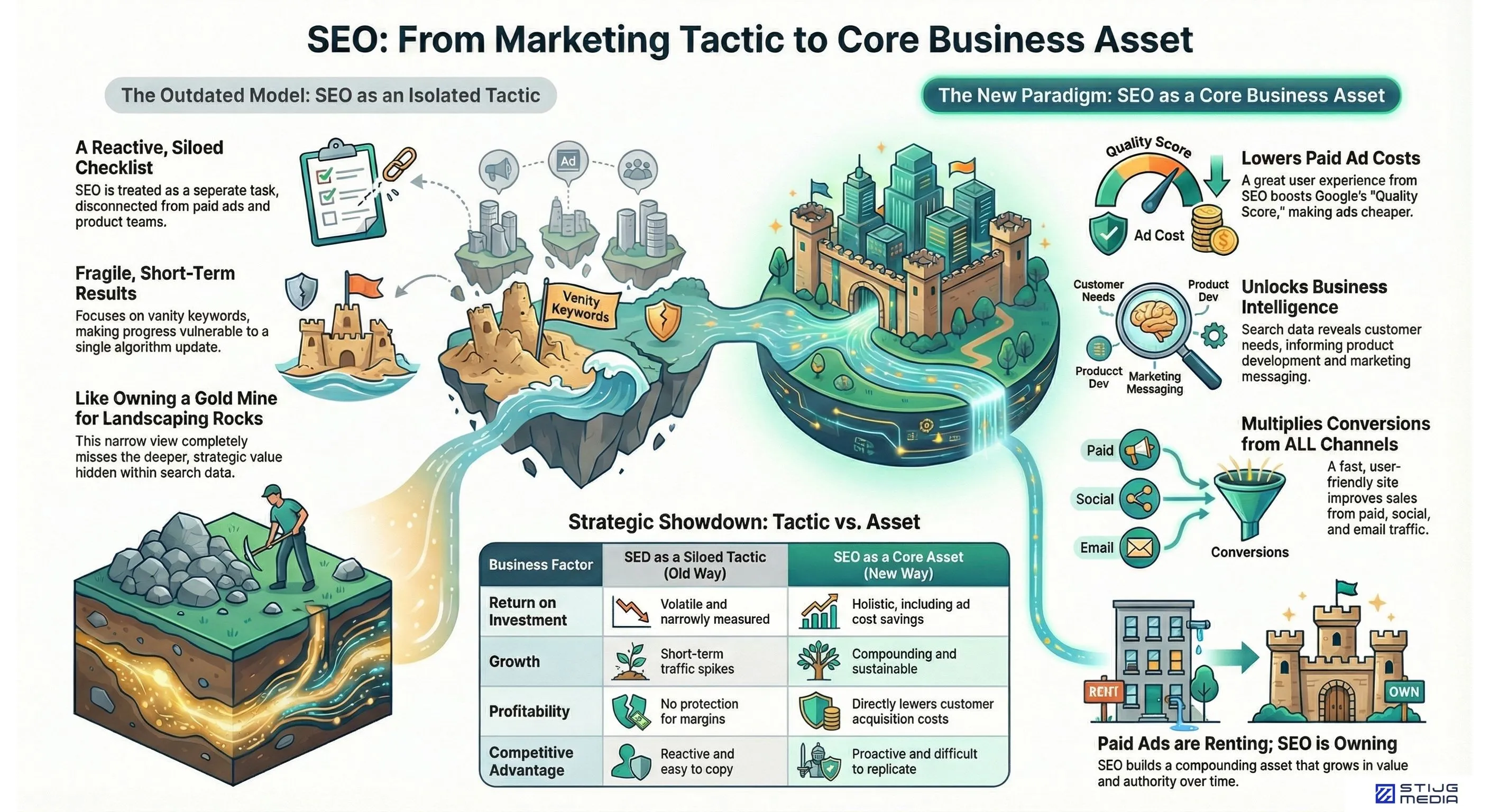
This narrow view is precisely why so many online stores struggle. They treat SEO as a checklist of technical tasks, a tactic to be deployed, rather than a strategy to be integrated. The truth, especially in the AI-driven marketing landscape of 2025, is far more profound. Search Engine Optimization (SEO) is the process that drives your marketing efforts in the digital economy. It will be difficult to achieve any of your digital sales objectives without implementing a SEO program for your website as a part of your digital strategy. Viewing it as just another traffic source is like owning a gold mine and only using it for landscaping rocks. The real value lies much, much deeper.
This guide will deconstruct that outdated model. We will explore what are the key components of e-commerce SEO and demonstrate why a modern, holistic e-commerce SEO strategy is not just another marketing expense, but the single most important investment you can make in the long-term profitability and resilience of your online business.
Deconstructing the Old Model: SEO as an Isolated Traffic Channel
The traditional approach to search engine optimization for an online store is reactive and siloed. A business owner might notice a traffic plateau and think, “I need to do some SEO.” This typically involves a flurry of activity focused on a few vanity keywords. The process looks something like this:
- Conduct basic keyword research for high-volume product terms.
- Optimize a few product page titles and descriptions.
- Write a couple of blog posts.
- Maybe try to get a few backlinks.
- Track rankings for those few keywords and hope for the best.
In this model, SEO is a separate task assigned to one person or an agency, disconnected from the paid ads team, the content team, and the product development team. Success is measured in a vacuum: “Did our rank for ‘blue widgets’ go up?”
While this approach isn’t entirely without merit—any optimization is often better than none—it’s fraught with risk and missed opportunities. It creates a fragile system where a single Google algorithm update can wipe out months of progress. It completely ignores the synergistic power that search insights hold for the rest of the business. It’s a short-term tactic masquerading as a long-term strategy, and it’s a primary reason so many business owners ask, “why is my online store not getting traffic” even after “doing SEO.” In today’s market, this approach is becoming dangerously obsolete. In fact, a recent study suggests that a brand can be considered as old fashioned if it does not utilise the SEO as their marketing strategy, in penetrating the online marketplace.
The New Paradigm: How SEO Functions as a Core Business Asset
To truly understand the importance of SEO for online business, you must shift your perspective. Stop seeing it as a way to get free clicks. Start seeing it as a central intelligence and performance-enhancing system that underpins and amplifies every other marketing investment you make. This is how you build a resilient, profitable e-commerce brand.
Beyond ‘Free Traffic’: How SEO Directly Lowers Your Paid Ad Costs
One of the most immediate and tangible benefits of a foundational SEO approach is its impact on your paid search (PPC) campaigns. Many businesses see SEO and PPC as separate, even competing, channels. The reality is that they are two sides of the same coin, and a strong SEO foundation makes your ad dollars dramatically more efficient.
Here’s how it works: When you run Google Ads, your cost-per-click (CPC) isn’t just based on your bid. It’s heavily influenced by your “Quality Score.” Google assigns this score based on three main factors: ad relevance, expected click-through rate, and—most importantly—landing page experience. A high-quality, relevant, and fast-loading landing page leads to a higher Quality Score. A higher Quality Score means Google rewards you with better ad placements for a lower CPC.
What creates a great landing page experience? The core tenets of on-page SEO. Things like:
- Fast page load times (a cornerstone of technical SEO and Core Web Vitals for e-commerce).
- Clear, relevant page titles and headings.
- High-quality, optimized images and compelling, SEO-friendly product descriptions.
- A logical site architecture for e-commerce that’s easy to navigate.
- Mobile-friendliness (a key part of mobile SEO for online stores).
When your site is optimized for search engines, it’s inherently optimized for users. By investing in SEO, you are directly improving your landing page experience, which boosts your Quality Score. This makes your entire paid search budget more efficient, allowing you to get more clicks and conversions for the same ad spend, directly protecting your profit margins.
SEO as Your Core Business Intelligence Engine
The data you can gather from a comprehensive e-commerce SEO program is one of your most valuable, yet underutilized, business intelligence tools. Most businesses stop at finding high-volume keywords. A strategic approach uses search data to understand the deepest needs and questions of your target audience.
Through robust buyer intent keyword research, you can map out your entire customer journey. You can identify:
- Informational Keywords: Questions your audience asks at the very beginning of their journey (e.g., “how to choose a running shoe for flat feet”). This informs your blogging for e-commerce stores and e-commerce content marketing strategy.
- Commercial Investigation Keywords: Terms people use when comparing options (e.g., “nike vs adidas stability shoes” or “best e-commerce platforms for seo”). This helps you create comparison pages and highlight your unique value proposition.
- Transactional Keyword Examples: Phrases with high purchase intent (e.g., “buy nike zoomx invincible run 3 size 11” or “BigCommerce SEO services discount”). These are crucial for your product and category pages.
This intelligence, gathered using tools like Ahrefs for e-commerce keyword research or by running a Semrush for online store audit, shouldn’t live in an “SEO” spreadsheet. It should be shared across your organization. This data can and should inform:
- Product Development: Are customers consistently searching for a feature or product variant you don’t offer? That’s a clear signal from the market.
- Marketing Messaging: The exact language customers use in search is the language that will resonate most in your ad copy, social media posts, and email subject lines.
- Customer Service: Understanding common questions from search data allows you to build out proactive FAQ sections and help docs, reducing support tickets.
The Conversion Multiplier: From Traffic Source to Revenue Engine
Here’s a common scenario: a business invests heavily in a social media campaign that drives thousands of visitors to their online store, but sales barely budge. The campaign is labeled a failure. But was the traffic the problem, or was the website itself the issue?
A technically sound, user-friendly website doesn’t just rank better; it converts better. Think of your website as your digital flagship store. If the floors are dirty, the lights are flickering, and customers can’t find what they’re looking for, it doesn’t matter how many people you convince to walk through the door—they won’t buy anything. Technical SEO is the process of cleaning the floors and fixing the lights.
Key technical and user experience factors that SEO addresses include:
- Site Speed: Slow-loading pages are a primary driver of cart abandonment. A focus on how to improve e-commerce site speed and meet Core Web Vitals is crucial for e-commerce conversion rate optimization.
- Mobile Experience: With a majority of traffic coming from mobile devices, a clunky mobile site is a conversion killer.
- Navigation & Architecture: A logical structure, clear internal linking for product pages, and intuitive category page SEO best practices help users find products easily. This is where you think about how to create an seo-friendly URL structure that makes sense.
- Trust Signals: A secure site (HTTPS) and clear contact information are foundational. In fact, it’s been noted that all search engines pay attention to whether there is contact information on the site, including phone numbers and e-mail addresses.
When you fix these issues, you don’t just improve your chances of ranking on Google. You improve the conversion rate of traffic from every single source—paid search, social media, email marketing, direct visits, and referrals. A client recently noted, after we implemented a foundational SEO overhaul, “I’ve seen an uptick in website traffic and calls since.” The calls didn’t just come from organic search; the improved user experience made it easier for all visitors to convert.
From Marketing Expense to Balance Sheet Asset
Perhaps the most significant mindset shift is understanding SEO not as a short-term marketing expense, but as a long-term investment in a business asset. Paid advertising is like renting an audience. The moment you stop paying, the traffic stops. It’s a constant, necessary expense, but it doesn’t build lasting value.
SEO, on the other hand, is like buying the land your business is built on. Every piece of optimized content you create, every high-quality backlink you earn, every technical improvement you make contributes to your site’s authority. This authority compounds over time, creating a moat around your business that becomes increasingly difficult and expensive for competitors to overcome. This is the path to long-term sustainable growth vs. short-term traffic spikes.
This is how brands achieve durable, top-of-page-one rankings. As one of our e-commerce partners shared, “We went from page 8 to page 1 in six months and have stayed there ever since. Adriaan and his team have done amazing work providing steady guidance to help drive business growth.” That “staying power” is the result of building a genuine asset, not just chasing a temporary ranking. This asset generates predictable traffic and revenue month after month, increasing the overall valuation of your business.
The Four Pillars: What Are the Key Components of E-commerce SEO?
So, if you’re ready to adopt this new paradigm, how to do SEO for an online store becomes the next logical question. A successful e-commerce SEO strategy is built on four interconnected pillars. Answering “what are the 4 types of SEO?” helps clarify the work involved.
1. Technical SEO: The Unseen Foundation
What is technical SEO for e-commerce? It’s the work that ensures search engines can efficiently find, crawl, understand, and index your website. Without a solid technical foundation, all your other efforts will be hampered. Key areas include:
- Site Architecture: Designing a logical, scalable structure for your categories, subcategories, and products.
- Crawlability & Indexability: Using tools like Google Search Console for e-commerce to monitor how Google interacts with your site, managing your robots.txt file, and implementing sitemaps. For large stores, crawl budget optimization is critical.
- Site Speed: Optimizing images, leveraging browser caching, and minimizing code to ensure your pages load quickly.
- Duplicate Content: Using canonical tags for product variants and implementing other solutions for fixing duplicate content on e-commerce sites, which is a common issue.
- Structured Data: Implementing schema markup for e-commerce sites to give search engines detailed information about your products (price, availability, reviews), which can lead to rich results in the SERPs.
2. On-Page SEO: Optimizing Your Digital Shelves
This is the practice of optimizing individual pages on your site to rank higher and earn more relevant traffic. For an online store, this primarily concerns your product and category pages.
- Keyword Research & Targeting: Moving beyond simple terms to understand user intent, targeting long-tail keywords for e-commerce, and mapping keywords to the correct pages.
- Product Page Optimization: Writing unique, descriptive, and SEO-friendly product descriptions, using high-quality images with optimized alt text, and structuring content with proper headings.
- Category Page Optimization: Optimizing collection pages for search with introductory text, clear product listings, and faceted navigation SEO solutions that prevent indexing issues.
- Internal Linking: Creating a strong internal linking for product pages and other key areas of the site to distribute authority and help users and search engines navigate.
3. Content Marketing: Answering Questions and Building Authority
E-commerce content marketing is about creating valuable, relevant content that attracts your target audience at various stages of their buying journey. This builds authority and drives traffic to your commercial pages.
- Blogging for E-commerce Stores: Writing helpful guides, tutorials, and articles that answer your customers’ questions and solve their problems.
- Buying Guides: Creating in-depth guides that compare products or help customers choose the right option for their needs.
- User-Generated Content (UGC): Encouraging and optimizing user-generated content for SEO, such as customer reviews and Q&As, which provide fresh, relevant content and social proof.
4. Off-Page SEO: Building Trust and Authority Across the Web
Off-page SEO refers to actions taken outside of your own website to impact your rankings. It’s primarily about building your site’s authority and reputation.
- Link Building: The core of off-page SEO is developing e-commerce link building strategies to earn high-quality backlinks from other reputable websites. This is a powerful signal to search engines that your site is trustworthy.
- Brand Mentions: Building brand awareness through digital PR, partnerships, and social media.
- Local SEO for E-commerce Brands: For brands with physical locations, optimizing Google Business Profiles and local citations is essential for capturing “near me” searches.
When these four pillars work in harmony, you begin the process of increasing organic traffic to your online store in a sustainable way. This comprehensive approach is central to the best e-commerce seo best practices and forms the core of any effective e-commerce seo checklist.
Key Factors for Your Decision: A Strategic Breakdown
When considering an investment in SEO, every business owner needs to evaluate it against key performance indicators. Here’s how the two philosophies—SEO as a silo vs. SEO as an asset—stack up against the factors that truly matter.
Return on Investment (ROI)
SEO as a Silo:
ROI is measured narrowly, typically as (Organic Revenue - SEO Cost) / SEO Cost. This often looks positive but misses the bigger picture and can be volatile, dropping significantly after an algorithm update.
SEO as an Asset:
ROI is calculated holistically. It includes the direct organic revenue plus the cost savings on PPC, the increased conversion rate across all channels, and the long-term value of the brand authority built. This provides a much more accurate and compelling picture of true business impact.
Long-term Sustainable Growth vs. Short-term Traffic
SEO as a Silo:
Focuses on short-term ranking tactics that can produce quick but often fleeting traffic spikes. This approach is vulnerable to algorithm changes and competitive pressure.
SEO as an Asset:
Focuses on building a foundation of technical excellence, helpful content, and genuine authority. This creates compounding growth that is more resilient and sustainable over the long haul.
Overall Business Profitability and Margin Protection
SEO as a Silo:
Can increase revenue, but does little to protect margins. It operates independently of other costs, particularly rising customer acquisition costs (CAC) from paid channels.
SEO as an Asset:
Directly protects and improves profitability. It lowers CAC by making paid ads more efficient and by growing a “free” organic channel, reducing reliance on expensive advertising over time.
Future-proofing and Competitive Advantage
SEO as a Silo:
This is a reactive strategy. It’s about keeping up. If a competitor outspends you or finds a new tactic, you’re back to square one.
SEO as an Asset:
This is a proactive strategy. It builds a durable competitive advantage that is difficult and time-consuming for others to replicate. In an AI-driven future where user experience and genuine authority are paramount, this foundational approach is the ultimate way to future-proof your business.
Making the Right Choice for Your Needs
Is SEO worth it for eCommerce? Considering the data, the answer is an overwhelming yes. However, the approach you take must align with your specific business situation. There is no one-size-fits-all solution, only the right strategy for your goals.
For The E-commerce Brand Owner experiencing stalled traffic and rising customer acquisition costs:
Your primary challenge is profitability erosion. Relying solely on paid channels is a race to the bottom as costs inevitably rise. Adopting the “SEO as a business asset” model is your path to sustainable growth. The immediate goal is to make your paid spend more efficient by improving site quality and to start building your organic traffic base to reduce your dependence on ads over the long term. Focus on a comprehensive e-commerce seo audit checklist to find the biggest opportunities in technical SEO and on-page product page optimization first.
For The Local Service Business Owner struggling with unpredictable revenue and inconsistent lead flow:
Your pain point is predictability. Your revenue is tied to a lead flow that can feel like a rollercoaster. A foundational SEO approach, with a strong emphasis on local SEO, builds a predictable stream of high-intent local leads. By establishing authority in your service area, you create a system that generates calls and form fills consistently, smoothing out revenue and allowing you to plan for growth with confidence.
For The Overwhelmed Marketer using outdated tactics and seeking a clear, effective strategy for the future:
You’re likely juggling multiple channels that don’t seem to work together, and it’s exhausting. The “asset” philosophy provides the unifying strategy you’ve been looking for. It positions search intelligence as the hub of your marketing wheel. The insights from SEO inform your content strategy, your ad campaigns, and your social media efforts. It stops you from chasing disconnected tactics and allows you to build a cohesive, data-driven marketing machine that delivers measurable results.
Ultimately, the right choice depends on your vision for your business. If you are seeking sustainable, profitable growth that compounds over time, then treating SEO as a core business asset isn’t just an option—it’s a necessity. With the growing sophistication of the digital marketplace, there is one “customer acquisition improvement exercise” that can help improve your overall ecommerce ROI: search engine optimization.
For over two decades, our team has been dedicated to helping businesses move beyond outdated tactics and build genuine, long-term digital assets. At Stijg Media, based in Norwood, MA, we don’t just focus on rankings; we focus on building a strategic foundation that amplifies your entire marketing ecosystem for sustainable, profitable growth. For a personalized assessment of how this foundational approach can transform your business, contact our expert team today.