E-E-A-T stands for Experience, Expertise, Authoritativeness, and Trustworthiness. It’s not a direct ranking factor but a core principle from Google’s Search Quality Rater Guidelines used to evaluate content quality. It’s critically important because it guides how Google’s algorithms are trained to recognize and reward helpful, people-first content.
The End of Easy Answers: Why E-E-A-T is Your Moat in the AI Era
The digital landscape is flooded. In the last few years, the proliferation of AI-generated content has created a tsunami of information, much of it generic, repetitive, and devoid of real insight. For any business trying to connect with an audience, this presents a monumental challenge: how do you stand out? How do you earn the attention, and more importantly, the trust of real people when the internet is filled with digital echoes?
The answer lies in a concept that has become the North Star for sophisticated marketing and SEO strategy: E-E-A-T. This acronym, representing Experience, Expertise, Authoritativeness, and Trustworthiness, is far more than the latest industry buzzword. It is the human-centric philosophy Google uses to train its complex search systems. Understanding it is the key to not only surviving but thriving in this new era.
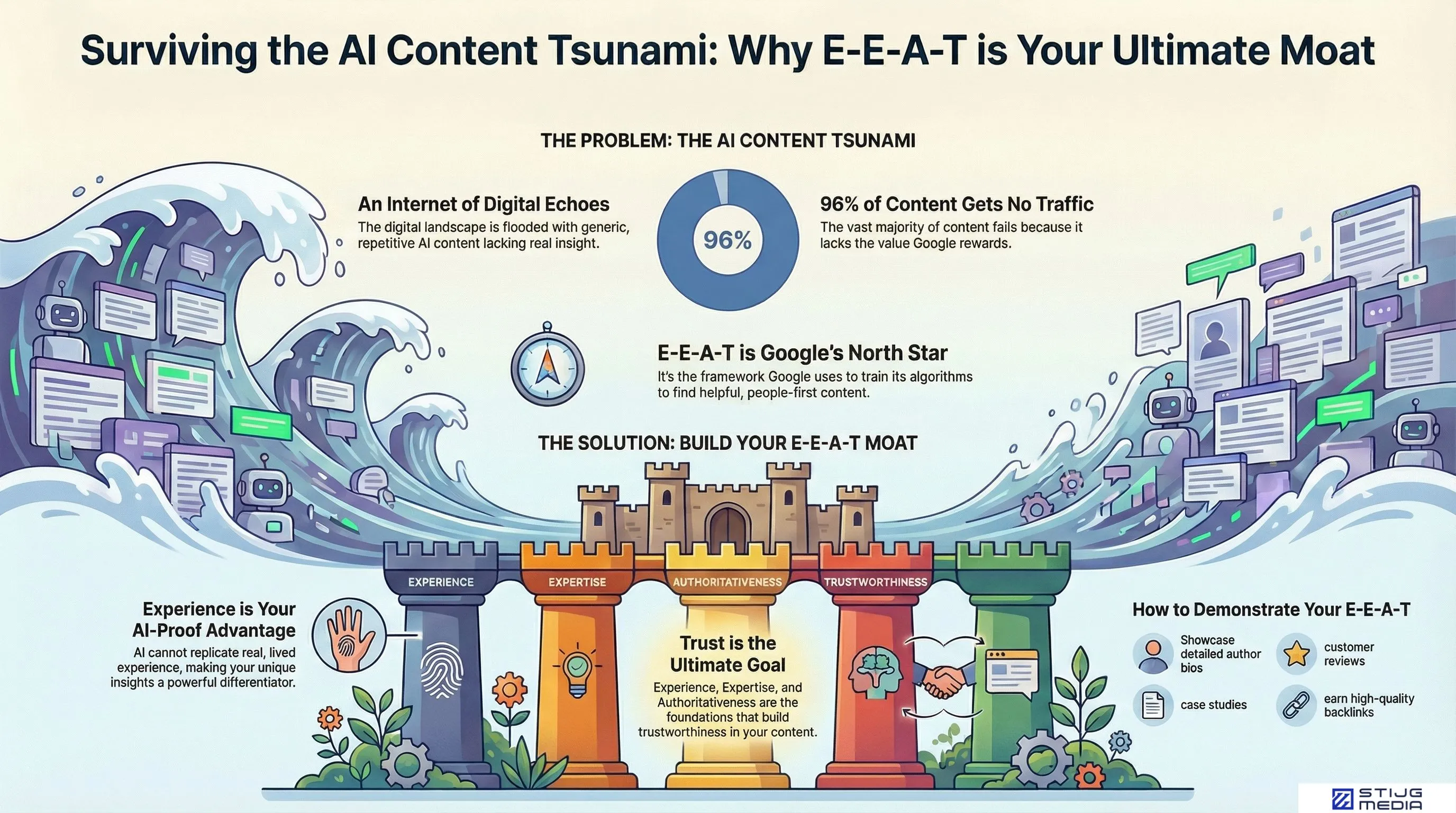
Our core thesis is this: E-E-A-T is not a simple SEO checklist to be ticked off, but rather the ultimate defense against untrustworthy information and the single most critical differentiator in an age of artificial intelligence. It’s about proving you are a real entity with real experience, creating content with a beneficial purpose that delivers genuine results for your audience.
Deconstructing the Myth: Why There’s No “E-E-A-T Score”
Let’s clear up the biggest misconception first. There is no magical “E-E-A-T score” that Google assigns to your website. You cannot find it in Google Search Console, and there isn’t a specific line of code you can add to boost it. Instead, E-E-A-T is a framework used by thousands of human evaluators who review the quality of Google’s search results.
These evaluators use a comprehensive document called the Google’s Quality Rater Guidelines (QRG) to provide feedback on the Page Quality Rating of countless websites. This feedback doesn’t directly change the ranking of a specific page they review. Instead, it serves as training data. This data is used to refine the ranking systems and algorithms that determine what shows up on the search engine results page (SERP) for billions of queries. So, while Google’s quality raters use E-E-A-T to assess search results, and their feedback informs Google’s algorithms, it is not a direct, technical ranking factor like site speed.
So, if the algorithm doesn’t “read” E-E-A-T, how does it work? Google’s systems are designed to identify a constellation of tangible ranking signals that act as proxies for high E-E-A-T. The algorithm can’t understand “trust” in a human sense, but it can measure signals that correlate with it. These signals are the tangible evidence of your authority and expertise that search engines can find and evaluate across the web. Think of it like this: a human rater can read an article and say, “This feels trustworthy,” while the algorithm looks for the ingredients that typically produce that feeling, such as:
- The quality and authority of other websites that link to your page (backlinks).
- Mentions of your brand or author on other reputable sites.
- Positive online reviews and customer testimonials.
- The overall reputation of the publisher or content creator.
- The use of secure protocols like HTTPS to protect user data.
This is the fundamental shift in thinking required for modern search engine optimization. The goal isn’t to trick an algorithm; it’s to genuinely demonstrate your E-E-A-T so convincingly that the proxy signals naturally follow.
Trust as the Apex: The True Purpose of E-E-A-T
It’s common to view the four components of E-E-A-T as equal pillars. This is a mistake. The framework is better understood as a hierarchy, with Trustworthiness at the very top. Experience, Expertise, and Authoritativeness are not the end goals; they are the foundational inputs that build the single most important element: Trust.
Here’s how they work together:
- Experience: Do you have first-hand, lived experience with the topic? Have you actually used the product, visited the location, or navigated the process you’re writing about?
- Expertise: Do you possess the necessary skills and knowledge in the field? This is about credentials and a deep understanding of the subject matter.
- Authoritativeness: Are you or your brand recognized as a go-to source of information on this topic? This is about your reputation and digital footprint within your industry.
- Trustworthiness: This is the culmination of the other three. It encompasses the accuracy, honesty, safety, and reliability of the content, the content creator, and the website. A user must feel safe and confident in the information you provide.
Consider a topic related to “Your Money or Your Life” (YMYL), such as financial information or medical content. A well-written article about investment strategies might demonstrate expertise. However, if it’s published anonymously on a brand-new website, it lacks authoritativeness. Without a clear author bio, a transparent About Us page, and a history of reliable content, it will fail to build user trust. Google’s systems are especially sensitive to this for YMYL topics, where misinformation can cause serious harm.
The “Experience” Moat: Google’s Answer to the AI Revolution
The addition of the first “E” for Experience was perhaps the most significant recent evolution of this framework. In December 2022, Google updated its framework from E-A-T to E-E-A-T, adding ‘Experience’ to better evaluate content based on first-hand knowledge. This was not a minor tweak; it was a direct response to the changing information ecosystem.
Why is Experience so important now? Because it is the one thing that large language models and AI-generated content cannot authentically replicate. An AI can scrape the web and synthesize existing information into a coherent article. It can mimic expertise. But it cannot share the nuanced insights that come from actually doing something. It has no lived experience.
This focus on first-hand experience is now a powerful competitive advantage. While AI is a useful tool, it cannot replicate the unique insights and experiences humans provide, making a focus on E-E-A-T a key way to differentiate a business from competitors. Your unique perspective, original photography, personal case studies, and genuine customer stories are your moat against the flood of generic content.
Demonstrating this experience is what separates content that merely exists from content that actually performs and delivers business results. It’s what transforms a page from a simple collection of keywords into a valuable resource that helps people. It’s no coincidence that many of our clients who see the most dramatic improvements are those who lean into their unique experience. As one client shared, “We went from page 8 to page 1 in six months and have stayed there ever since.” Their success wasn’t from a technical trick; it was from effectively showcasing their deep, real-world experience in their industry.
From Abstract Philosophy to Actionable Signals: How to Demonstrate E-E-A-T
So, how do we translate this high-level concept into a practical SEO strategy? We focus on creating and highlighting the tangible on-page and off-page trust signals that Google’s systems can measure.
On-Page SEO Signals: Building Trust on Your Website
- Detailed Author Bios: Every article should have a clear author with a dedicated bio. This should include their credentials, relevant experience, and links to their social media profiles or other publications. This connects your content to a real person and their digital identity.
- A Robust “About Us” Page: This is one of the most critical pages on your site. Tell your story. Who are the people behind the business? What is your mission? Showcase your team of subject matter experts (SMEs) and what makes them qualified.
- Accessible Contact Information: A business that is easy to contact feels more trustworthy. Provide a physical address (if applicable), phone number, and email address. This shows you are a real, accountable entity.
- Citations and Sources: Back up your claims, especially for YMYL topics. Link out to reputable, authoritative sources like academic studies, government reports, or established industry publications. This demonstrates factual accuracy and good information literacy.
- Original Research and Case Studies: Publishing unique data, surveys, or detailed case studies with real results is a powerful signal of expertise and experience. This also creates an asset that other sites will want to link to.
- User-Generated Content (UGC): Incorporate customer testimonials and reviews directly on your service or product pages. This social proof provides unbiased evidence of your value from real people.
Off-Page SEO Signals: Building Your Reputation Across the Web
- High-Quality Backlinks: Earning links from other well-respected websites in your niche is a cornerstone of authoritativeness. A robust link building strategy is about quality, not quantity.
- Brand Mentions: Even unlinked mentions of your brand, products, or key personnel in reputable online publications contribute to your brand reputation and can be identified by Google’s systems.
- Third-Party Online Reviews: Cultivate positive reviews on platforms people trust, like your Google Business Profile, G2, Trustpilot, or industry-specific review sites.
- Industry Recognition: Has your business or founder won awards, been featured on podcasts, or spoken at conferences? Highlighting this industry recognition strengthens your authoritativeness. A respected industry figure once remarked about our own founder, “I would strongly recommend anyone in this space to consider Adrian an authority on these…” This kind of third-party validation is invaluable.
- Building Topical Authority: Consistently publishing in-depth, expert-level content on a specific set of topics over time establishes your website as a definitive resource, building a strong reputation with both users and search engines.
A Nuanced Comparison: Choosing the Right Strategic Lens
To succeed today, a business must decide which approach will guide its marketing efforts. The choice often comes down to a philosophical difference in how you view search engine optimization and content.
E-E-A-T as a Guiding Philosophy
Pros: This approach is sustainable and future-proofs your marketing against algorithm volatility. It aligns with Google’s long-term goal of satisfying user intent with helpful, people-first content. By focusing on building real brand equity and user trust, you create a durable competitive advantage and insulate your business from the shocks of Google Core Updates.
Cons: The results are not always immediate. It requires a genuine, long-term investment in creating high-quality content and building a real reputation. The ROI can be harder to measure with simple metrics like keyword ranking in the short term.
Traditional SEO as a Set of Direct Ranking Factors
Pros: Focusing on technical SEO, keyword density, and other direct ranking signals can sometimes yield quicker, more measurable wins. It’s easier to create a checklist of tasks and report on immediate outputs like an improved site speed score or a specific keyword moving up a few positions.
Cons: This strategy is inherently reactive and prone to “chasing the algorithm.” It can lead to the creation of thin, unhelpful content designed for bots instead of people. Websites that rely heavily on these tactics are the most vulnerable when Google releases updates designed to devalue manipulative or low-quality optimization.
Human-Created Content vs. AI-Generated Content
Human-Created (with E-E-A-T): The primary advantage is its ability to showcase unique, first-hand experience, provide novel insights, and build a genuine connection with the reader. It is the only way to create truly differentiated, authoritative content. The main drawback is that it is slower and more resource-intensive to produce.
AI-Generated Content: The benefits are speed and scale. AI is a powerful tool for generating ideas, creating outlines, or summarizing factual information. However, when used to create entire articles, it lacks genuine experience, often contains factual inaccuracies, and produces generic content that is easily replicated. This is a fast path to becoming a commodity. The impact is already being felt; in 2025, many websites saw traffic drops of 20-40% due to AI-generated summaries in search results, increasing the importance of strategies that drive more engaged, high-quality traffic.
Key Factors for Your Business Success in the AI Era
Is E-E-A-T still relevant? It’s more relevant than ever. This is precisely why an estimated 96.55% of content gets zero organic traffic from Google—it lacks the unique value, authority, and trust that Google’s systems are designed to reward. For any business leader, the strategic implications are clear.
Future-proofing marketing against AI disruption
An E-E-A-T-focused strategy is fundamentally resilient. While competitors are churning out low-cost, generic AI content, you are building a brand that is synonymous with trust and expertise. This is a defense against the commoditization of information and a way to ensure your voice is heard above the noise.
Generating predictable revenue and high-quality leads
High E-E-A-T content doesn’t just attract traffic; it attracts the right traffic. By deeply satisfying user intent and demonstrating your credibility, you attract qualified prospects who are further along in the buying journey and already trust your brand. This leads to higher conversion rates and more predictable business results.
Building sustainable trust and authority online
Trust is the ultimate currency on the web. E-E-A-T is the framework for earning it. This approach transforms your website from a digital brochure into a respected industry resource, fostering customer loyalty, encouraging repeat business, and building an asset that grows in value over time.
Differentiating from competitors using outdated tactics
In a sea of sameness, demonstrable experience is the ultimate differentiator. While your competitors are busy chasing keyword rankings with soulless content, you can build a powerful brand reputation that they simply cannot copy. Your expertise, your team’s stories, and your customers’ success become your most powerful marketing tools.
Making the Right Choice for Your Needs
Adopting an E-E-A-T philosophy isn’t a one-size-fits-all process. The way you apply these principles should be tailored to your specific business model and goals.
The Local Service Business Owner focused on consistent lead generation and predictable scheduling.
Your greatest asset is your direct connection to the community and your hands-on work. Your focus should be heavily on the ‘E’ (Experience) and ‘T’ (Trust). Prioritize your Google Business Profile, actively soliciting reviews with photos from happy clients. Create content that showcases your work in the real world: detailed case studies of local jobs, before-and-after photo galleries, and videos explaining your process on-site. Your first-hand experience is what differentiates you from faceless national directories.
The National Ecommerce Brand Manager concerned with rising customer acquisition costs and stalling traffic.
You need to focus on both ‘E’s—Experience and Expertise. Go far beyond generic product descriptions scraped from a manufacturer’s catalog. Invest in high-quality, original product photography and videos showing your products in use. Create in-depth buying guides and comparison articles written by genuine product experts. Feature user-generated content prominently on product pages. This demonstrates authentic experience with your products, builds trust, and helps justify your price point against cheaper competitors.
The In-house Marketing Manager tasked with adapting their company’s overall digital strategy to the AI revolution.
Your role is to build ‘A’ (Authoritativeness) at an organizational level. This requires a holistic content strategy. Your job is to identify the subject matter experts within your company and turn them into recognized authorities. This means creating detailed author pages for them, getting them booked on industry podcasts, writing guest posts on reputable sites, and publishing original research or whitepapers under their name. You are not just marketing a company; you are building the digital footprint and reputation of its most valuable experts.
Ultimately, the best choice depends on your unique situation, resources, and long-term ambition. The common thread, however, is a shift away from short-term tactics and toward the sustainable, long-term strategy of building a brand that people and search engines can trust. At Stijg Media, located in Norwood, MA, we build foundational E-E-A-T-driven SEO strategies that deliver sustainable growth and predictable revenue. We believe in creating people-first content that builds real authority and cements your position as a leader in your field. If you are ready to future-proof your marketing, contact our team for a personalized assessment.