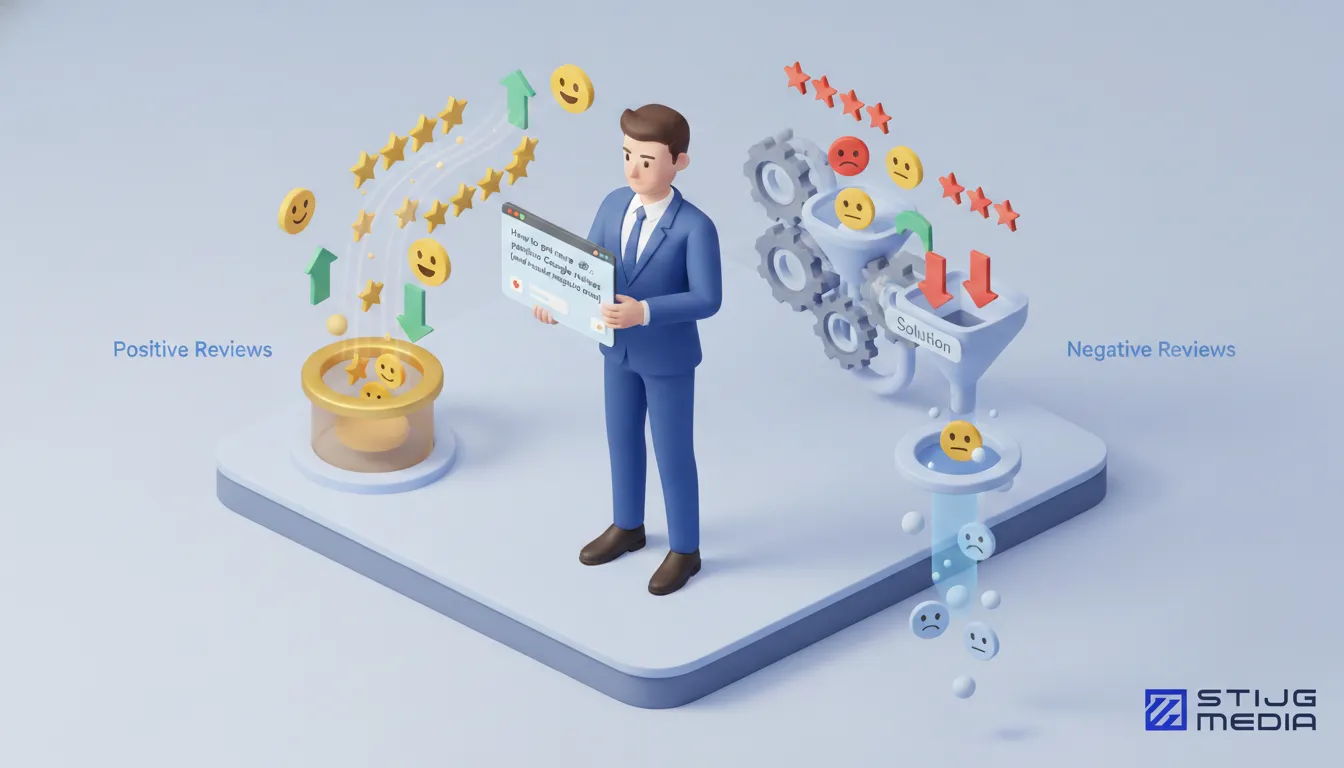
The most successful businesses don’t just ask for Google reviews; they build a proactive, operational “Review Engine” that systematically generates positive feedback and transforms negative reviews into an invaluable early-warning system for process improvement. This guide shows you how to move beyond treating reviews as a reactive marketing chore and start architecting a system that builds trust, boosts local SEO, and fuels sustainable growth.
Stop chasing stars and start building a system. For years, businesses have been conditioned to view their Google Business Profile as a passive scoreboard. A positive review is a small win; a negative one is a fire to be put out. This reactive approach is inefficient, stressful, and fundamentally misunderstands the power of customer feedback in the digital age. Your online reputation isn’t something that happens to you; it’s something you build, one customer experience at a time.
The core shift is from asking to architecting. It’s about creating a deliberate, repeatable process that identifies your happiest customers, makes it effortless for them to share their experience, and uses the inevitable critical feedback to find and fix the operational cracks in your business before they become chasms. This is how you don’t just manage your reputation; you engineer it.
The Old Way vs. The New Way: A Strategic Comparison
Choosing your approach to online reputation management has profound implications for your business. It affects everything from your search engine visibility to your operational efficiency. Let’s compare the traditional, reactive method with the proactive “Review Engine” framework.
Reactive Review Management (The “Chore”)
This is the default mode for many businesses. It involves passively waiting for reviews to appear and then reacting to them—thanking positive reviewers and performing damage control for negative ones. It’s often sporadic, driven by whoever has a spare moment, and lacks a strategic goal beyond “get more good reviews.”
- Pros: Low initial effort; doesn’t require a dedicated system or software.
- Cons: Inconsistent results; high stress when negative reviews appear; missed opportunities for feedback; minimal impact on business improvement.
Proactive “Review Engine” (The “System”)
This is an operational approach. It integrates the process of generating and learning from reviews directly into the customer journey. It’s a system designed not just to collect feedback, but to use it as a strategic asset for marketing and operations. One business that used a systematic process of ‘inviting’ customers to leave ‘online feedback’ via email acquired more than 100 positive online reviews, demonstrating the power of a structured approach.
- Pros: Consistent flow of positive reviews; turns negative feedback into actionable insights; builds a powerful feedback loop; improves team performance and customer service.
- Cons: Requires initial setup and process design; may involve investment in review generation software.
Key Decision Factors Analyzed
Impact on local search rankings (SEO)
Reactive: SEO impact is unpredictable. Long gaps with no new reviews can signal stagnation to Google’s algorithm. A sudden string of negative reviews can quickly damage your local search ranking.
Proactive: A steady stream of positive reviews is a powerful signal for local SEO. In fact, review quantity, velocity, and diversity account for 15.44% of what it takes for a local business to appear in Google’s local map pack. A well-oiled Review Engine directly fuels this critical ranking factor, helping you get more reviews for local business visibility. As one of our clients noted, “We went from page 8 to page 1 in six months and have stayed there ever since.” This is how google reviews affect local search ranking in a tangible way.
Ability to build customer trust and credibility
Reactive: Trust is fragile. Sporadic or poorly handled responses to negative reviews can make potential customers question your commitment to service. Generic “thank you” notes on positive reviews are easily ignored.
Proactive: Trust is systematically built. A constant flow of recent, positive reviews acts as powerful social proof. More importantly, thoughtful, professional responses to all reviews—positive and negative—demonstrate transparency and a commitment to customer service recovery techniques. This public record of accountability turns your review page into a compelling sales tool.
Efficiency of the feedback generation process
Reactive: Highly inefficient. Relies on ad-hoc requests or simply hoping customers will leave feedback. This “hope-and-pray” strategy yields poor results and provides no consistent data.
Proactive: Extremely efficient. By identifying the best customer journey touchpoints and using tools like email, text messages, or QR codes for google reviews, you automate the request process. Using review generation software can streamline this further, ensuring a consistent flow of feedback without manual effort from your team.
Opportunity to use negative feedback for operational improvements
Reactive: Negative feedback is seen as a problem to be hidden or argued with. The focus is on the single complaint, not the underlying cause. The opportunity for learning is almost always lost.
Proactive: Negative feedback is treated as free consulting. It’s a gift that points directly to a flaw in your product, service, or process. A Review Engine includes a customer feedback loop strategy that routes this information to the right people to solve the root cause, preventing future negative reviews and improving the overall customer experience.
From ‘Ask’ to ‘Architect’: Building Your Proactive System
Shifting to a proactive system means you stop randomly asking for reviews and start designing a process that makes getting them a natural outcome of your customer experience. This is how to get more positive Google reviews systematically.
1. Identify Your “Magic Moments”
A “magic moment” is the point in the customer journey where satisfaction is at its peak. This is the perfect time to request feedback. It could be:
- Immediately after a successful service completion (e.g., a plumber sending a follow-up text after a job).
- A week after a product is delivered, giving the customer time to experience its benefits.
- For professionals like doctors, a few days after a positive consultation, allowing the patient to reflect on the experience (a key strategy to get more patient reviews for doctors).
Map your customer’s journey and pinpoint these moments. This is where your review request will have the highest conversion rate.
2. Make it Effortless to Leave Feedback
The single biggest barrier to getting more reviews is friction. You must make it ridiculously easy for customers to leave feedback. The first step is to create a Google review link. Here’s how to find my direct google review link:
- Log in to your Google Business Profile Manager.
- Select the correct business location.
- On the home screen, find the “Get more reviews” card.
- Click “Share review form.” This will give you a short, direct link.
This link is your golden ticket. Use it in emails, text messages, and on your website. You can also turn this link into a QR code to place on receipts, business cards, or signage in your physical location.
3. Craft the Perfect, Non-Pushy Request
Soliciting reviews without being pushy is an art. The key is to frame the request around their experience, not your need for reviews. Here’s a simple google review request template for happy customers:
“Hi [Customer Name], thank you for choosing us. We hope you had a great experience. We rely on feedback from customers like you to improve. If you have a moment, could you share your thoughts on Google? It helps others find us and helps us get better. Here’s a direct link: [Your Link]. Thank you again!”
Notice the language. It’s about their feedback and helping others. Remember the dos and don’ts of asking for reviews: Do make it personal and easy. Don’t offer incentives. The google review policy on incentives is clear: you cannot offer compensation for reviews, as this can lead to them being removed and damage your profile’s trustworthiness.
Weaponizing Negative Feedback: Your New Early-Warning System
A negative review isn’t a PR crisis; it’s an unpolished gem of business intelligence. The moment you reframe a bad review from an attack to be defended into a data point to be analyzed, you unlock one of the most powerful growth tools available to your business. It is the key to turning a negative review into a positive outcome.
A moving company that began systematically tracking and responding to poor reviews as feedback increased its overall review score by 12% in 18 months. This wasn’t because they argued with reviewers; it’s because they used the feedback to fix their operational issues.
The Root-Cause Analysis Process:
- Isolate the Complaint: What is the specific issue? Was it a product defect, a rude employee, a missed deadline, a communication breakdown? Be precise.
- Track the Pattern: Is this the first time this issue has come up? Use a simple spreadsheet or your CRM to track negative feedback themes. If “late delivery” shows up three times in a month, you don’t have three angry customers—you have a logistics problem.
- Engage the Team: Bring the feedback (anonymized, if necessary) to the relevant team. Don’t blame; investigate. Ask “Why did this happen?” five times to get to the root cause.
- Implement a Fix: Create a solution. This could be a new training module, a checklist for employees, or a change in a software setting.
- Close the Loop (Publicly): In your public reply to the review, mention the change you’ve made. Example: “Hi [Name], thank you for this feedback. You were right, our dispatch system was causing delays. We’ve since implemented a new process to ensure this doesn’t happen again.” This is professional, accountable, and impressive to potential customers reading your page.
Handling Difficult and Fake Reviews
Not all negative reviews are created equal. Knowing how to deal with a vindictive negative review or a fraudulent one is crucial for managing your online business reputation.
- Fake Reviews: If you’re certain a review is fake (e.g., from someone who was never a customer), you can try to remove a fake google review. The process is to first flag the review within your Google Business Profile. Explain clearly why it violates Google’s policy (e.g., conflict of interest, spam). If that fails, you can use the Google Business Profile support form to escalate a false google review. Keep records, but be aware that removal is not guaranteed and can take time. Understanding what is google’s review spam policy is essential here.
- Former Employees: A review from a former employee is a clear conflict of interest and violates Google’s policies. Flag it immediately under this category.
- Review Bombing: If you are targeted by a sudden influx of 1-star reviews, this is known as review bombing. Report this to Google support directly. They have mechanisms to investigate coordinated attacks.
The Internal Flywheel: Your Employees Are the Source of Great Reviews
You can have the best review generation software in the world, but if your team isn’t delivering an experience worth reviewing, your efforts will fail. Your employees are the engine of your reputation. The key is to train, empower, and incentivize them to see review generation as a core part of the service experience.
How to Train Staff to Ask for Reviews
Training shouldn’t be about memorizing a script. It should be about situational awareness. Teach your team to recognize the “magic moments” mentioned earlier. When a customer expresses delight unprompted (“This is the best service I’ve ever had!”), train your employee to respond with: “That’s so great to hear! It would mean the world to us if you’d share that thought in a Google review. It helps people just like you find us.”
Incentivize the Process, Not the Outcome
Never tie bonuses or commissions to the number of 5-star reviews an employee gets. This encourages unethical behavior. Instead, reward the behavior of providing excellent service and asking for feedback. Celebrate team members who are mentioned by name in positive reviews. Make customer feedback a standing item in team meetings. This creates a culture that is genuinely focused on customer experience management.
Closing the Loop Publicly: The Art of the Perfect Reply
Every single review is an opportunity. A public reply is not just for the reviewer; it’s for every potential customer who will read it in the future. Should you respond to every google review? Yes, absolutely. Even responding to a google review without a comment with a simple, “Thank you for taking the time to leave us a rating, we appreciate your business!” shows you are paying attention.
Response Frameworks:
- Positive (5-Star) Reviews: Go beyond “Thanks!” Be specific. Mention the team member they praised or the service they enjoyed. This makes the thank you feel genuine. Writing the perfect response to a positive review reinforces the good behavior you want to see.
- Neutral (3-Star) Reviews: These are goldmines. A 3-star review often comes from a customer who wanted to love you but something small went wrong. Your response is critical. Acknowledge the good and the bad. Example: “Hi [Name], we’re glad you enjoyed our product, but we’re sorry to hear that the shipping was slower than expected. We’re looking into what happened with our carrier to prevent this in the future.” This is how to respond to a 3-star review effectively.
- Negative (1 or 2-Star) Reviews: This is where you demonstrate your professionalism. The goal is not to win the argument; it’s to showcase your problem-solving skills and commitment to your customers. After receiving a one-star review she felt was unfair, business owner Samara Scott-Hunter implemented a one-month ‘cooling-off period’ before responding to ensure a more measured and professional public reply. This is a brilliant tactic. Always thank them for the feedback, apologize for their experience (not for a fault), show empathy, and take the conversation offline to resolve it.
The Simple Math of Your Online Reputation
Many business owners get stuck on abstract goals like “improve my google star rating.” Let’s make it concrete with some simple math that answers the most common questions.
How many 5-star reviews do I need to negate a 1-star review?
Let’s say you have a single 1-star review and want to reach an average of 4.9 stars, which is a common goal for achieving a high-trust perception. The math is straightforward:
(1 review * 1 star) + (X reviews * 5 stars) / (1 + X total reviews) = 4.9 stars
Solving for X, you find that you need 39 five-star reviews to offset the damage of a single one-star review to achieve a 4.9 average. This illustrates why a proactive system for generating a high volume of positive reviews is not a luxury, but a necessity for repairing online reputation after bad reviews.
This is why understanding how to handle what to do about 1-star reviews is so critical—preventing them through operational excellence is far more efficient than trying to drown them out later. The goal should always be to earn a reputation so strong that a single negative review is clearly an outlier.
Making the Right Choice for Your Needs
Transitioning from a reactive chore to a proactive system isn’t a one-size-fits-all process. The right strategy depends on your resources, goals, and current challenges. Here’s how different types of business leaders can approach this shift.
For the Overwhelmed Local Business Owner…
You need a simple, time-saving system. Your goal is efficiency. Start by creating your direct Google review link and turning it into a QR code. Print it on your receipts or invoices. Then, create a single, simple email or text message template. Spend one hour per week sending it to your best customers from the past seven days. This small, consistent action is the first step in building your engine without overwhelming your schedule.
For the Growth-Focused Marketing Manager…
You need a scalable strategy to improve online reputation and conversion rates. Your focus is on data and automation. You should investigate review generation software to automate requests at key customer journey touchpoints. Integrate your review flow with your CRM. Use customer sentiment analysis to track trends in feedback. Your goal is to build a system that not only boosts your star rating but also provides marketing with a steady stream of user-generated content and testimonials you can embed on your website. Your efforts directly contribute to conversions, as 72 percent of consumers visit a store within five miles of their location after a positive local search experience fueled by reviews.
For the Reputation-Conscious Entrepreneur…
You see negative reviews as a direct threat to the brand you’ve built. You need a constructive framework for responding and improving. Your primary focus should be on the “Weaponizing Negative Feedback” and “Internal Flywheel” sections of this guide. Implement a formal process for analyzing every piece of negative feedback. Make customer feedback a key performance indicator for your leadership team. Your goal is to transform your fear of bad reviews into a culture of continuous improvement, where your public responses become a testament to your company’s integrity and commitment to excellence.
Ultimately, the best approach is one that aligns with your business goals and operational capacity. The key is to start thinking of your Google reviews not as a reflection of your past, but as a blueprint for your future. At Stijg Media, located in Norwood, MA, we specialize in helping businesses design and implement these proactive “Review Engines” to build lasting trust and drive measurable growth. For a personalized assessment of your online reputation and a clear strategy to improve it, contact our expert team today.