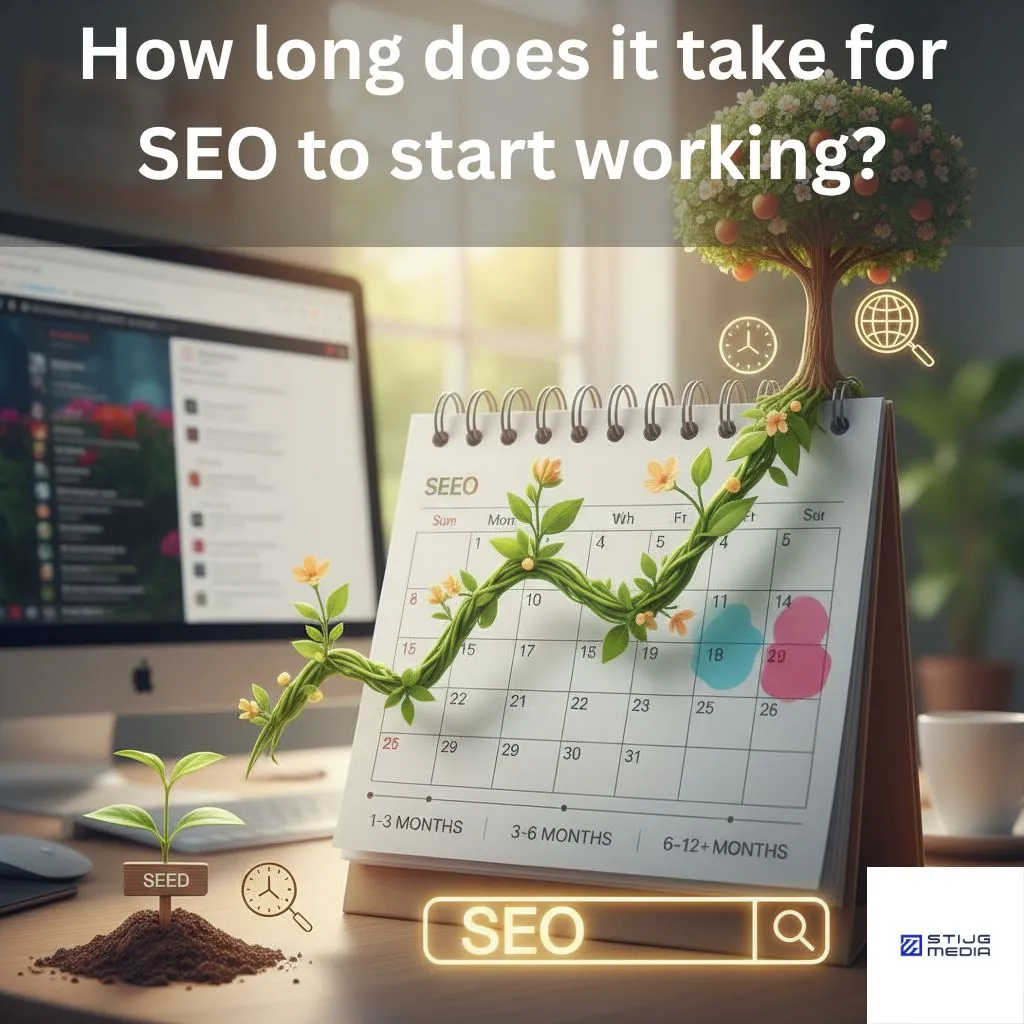
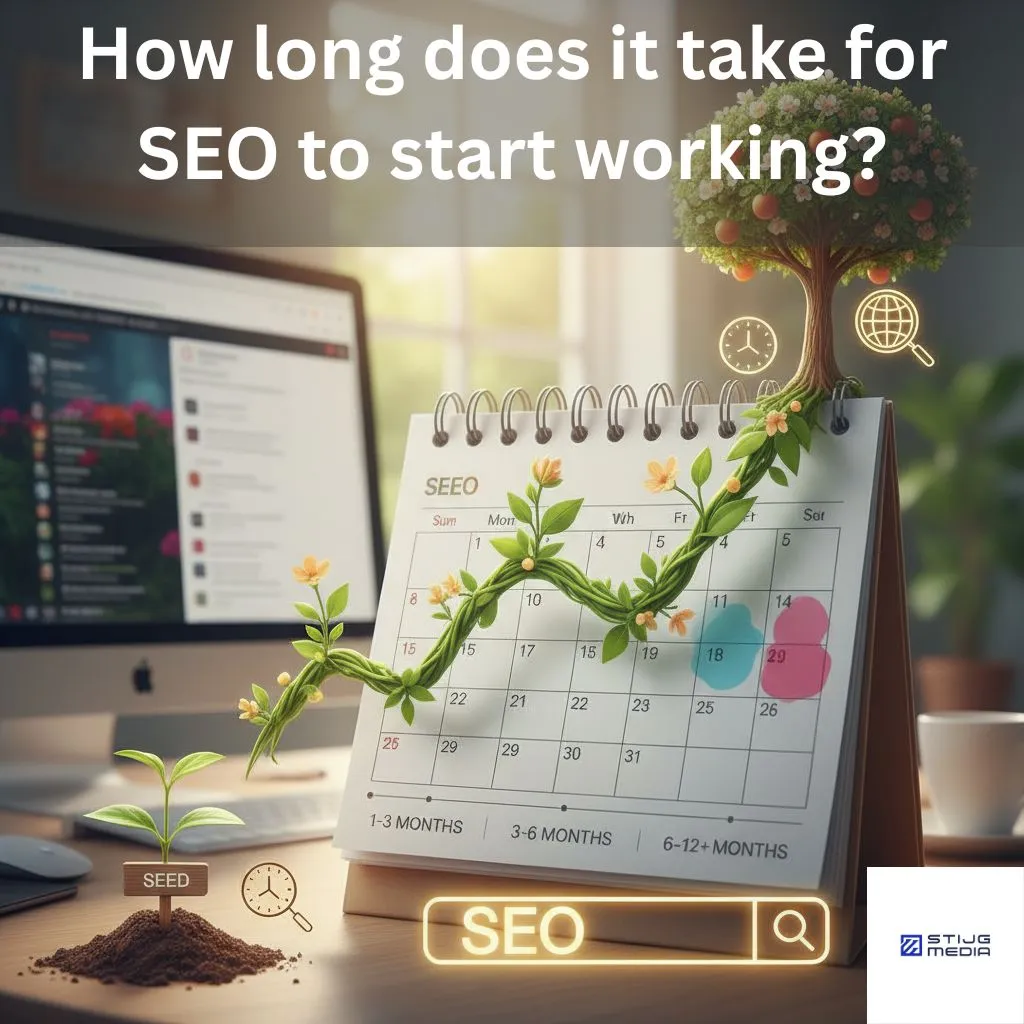
How long does SEO really take to work in 2025? (The answer isn’t 4-12 months)
Most agencies will tell you that it takes 4 to 12 months to see results from SEO. While technically not wrong, this answer is fundamentally misleading. It focuses exclusively on lagging indicators like page-one rankings for competitive keywords. The truth is, a well-executed SEO strategy starts “working” and showing measurable signs of progress within the first 30 to 90 days, long before you hit page one. The key is knowing which signals—the leading indicators of momentum—to track.
Deconstructing the flawed question: Why modern SEO is about building a ‘keyword portfolio’
For years, the central question from every business owner has been, “How long until I rank #1 for [my golden keyword]?” This question is a relic of an older, simpler search landscape. In 2025 and beyond, focusing on a handful of high-competition “golden keywords” is not just an inefficient strategy; it’s a direct path to frustration and wasted investment.
Modern, effective SEO is not about winning a single trophy. It’s about building a robust “keyword portfolio.” Think of it like a stock portfolio. You wouldn’t pour all your money into a single, volatile tech stock and pray for it to skyrocket. That’s too risky. Instead, a smart investor diversifies across dozens or hundreds of assets. Some are stable blue-chips, others are high-growth, and many are smaller, consistent performers. Together, they create stable, predictable growth.
Your SEO strategy should operate on the same principle. Instead of focusing all your energy on a keyword like “business accounting software” (a high-risk, high-reward ‘stock’), a portfolio approach targets that term plus hundreds of related, long-tail keywords:
- “accounting software for SaaS startups”
- “how to integrate payroll with accounting software”
- “best cloud-based accounting tools for small business”
- “what is a reasonable time for SEO results for a new software”
- “timeline for seeing SEO-driven leads from content marketing”
These longer, more specific queries have lower individual search volume, but they are also far less competitive and signal much higher buyer intent. A user searching for “how to integrate payroll with accounting software” is not just browsing; they are actively trying to solve a problem. Capturing this long-tail traffic is the foundation of sustainable organic growth. When you build a portfolio of content that answers these specific questions, you start to generate qualified traffic and build topical authority long before you ever challenge the industry giants for the most competitive keywords.
Outputs vs. Outcomes: The critical difference between vanity and value
The obsession with “golden keywords” stems from a fundamental misunderstanding between outputs and outcomes. This distinction is perhaps the most important concept an executive or marketer needs to grasp when evaluating the success of a national SEO campaign timeline.
- An Output is the completion of a task. In SEO, this includes things like publishing a blog post, building a backlink, or achieving a #1 ranking for a specific keyword.
- An Outcome is the tangible business result generated by those tasks. This is what actually matters: generating qualified leads, increasing sales, lowering customer acquisition cost, or growing market share.
Too many businesses and even some agencies fixate on outputs. They celebrate a #1 ranking as the finish line. But what if that top-ranking page has a 90% bounce rate? What if the keyword, despite its high volume, drives no conversions? In that case, the output is a vanity metric. As Search Engine Land emphasizes in their comprehensive guide to SEO reporting, rankings are important to track, but tangible business outcomes like leads, conversions, and revenue are what truly matter. This is the core problem with the “4-12 month” timeline—it measures the arrival of an output, not the achievement of an outcome.
Focusing on a keyword portfolio, by contrast, is an outcome-driven strategy. By targeting dozens or hundreds of long-tail keywords, you are not chasing the glory of a single ranking. You are systematically building an engine that captures high-intent traffic from all stages of the buyer’s journey. One page might bring in five qualified leads per month, another might bring three, and a hundred other pages might bring in one each. None of these is a spectacular “output” on its own, but together, the “outcome” is 100+ new leads every single month. This is how you build a predictable, scalable revenue channel, not just a flashy ranking report.
Your new scorecard: How to track leading indicators in the first 90 days
So, if a page-one ranking for a competitive keyword is the wrong metric for the first six months, how do you know if your SEO investment is working? You need a new scorecard. Instead of watching for lagging indicators (the final result), you must track the leading indicators—the early signs of momentum that prove your strategy is gaining traction with search engines like Google.
These are the metrics we at Stijg Media prioritize in the first 90 days of any campaign, because they are the true predictors of future success. You can find all of them for free in Google Search Console.
1. Growth in Total Search Impressions
Impressions are the number of times any page from your website appeared in a search result. This is the very first sign of life. An increase in impressions means Google is beginning to recognize your site’s relevance for a wider range of queries. It’s testing your content, showing it to more people, even if you’re on page seven or eight. A steady, upward trend in impressions is the foundational signal that your content and technical SEO work are being recognized. Before you can get clicks, you must get impressions.
2. An Increase in the Number of Indexed Keywords
When you launch a new SEO campaign, you’re publishing new pages and optimizing existing ones. Google Search Console will show you the total number of unique keywords your site is ranking for, even if it’s on page 10. In the first 30-60 days, you should see this number climb steadily. Going from ranking for 500 keywords to 1,500 keywords in a quarter is a massive leading indicator of success. It proves that Google’s crawlers are finding your new content, understanding its context, and adding it to their index for an expanding set of queries. This is a direct measure of your growing topical authority.
3. Clicks on New Pages (Even at Low Ranks)
Seeing a brand new page get its first 5, 10, or 20 clicks is a huge milestone. It may seem small, but it’s powerful validation. It means your title tag and meta description were compelling enough to earn a click over competitors, and that Google found your page relevant enough to show it in the first place. These early clicks provide valuable user signals back to Google. When users click your result and don’t immediately bounce back to the search page, it tells the algorithm that your page satisfied their query. This positive feedback loop is essential for climbing from page five to page one.
4. Improvement in Long-Tail Keyword Rankings
While your primary keyword might be stuck on page six, you will often see your new content quickly start ranking for longer, more specific variations. For example, your target might be “e-commerce SEO timeframe,” but a new article could start ranking on page two for “how long does a new product page take to rank on google” within a few weeks. Tracking these long-tail ranking improvements is crucial. It shows that your content is hitting the mark and building the foundational relevance needed to eventually compete for the broader, more difficult terms.
The compounding effect: How small wins build exponential growth
Why are these leading indicators so important? Because SEO is not a linear process; it’s a compounding one. Each piece of content you publish, each technical fix you implement, and each backlink you earn is like a small deposit into a high-yield savings account. In the beginning, the interest earned is tiny and almost unnoticeable. But over time, the interest starts earning its own interest, and the growth becomes exponential.
Here’s how it works in practice:
- Initial Effort (Months 1-3): You publish a cluster of high-quality articles around a specific topic. You see a rise in impressions and the number of indexed keywords (Leading Indicator #1 and #2). A few long-tail keywords start to rank on pages 3-5 (Leading Indicator #4).
- Early Traction (Months 3-6): Those pages start to earn a trickle of clicks and a few high-quality backlinks (Leading Indicator #3). Google sees these positive user signals. One client told us, “I’ve seen an uptick in website traffic and calls since,” which perfectly captures this early traction phase. The authority from those backlinks passes to your entire site.
- Momentum (Months 6-9): Because of the accumulated authority and positive user signals, Google starts ranking your content higher for more competitive, medium-tail keywords. Your traffic begins to grow more noticeably. Your domain authority starts to rise.
- Authority & Liftoff (Months 9-12+): Your site is now seen as an authority on the topic. Google ranks your new content faster and higher. You now have the accumulated authority to compete for the “golden keywords.” This is when you see the dramatic, hockey-stick growth in organic traffic that most people associate with “SEO working.”
This compounding effect is why SEO is such a powerful long-term strategy. The work you do in month one is not just for month one; it’s laying the groundwork that makes the results in month twelve possible. Rushing the process or getting discouraged by the lack of page-one rankings in the first few months is like pulling your money out of a retirement account after a year because you’re not a millionaire yet. You’re interrupting the compounding process just before the real growth begins.
Comparing the metrics: Lagging vs. leading indicators
Understanding the pros and cons of each measurement framework is key to setting realistic SEO goals and maintaining confidence in your strategy.
Lagging Indicators (The Old Scorecard)
Examples: Page 1 rankings for high-volume keywords, total organic traffic, total leads/sales from organic.
Pros:
These are the ultimate goals. They are easy to understand for stakeholders and directly correlate with significant business impact. Reaching page one for a target keyword is a clear, unambiguous victory.
Cons:
They are incredibly slow to appear, often taking 6-12 months or more. Focusing solely on them creates immense pressure and anxiety, leading many to abandon their strategy prematurely. They don’t tell the story of the progress being made beneath the surface.
Leading Indicators (The Modern Scorecard)
Examples: Growth in search impressions, number of indexed keywords, clicks on new content, long-tail ranking improvements.
Pros: They provide immediate feedback, often appearing within the first 30-90 days. They validate that the strategy is sound and that Google is responding positively. This builds confidence and allows for agile adjustments long before you’ve wasted a year of investment.
Cons: They require more sophisticated interpretation and education for stakeholders. An increase in impressions doesn’t immediately translate to revenue, so their value as a predictor of future success must be clearly communicated.
What affects how long SEO takes? Key factors decoded
Even with the right scorecard, the timeline for seeing results—both leading and lagging—is not one-size-fits-all. Several critical factors influence the average time for SEO to show results.
1. Website Age, History, and Authority
An established website with a clean history and a strong backlink profile (high domain authority) will see results much faster than a brand new domain. A new site starts from zero in Google’s eyes and must build trust and authority from scratch. This “sandbox” period can be frustrating, but it’s a necessary part of the process. An existing site might just need optimization, while a new site needs a full foundation built.
2. The Competitive Landscape
Are you a local plumber trying to rank in a small town, or a B2B SaaS company competing against Salesforce and HubSpot? The level of competition is a massive factor. Ranking for highly competitive keywords requires significantly more time, content, and authority-building. A competitive analysis is step one in any realistic SEO strategy timeline, as it dictates the level of effort required.
3. Your Content Strategy (Quality & Velocity)
How good is your content, and how often are you publishing it? A strategy that involves publishing one mediocre blog post a month will fail. A strategy that consistently produces high-quality, expert-driven content that comprehensively covers a topic will see results much faster. How content quality affects ranking speed cannot be overstated. Search engines are becoming increasingly adept at distinguishing expert content from generic fluff. A recent study by Ahrefs analyzing over 1 million newly published pages found that only 1.74% will reach Google’s top 10 search results within a year, down from 5.7% in 2017. This underscores both the increasing difficulty and the critical need for exceptional quality.
4. Technical SEO Foundation
Your website’s technical health is the foundation upon which all other SEO efforts are built. If your site is slow, has crawling errors, isn’t mobile-friendly, or has a confusing structure, Google will struggle to find and rank your content, no matter how good it is. The technical SEO impact on ranking speed is immense; a clean, fast site allows Google’s indexing speed to work in your favor.
5. Link Building and Authority Signals
Backlinks remain a powerful ranking signal. Earning high-quality links from authoritative websites tells Google that your site is a trusted resource. The time for backlinks to take effect varies, but a consistent strategy to earn links will dramatically accelerate your timeline. For one of our clients, a focused link-building campaign was the key. As they put it, “We went from page 8 to page 1 in six months and have stayed there ever since.” This kind of jump is often powered by a significant boost in authority.
Answering your pressing SEO timeline questions
What is the 80/20 rule of SEO?
The 80/20 rule (or Pareto Principle) in SEO suggests that 80% of your organic results will come from 20% of your efforts. The key is identifying that critical 20%. It’s often not what people think. That 20% might be:
- Fixing a single site-wide technical issue that’s holding back every page.
- Creating one comprehensive “pillar page” of content that generates dozens of backlinks and ranks for hundreds of long-tail keywords.
- Optimizing the top 5 pages that already get some traffic but could be on page one with a little more work.
A good SEO strategy focuses on identifying and executing that high-impact 20% first.
How long does it take for SEO to work in 2025?
To summarize our core thesis: You will see leading indicators that SEO is working within 1-3 months. This includes growth in impressions, indexed keywords, and clicks from long-tail searches. You should expect to see a noticeable increase in qualified traffic—the kind that can turn into leads—within 4-6 months as your keyword portfolio builds. Achieving significant page-one rankings for competitive, high-volume keywords (the lagging indicators) typically takes 6-12 months, and sometimes longer in highly competitive industries.
How long does it take for a Google page to get ranked?
This is a multi-stage process:
- Discovery & Indexing: For a new page on an established site, Google might discover and index it within a few days to a week. For a brand new website, this can take several weeks.
- Initial Ranking: Once indexed, a page will typically start ranking very low (pages 5-10+) for its target keywords within a few weeks to a month.
- Meaningful Ranking (Pages 1-3): This is the long haul. Moving from page 5 to page 1 requires building authority, gathering positive user signals, and earning backlinks. This is the part that takes 3+ months. While some claim to see a Google page ranking in 2 days, this is only possible for very low-competition, extremely specific keywords on an already authoritative site.
The consensus among experts remains that while you will see SEO progress long before the one-year mark, ranking on page one is critical for driving meaningful traffic and conversions for commercially valuable terms. This is why the leading indicators are so vital for bridging that gap and proving ROI along the way.
Making the right choice for your needs
Understanding this modern approach to SEO measurement is key to making a confident investment. The “best” way to view the timeline depends entirely on your role and objectives.
The Impatient Business Owner
You need to justify the monthly expense and can’t afford to wait a year for a sign of life. Your focus should be entirely on the leading indicators. Stop asking your agency for “ranking reports” in the first 90 days. Instead, demand a “progress report” that shows month-over-month growth in Google Search Console impressions, the number of indexed keywords, and initial clicks on new content. This data proves your investment is gaining traction and building the foundation for future outcomes.
The ROI-Focused Marketer
You are measured on MQLs, SQLs, and cost of acquisition, not keyword positions. You need to champion the “keyword portfolio” and “outcomes over outputs” mindset within your organization. Your measurement framework should connect the dots between new content pieces, the long-tail traffic they generate, and the actual conversions (e.g., demo requests, content downloads) those pages produce. Your success is measured by the total volume of qualified leads from the entire organic ecosystem, not by whether you rank #1 for a single vanity term.
The Skeptical Newcomer
Perhaps you’ve been burned by unrealistic SEO promises before. Your priority should be education and finding a trustworthy partner. Any agency that promises guaranteed page-one rankings in a short timeframe is waving a massive red flag. A true strategic partner will walk you through the difference between leading and lagging indicators. They will set realistic SEO expectations based on your specific industry and competition, and they will provide transparent reporting on the early signs of momentum to build your confidence in the long-term strategy.
Ultimately, a successful SEO strategy in the modern AI age is not a black box of secret tactics but a transparent, logical process of building authority and providing value over time. For businesses ready to move beyond outdated metrics and build a sustainable organic growth engine with a clear view of progress from day one, the team at Stijg Media, based in Norwood, offers a strategic partnership designed for long-term success. Contact our strategists today for a personalized assessment of your website’s potential and a clear roadmap for achieving measurable results.