The only way to truly know if your marketing is working is to stop reporting on marketing metrics and start translating your activities into a ‘Business Impact Scorecard’ that speaks the language of your C-suite and sales team: pipeline, revenue, and profitability. This approach moves your marketing function from a perceived cost center to a proven growth engine.
The Great Disconnect: Why Your Marketing Reports Are Failing You
It’s a scene that plays out in boardrooms everywhere. The marketing team presents a glowing report filled with impressive charts showing upward trends in website traffic, social media engagement, and email open rates. They’re proud of the performance. But across the table, the CEO and Head of Sales are unmoved. They see a lot of activity, but they don’t see what matters most: more customers, more revenue, and a healthier bottom line. This is the fundamental flaw of the modern marketing report.
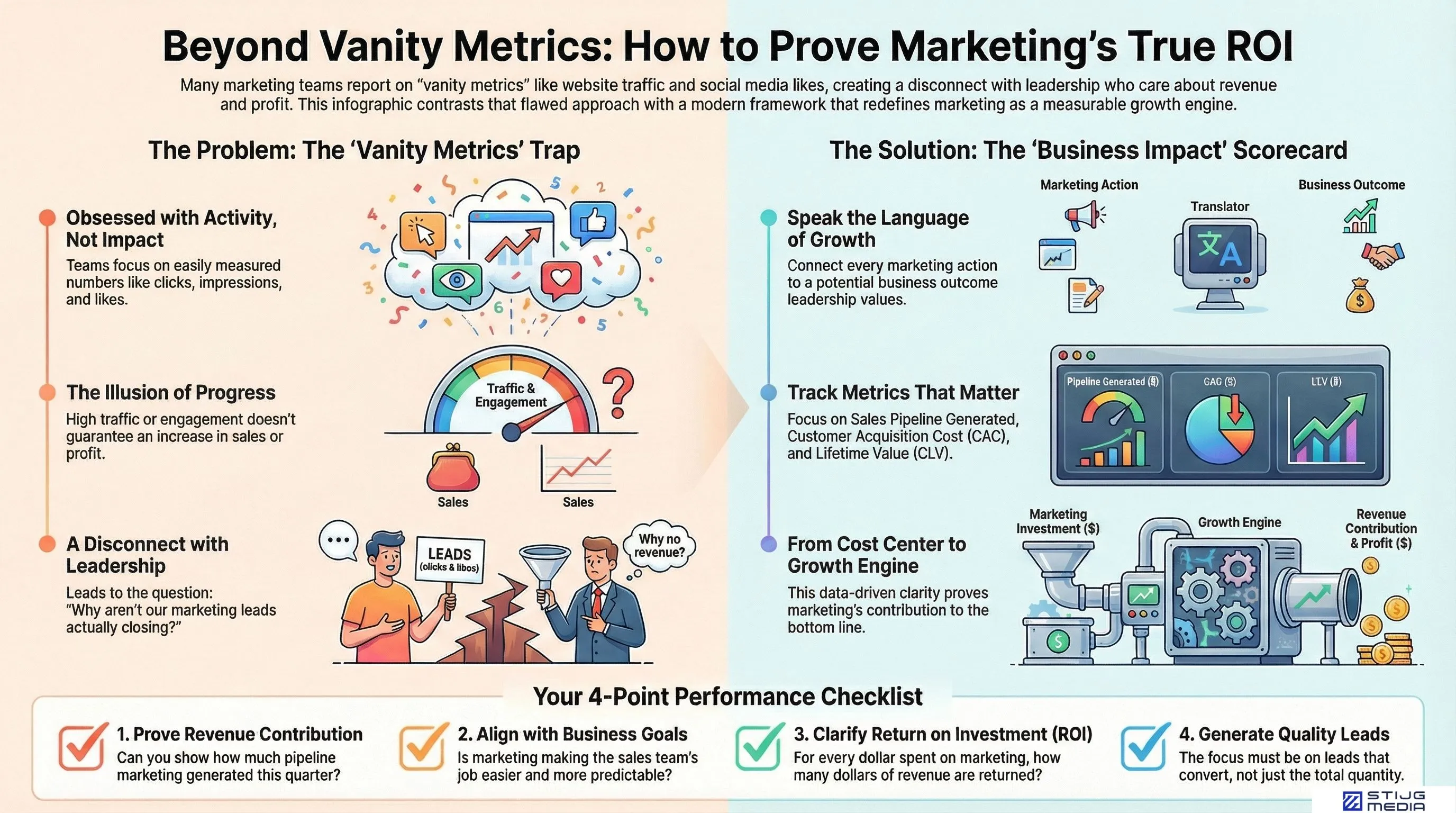
We’ve become obsessed with “vanity metrics”—easily measured, surface-level numbers that feel good to report but often have little correlation with actual business success. Metrics like clicks, impressions, and likes are indicators of activity, not impact. When you’re assessing your current marketing plan, celebrating these figures without a clear line to the money is a common cause of diagnosing poor marketing performance. Celebrating high click-through rates or impressions without connecting them to business outcomes like conversions, pipeline growth, or customer retention can mask a weak ROI, according to industry analysis. This disconnect is often why so many leaders ask, “Why is my marketing not generating leads that actually close?” The answer is that the team is likely optimizing for the wrong results.
A Tale of Three Strategies: Gut-Feel vs. Vanity Metrics vs. Business Impact
When evaluating how to measure marketing effectiveness, businesses typically fall into one of three camps. Understanding where you are is the first step toward building a strategy that works.
The ‘Gut-Feel’ Approach: Flying Blind
This is decision-making based on instinct and anecdotal evidence. A business owner might run ads because they “feel” like they should be on a certain platform or continue a strategy because a single customer mentioned it. While fast, this approach is dangerously unreliable. It’s impossible to scale, impossible to justify budget allocation, and leads to a constant state of guessing what is truly driving the business forward.
The ‘Vanity Metrics’ Dashboard: The Illusion of Progress
This is the most common approach today. Teams diligently use Google Analytics for marketing measurement, create detailed spreadsheets tracking organic traffic growth analysis, and report on social media marketing analytics. The problem is, an increase in website traffic doesn’t automatically mean an increase in sales. A high website bounce rate analysis might be ignored in favor of a rising visitor count. This focus on lead quantity vs lead quantity alienates leadership and obscures the true marketing return on investment formula.
The ‘Business Impact’ Scorecard: Speaking the Language of Growth
This forward-thinking approach redefines what metrics matter in marketing. It requires a mental shift to connect every marketing action to a potential business outcome. It’s not about abandoning data; it’s about elevating the right data. It answers the question of how to prove marketing value by focusing on metrics like sales pipeline generated, influenced revenue, customer acquisition cost (CAC), and customer lifetime value (CLV) calculation. This is how you build trust and demonstrate undeniable performance.

Building Your Business Impact Scorecard: A Practical Framework
Transitioning from vanity metrics to a Business Impact Scorecard isn’t an overnight process, but it is a systematic one. It’s about building a new operational framework for tracking marketing campaign performance that aligns your efforts with the company’s core financial objectives.
Step 1: Translate Business Goals into Marketing Objectives
Stop setting marketing goals in a vacuum. Your strategy must begin with the C-suite’s objectives. If the business goal is to increase annual recurring revenue by $3 million, your job is to work backward. What is your average deal size? What is your sales team’s close rate? Answering these questions helps you calculate how much qualified sales pipeline marketing needs to generate to hit that goal. This process ensures you’re setting realistic marketing goals that are directly tied to the company’s financial health.
Step 2: Identify and Track ‘Revenue Signals’
Not all website engagement is created equal. A “Revenue Signal” is a high-intent customer behavior that indicates a prospect is moving from passive browsing to active consideration. Instead of just tracking traffic, focus on measuring these key performance indicators for digital marketing:
- Demo or consultation requests
- Pricing page visits
- “Contact Us” form submissions
- Downloads of bottom-of-funnel content (e.g., case studies, buyer’s guides)
- High engagement with specific service pages
Effective tracking user engagement on site requires tools that can follow a user’s journey. Using a clear system for how to use UTM parameters to track campaigns is essential here, as it allows you to attribute these valuable actions back to their specific source, whether it’s an email campaign, a paid ad, or a social media post.
Step 3: Map Marketing Actions to Pipeline and Revenue
This is where the magic happens. By integrating your marketing automation platform with your company’s CRM, you can follow a lead’s entire lifecycle. You can see when a marketing qualified lead (MQL) from a webinar becomes a sales qualified lead (SQL) after a discovery call. This MQLs tracking and SQLs tracking is the bedrock of accountability. For business owners looking for ways to track marketing success for small business, even a simple integration can provide powerful insights. Adriaan with Stijg Media has been incredible to work with… I’ve seen an uptick in website traffic and calls since. This testimonial is a perfect example of connecting an initial marketing metric (traffic) to a high-intent Revenue Signal (calls). You begin to understand the real cost per lead by channel and can calculate a true return on ad spend (ROAS). Neglecting to track which marketing channels lead to the most sales is problematic and results in wasted money and resources if you don’t know what is driving revenue, a fact that cannot be overstated.
Answering Common Questions: The Rules of Marketing Engagement
In the digital marketing world, certain “rules” and concepts often circulate. Understanding them provides context for why sustained, multi-channel efforts are so important for generating real business impact.
What are some marketing ‘rules of thumb’ I should know?
You may have heard of various numerical rules. The most established is the “Marketing Rule of 7,” a classic concept suggesting a prospect needs to see or hear a marketing message at least seven times before they take action. The “7 times 7 rule in marketing” is likely just a misinterpretation of this core principle. A more modern take is the “7-11-4 Rule,” which posits that to win a customer, you must have 11 touchpoints totaling 7 hours of their time across 4 different locations (e.g., your website, a social media channel, an in-person event, an email). These frameworks underscore the importance of measuring multi-channel marketing performance, as no single touchpoint tells the whole story. As for the “3 3 3 rule in marketing,” this is more of a communication and presentation principle than a marketing strategy rule—it suggests structuring a message around three key points for maximum clarity, a useful tactic when presenting your new Business Impact Scorecard to leadership.
From Cost Center to Growth Engine: Putting Your Scorecard to Work
Once your Business Impact Scorecard is in place, your role and the perception of marketing within the organization will fundamentally change. You now possess the data to connect marketing efforts to sales directly. This data-driven clarity is transformative. After realizing decisions were based on gut instinct, the CEO of TSheets created a ‘Lean Dashboard’ to track critical metrics like monthly recurring revenue, client value, and net churn rates to enable data-driven decisions, a move highlighted by Forbes that perfectly illustrates this shift from guesswork to informed strategy.
With this new clarity, you can confidently approach marketing budget allocation and performance reviews. You can show, for example, that while one channel has a lower cost-per-lead, another delivers leads with a 50% higher close rate, justifying a larger investment. A/B testing for marketing improvement becomes more meaningful because you’re testing for revenue impact, not just click-through rates. To develop effective marketing strategies, professionals must continuously use data to assess their past and present efforts, which reveals which projects had the best results, a core tenet of modern analytics. This is how you demonstrate tangible SERP ranking improvements or prove how to tell if your SEO is working. As one of our clients shared, “We went from page 8 to page 1 in six months and have stayed there ever since. Adriaan and his team have done amazing work providing steady guidance to help drive business growth.” That’s not just a ranking; that’s a sustainable source of high-quality organic traffic and leads that directly impacts the bottom line, preventing a situation where marketing costs far outweigh the financial returns, a key sign of a failing strategy.
Key Factors for Evaluating Your Marketing Performance
When assessing your marketing, whether internally or with an agency partner, your evaluation should center on these four critical business factors.
Ability to prove marketing’s contribution to revenue.
Your marketing reports should clearly answer: “How much new sales pipeline and closed-won revenue did our marketing efforts generate this quarter?” If the answer is vague or focuses only on top-of-funnel metrics, your measurement strategy is incomplete.
Alignment of marketing activities with C-suite and sales goals.
Marketing’s primary objective should be to make sales easier and more predictable. A successful marketing strategy is one where the sales leader sees marketing as their most valuable partner in hitting quota, not a source of low-quality leads.
Clarity on the return on investment (ROI) for marketing spend.
For every dollar invested in marketing, how many dollars of revenue are returned? A clear understanding of your Customer Acquisition Cost (CAC) and Customer Lifetime Value (CLV) is non-negotiable. This is the ultimate measure of efficiency and effectiveness.
Generation of high-quality leads that convert into sales.
The conversation must shift from the quantity of leads to the quality. A successful marketing engine produces prospects who are educated, engaged, and ready for a meaningful sales conversation. This is achieved by focusing on Revenue Signals, not just form fills.
Making the Right Choice for Your Needs
Shifting to a revenue-focused marketing framework isn’t a one-size-fits-all process. The priorities and implementation will look different depending on your role within the organization.
For the CEO/Founder:
Your focus is the bottom line. The Business Impact Scorecard is your lens for viewing marketing as a direct investment in growth. It provides the clarity to ask tough, specific questions: “We invested $X in that campaign; what was the pipeline return?” It transforms marketing from an opaque operational expense into a predictable and scalable revenue driver.
For the Marketing Manager:
You are under pressure to prove your team’s worth. This framework is your tool for liberation. It allows you to move the conversation away from justifying activity and toward demonstrating value in the language leadership understands. When you can say, “My team’s content marketing performance generated $500k in qualified pipeline last quarter,” you secure your budget and earn a strategic seat at the table.
For the Sales Leader:
Your world revolves around pipeline and closed deals. You need marketing to be an accountable partner, not a source of frustration. This scorecard aligns both teams around a single source of truth: sales-qualified opportunities. It ends the debate over lead quality by measuring marketing on the same metric that matters to you—the creation of real, closable business.
Ultimately, the right approach is one that moves beyond activity-based metrics and provides clear, undeniable proof of marketing’s contribution to the bottom line. For a personalized assessment of your current marketing performance and a clear strategy to connect your efforts to revenue, the team at Stijg Media in Norwood, MA, is here to provide the expert guidance your business needs to grow.