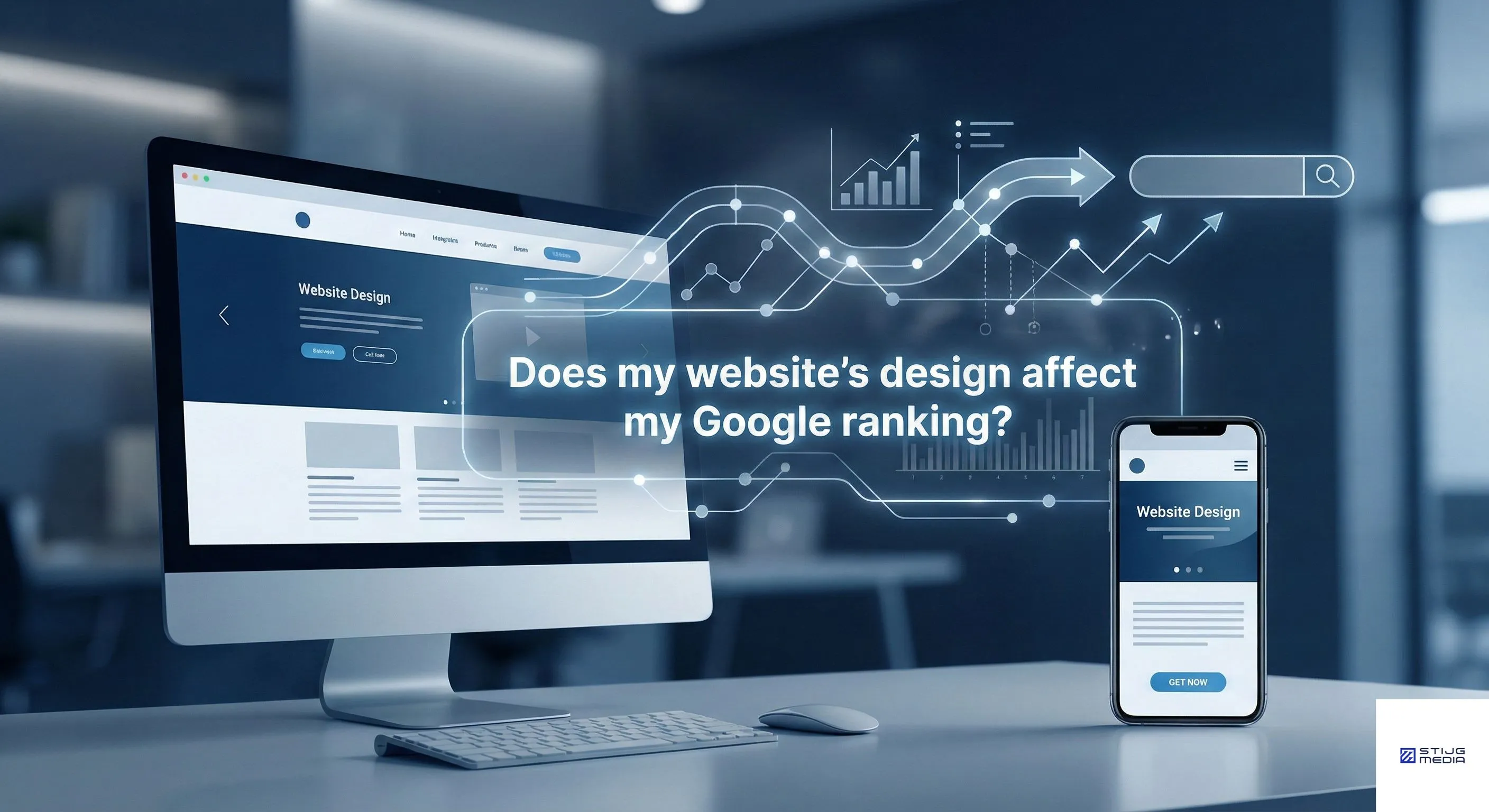
Yes, your website’s design significantly affects its Google ranking, but not in the way most people think. Google doesn’t rank aesthetics; it ranks user behavior. A good design improves user experience (UX), which generates positive signals like longer dwell time and lower bounce rates, directly impacting your search performance.
The Redesign Risk Fallacy: It’s Not About the Colors
For years, business owners have approached a website redesign with a mix of excitement and terror. The excitement comes from the promise of a fresh brand identity and a modern user interface (UI). The terror stems from the widely circulated warning: “a redesign can kill your SEO.” This warning is true, but the reason behind it is almost always misunderstood. It has very little to do with changing your logo, fonts, or color palette.
The real risk—what Google’s algorithm is actually sensitive to—is the disruption of established user pathways and expectations. Over years, your website has built up what we call “user experience equity.” This is the cumulative value of users knowing exactly where to find your contact page, how to navigate to your core services, and what to expect when they click a specific link. These predictable journeys create positive user behavior signals that Google’s crawlers and machine learning systems, like RankBrain, have learned to associate with authority and helpfulness.
When you undertake a website redesign without considering this equity, you’re not just changing the layout; you’re fundamentally altering the user journey. You might move a critical call to action (CTA), bury a popular blog post under a new navigation structure, or change URL slugs without proper redirects. Suddenly, users who once found your site helpful are now confused. They leave. Their dwell time plummets. Your bounce rate skyrockets. These are the negative signals that cause rankings to fall, not the fact that you switched from a blue to a green button.
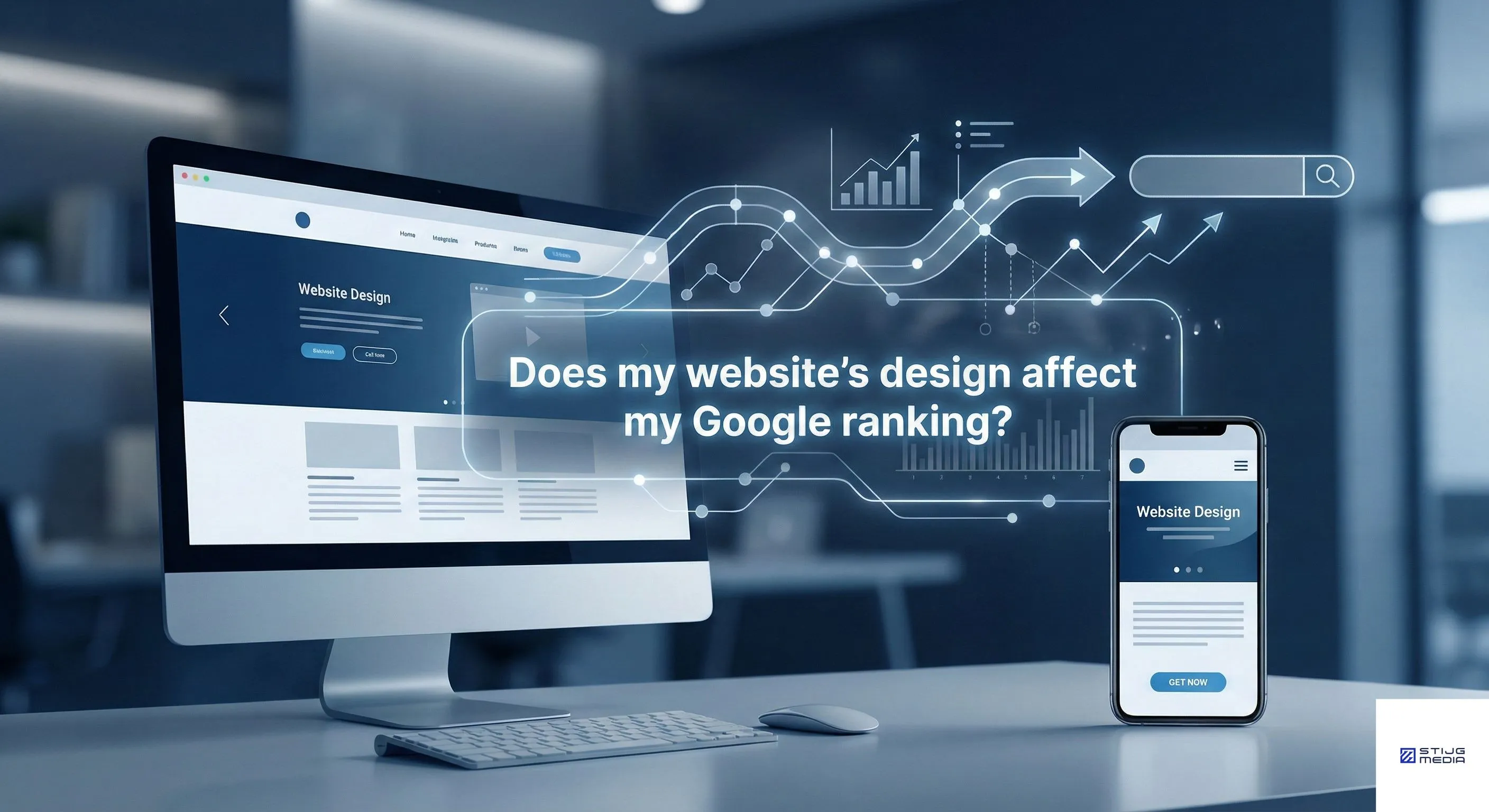
Deconstructing ‘Good Design’ into Google’s Language
The disconnect between marketers and search engine algorithms often comes down to language. A designer talks about “simplicity,” “visual hierarchy,” and “brand consistency.” A Google algorithm, however, only understands data. The key to successful web design for SEO is translating those abstract design principles into the concrete metrics that search engines measure.
Let’s break down how this works:
- Simplicity & Navigation: A clean, intuitive site architecture and clear navigation aren’t just about aesthetics. They allow users to find the information they need quickly, satisfying their search intent. This translates directly into higher pages per session and longer time on page. When users easily find what they’re looking for, they stay longer, sending a powerful signal to Google that your website is a valuable resource.
- Readability & Typography: Choosing the right fonts, line spacing, and using white space effectively isn’t just a branding exercise. It impacts readability. If your content is hard to read on a mobile device, users will leave. This contributes to a high bounce rate. In fact, research shows that poorly designed websites may frustrate users and result in a high “bounce rate”, a specific negative user behavior signal according to researchers. The Helpful Content Update specifically targets content that provides a satisfying experience, and being able to easily read the page is a foundational part of that.
- Visual Hierarchy & Layout: A strong visual hierarchy guides the user’s eye to the most important information first, typically the “above the fold content.” This design principle directly influences user engagement. By structuring a page with clear headings (H1, H2, H3), concise paragraphs, and optimized images with alt text, you make your content more scannable and accessible. This improves usability and helps both users and search engine crawlers like Googlebot understand the structure and importance of your information. This is so crucial that Google even has a “Page Layout Algorithm” to penalize sites with too many ads at the top.
The evolution is clear. Search engine ranking algorithms now assess factors far beyond just keywords, including ‘site usability, technical factors, but also, and above all, related to user experience’ as confirmed by industry analysis. Every design choice is an SEO choice.
Conducting a ‘User Equity Audit’: Protect Your SEO Before You Redesign
So, how do you redesign your website without losing your hard-earned SEO rankings? You start with a “User Equity Audit.” This is a pre-design process focused on identifying and protecting your most valuable user experience assets before a single line of code is written or a new design is mocked up.
This goes beyond a standard SEO audit. While a technical SEO check is vital for finding issues like broken links and ensuring crawlability, a User Equity Audit is about understanding user behavior. Here’s a simplified framework:
- Identify Your Power Pages: Using tools like Google Analytics and Google Search Console, identify the pages that receive the most organic traffic, have the highest user engagement (low bounce rates, high time on page), and generate the most conversions. These pages have proven user equity. Their URL structure, internal linking, and core content layout should be handled with extreme care.
- Map Critical User Journeys: Analyze how users navigate your site. Which pages do they typically land on from the SERP? Where do they go next? What paths lead to a conversion? This information architecture is a valuable asset. Your new design must preserve or improve these successful journeys, not demolish them.
- Analyze Engagement Metrics: Look at scroll depth maps and heatmaps. What parts of your pages are users actually interacting with? Is there a specific CTA that gets all the clicks? Don’t just assume your new design will be better; use data to protect what’s already working. One of our clients remarked, “I’ve seen an uptick in website traffic and calls since,” precisely because we preserved the core conversion pathways they had while improving the overall site performance.
- Benchmark Performance: Before you begin, record your Core Web Vitals (Largest Contentful Paint, First Input Delay, Cumulative Layout Shift), page speed, and mobile usability scores. Your new design’s primary technical goal should be to improve these numbers, not just match them.
By front-loading this analysis, you shift the redesign conversation from “What should it look like?” to “How can we enhance the experience our users and Google already value?”
From Mobile-First to Signal-First Design
For the last decade, the mantra has been “mobile-first indexing.” This meant designing for the mobile experience before the desktop one. While this is still fundamentally important, the next evolution in web design strategy is what we call “Signal-First Design.”
Signal-First Design acknowledges that a responsive design that simply looks good on a phone is no longer enough. The goal is to architect an experience that actively improves the behavior-based and technical ranking factors that Google measures. This means every design decision is filtered through the lens of performance and user engagement signals.
Consider the classic “3-second rule” in web design, the idea that a user will abandon a site if it doesn’t load within three seconds. Today, this isn’t a rule; it’s a generous suggestion. User patience is lower than ever, and page speed is a cornerstone of Core Web Vitals. A Signal-First approach doesn’t just compress images; it scrutinizes every element—heavy JavaScript, custom fonts, unoptimized CSS—that could harm website performance and negatively impact user experience. Sometimes, a site redesign that improves the underlying technical format, like moving to a more efficient CMS, can lead to significant ranking improvements even if the content stays the same because the technical user experience is a key factor.
Aesthetic Design vs. User Behavior Signals
Aesthetic-First Design
Focuses on visual appeal, branding, and creative expression. Success is often measured subjectively (“Does it look good?”). This approach can lead to beautiful websites that are slow, confusing to navigate, and perform poorly in search because they prioritize form over the function that generates positive user signals.
Signal-First Design
Focuses on performance, usability, and creating a frictionless user journey. Success is measured objectively through metrics like Core Web Vitals, bounce rate, dwell time, and conversion rates. This approach leads to websites that are not only visually appealing but are engineered to satisfy users and, by extension, search engine algorithms.
Traditional Keyword-focused SEO vs. User Experience Optimization
Traditional SEO
Primarily concerned with on-page SEO elements like keyword density, meta tags, and backlink acquisition. While still important, an over-emphasis on these elements at the expense of usability can create content that is awkward to read and websites that are difficult to use, ultimately harming the user experience.
User Experience Optimization (UXO)
A holistic approach that sees SEO and UX as two sides of the same coin. It optimizes for the entire user journey, from the click-through rate (CTR) on the SERP to the final conversion. It uses keywords to understand search intent and then builds an experience—through design, content, and technical performance—that best satisfies that intent.
Key Factors for Your Next Website Project
Risk of Losing Existing Rankings
This is the most significant concern. A Signal-First approach, built on a User Equity Audit, is the most effective mitigation strategy. By understanding and protecting what already works, you transform a redesign from a high-risk gamble into a strategic upgrade of your existing digital assets. This is how brands achieve results like, “We went from page 8 to page 1 in six months and have stayed there ever since.”
Future-Proofing for an AI-Driven Search Landscape
As AI-powered search (like Google’s SGE) becomes more prevalent, the ability to directly answer a user’s query with a satisfying experience will be paramount. AI will get even better at distinguishing between sites that just contain keywords and sites that are genuinely helpful. Investing in a high-performance, user-centric website design is the best way to build the E-E-A-T (Experience, Expertise, Authoritativeness, Trustworthiness) that future algorithms will reward.
Translating Investment into Measurable Business Outcomes
A beautiful website is a marketing expense; a high-performing website is a business asset. Every marketing investment must be justified by its return. A comprehensive site audit should identify technical issues affecting user experience, such as ‘broken links, slow page speeds, and mobile usability,’ according to university best practices. Fixing these issues through a strategic redesign directly impacts conversion rates, lead generation, and revenue. It’s important to remember that using only visitor numbers to determine a website’s value is flawed because it incorrectly assumes every visit has the same value as noted in government case studies. The true value comes from qualified traffic that converts.
Making the Right Choice for Your Needs
The question is no longer “Does design affect SEO?” but rather “How will our design strategy protect and grow our user experience equity?” The answer depends on your specific business goals.
The Local Service Business Owner
Your primary goal is a consistent stream of customer calls and appointments. Your focus should be on hyper-fast page speed, mobile usability, and clear, prominent calls to action. Your website design must make it effortless for a user on a mobile device to find your phone number, service area, and contact form. Simplicity and performance are more valuable than flashy animations. Your local SEO depends on a frictionless experience for users in immediate need of your services.
The Ecommerce Brand Manager
You are battling rising acquisition costs and shrinking margins. Your website design must be a conversion engine. This means optimizing for Core Web Vitals to ensure product pages load instantly, simplifying the checkout process to reduce cart abandonment, and using high-quality, optimized images that don’t kill performance. Your design strategy should be deeply integrated with conversion rate optimization (CRO) to turn existing traffic into revenue more efficiently.
The In-House Marketing Director
You need to justify a major redesign project’s ROI while mitigating the risk to your company’s most valuable marketing asset. Your process must begin with the User Equity Audit. You need to present the redesign not as a cosmetic update but as a strategic migration of SEO value and a necessary upgrade to the company’s technical infrastructure. Your success will be measured by improved performance metrics, increased organic traffic, and a higher conversion rate post-launch.
Ultimately, a successful website design in 2026 and beyond is one that serves the user first. By focusing on the signals of a positive user experience—speed, clarity, and ease of use—you are inherently optimizing for the very factors Google’s algorithm is designed to reward. At Stijg Media, we specialize in this data-driven approach, transforming websites into high-performing assets that drive measurable growth. For a personalized assessment of your website’s user experience equity, contact our expert team in Norwood, MA today.